
Education is a fundamental human right yet millions of children worldwide are left without the most basic learning opportunities. Lack of access, whether from economic instability, geographical restrictions, or systemic inequity, often defines underserved communities.
Such traditional schooling frameworks, though excellent in many regards, cannot facilitate equal access among all learners. In this information age, internet-based tutoring works as an appropriate bridge to help fill these gaps through flexibility and accessibility and the provision of tailored solutions for learning.
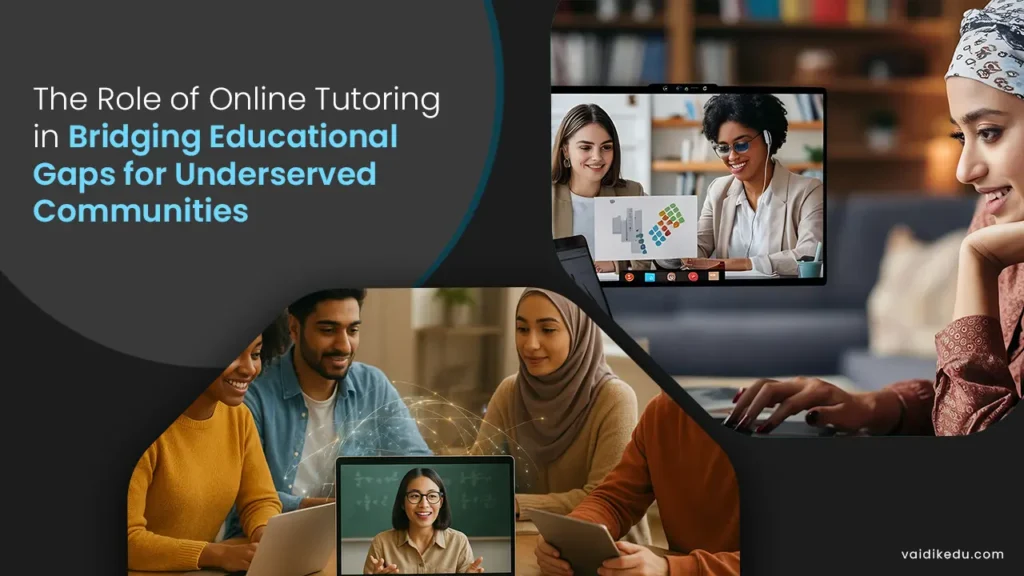
It refers to the fact that online tutoring uses digital tools to offer students one-on-one or group lessons, regardless of their location. With edtech platforms and access to the Internet, students who are in disadvantaged or remote settings can now learn from expert teachers and high-quality resources that may not have been accessible to them.
Thus, this can be a possible way to even out the field, allowing disadvantaged students to better compete academically.
Although there are several advantages of online tutoring, it still incurs some challenges in the form of digital divide issues, lack of infrastructure, and demand for digital literacy.
It is imperative to address these concerns so that optimum use can be made of online tutoring for the plugging of educational gaps. This blog discusses the numerous ways online tutoring helps bridge educational gaps, looks at some of the challenges it faces, and details how it can be optimized for the good of disadvantaged communities.
How Online Tutoring Bridges Educational Gaps
1. Access to Quality Education
The largest obstacle for people from underprivileged backgrounds is the lack of quality educational teachers and materials. Rural communities, low-income communities, and minorities often have limited access to educational resources.
Online tutoring cuts geographical constraints, enabling students to reach expert educators and access comprehensive study materials, regardless of where they may be.
Courses in nearly all subjects are available on sites like Khan Academy, Coursera, and local online tuitions. They are free or much cheaper than private tuition. Thus, even the student in a remote village or economically backward area gets quality instruction.
2. Personalized Learning and Individual Attention
Traditional classrooms often demand larger student-to-teacher ratios, which makes it impossible for teachers to attend to students’ personal needs. Online tutoring provides a personalized learning experience tailored to a student’s speed, strengths, and weaknesses.
Tutors can assess each student’s individual needs and match them with lesson plans accordingly so that students can grasp difficult concepts well.
For example, learning platforms like Duolingo and Byju, which make use of artificial intelligence, keep changing according to the learning styles of the student. They present personalized feedback exercises, which in turn are beneficial for those who cannot learn according to the old teaching methods.
3. Flexibility and Convenience
Many are bound to undertake their household chores within that fixed school-going period, or perhaps some minimal part-time employment is enough to support their living.
Supplemental learning then becomes something that can barely be afforded as a luxury. Online tutoring presents a boon in that it grants flexibility to the pace of learning and rescheduling of sessions whenever time permits.
With recorded lectures, downloadable notes, and interactive modules, students can learn anytime, anywhere. This flexibility is particularly useful for children who need to balance education with work or household responsibilities.
4. Cost-Effective Learning Solutions
Traditional private tutors were expensive and not accessible to most of the families in low-income communities. Online tutors are free and very affordable, with many free online learning opportunities.
Many platforms offer merit scholarships, discounted course contributions, or even government-sponsored programs so that learning does not impose a financial burden on the students.
Physical book costs and transportation expenses are also eliminated by online resources, creating further financial relief for students and their families.
5. Access to a Wider Variety of Subjects and Skills
Many low-income area schools don’t provide courses for certain subjects since the teachers who specialize in them are not available. Online tutoring, on the other hand, has many different subjects and skills, including STEM, language, arts, and vocational skills.
Online courses can now help students gain expertise in programming, digital marketing, creative writing, or entrepreneurship. This type of exposure to different skills and competencies builds an individual’s capability to seek a better livelihood, thus bringing a halt to poverty.
6. Bridging the Digital Divide Through Community Initiatives
Although online tutoring is very effective, it is not accessible to many underserved communities due to the lack of internet access and digital devices. Many non-profits and governments have launched programs to provide free or subsidized internet, mobile devices, and digital literacy training.
For example, Google Internet Saathi was launched in India, and UNICEF developed the Learning Passport to bring digital education to distant areas. With such programs, students can benefit from online tutoring without any kind of technological restrictions.
Challenges of Online Tutoring To Disadvantaged Communities
Despite all the potential of online tutoring that can transform the learning environment for disadvantaged communities, there are quite a few challenges that come along with it.
- Limited Internet Access and Infrastructure: there are instances where most students are still unable to access reliable internet or even digital tools.
- Lack of Digital Literacy Issues among Parents and Students- several parents and students in disadvantaged areas lack the digital skills to navigate such platforms, thus hindering their benefits.
- Lack of Motivation and Engagement – Some students may not find it easy to stay motivated and engaged without the face-to-face interaction that online learning may lack.
- Language Barriers and Cultural Differences – Although the online tutoring platforms are open to all globally, the programs might not be directed at local languages or cultural contexts.
- Security and Privacy Issues – Online learning exposes students to security risks, data privacy issues, and online harassment.
The way to beat these problems is through multi-stakeholder efforts that involve governments, educators, tech companies, and local communities that make investments in digital infrastructure, localized content, and awareness programs to amass the full benefit of the online tutoring opportunity.
Conclusion
Online tutoring changed face and has revolutionized the education sector by cutting geographical barriers that were limiting its access to almost underserved communities.
Online tutoring provides personalized instruction that is flexible and cost-effective, making it capable of bridging the gap in education and empowering students to take up a better future after completing their educational course.
However, to make online tutoring more inclusive, the issues of digital access, affordability, and engagement must be addressed. It is important that governments, NGOs, and tech companies work together to provide the necessary resources, digital literacy training, and culturally relevant content to ensure no student is left behind.
Online tutoring, therefore, becomes a crucial driver towards shaping this next generation for a more equitable and literate society in our quest to become a more digitized world.
Frequently Asked Questions
Online tutoring is the whole process of teaching students who receive lessons from their teachers over the internet. It is either video call or recorded lectures up to AI-powered platforms with interactive exercises.
Quality education, one-to-one attention, flexible hours, and affordable tutoring services eliminate geographical isolation and economic constraints to learning.
Online tutoring is going to become more immersive, personalized, and accessible as AI, virtual reality, and interactive learning tools advance and help bridge educational gaps.