

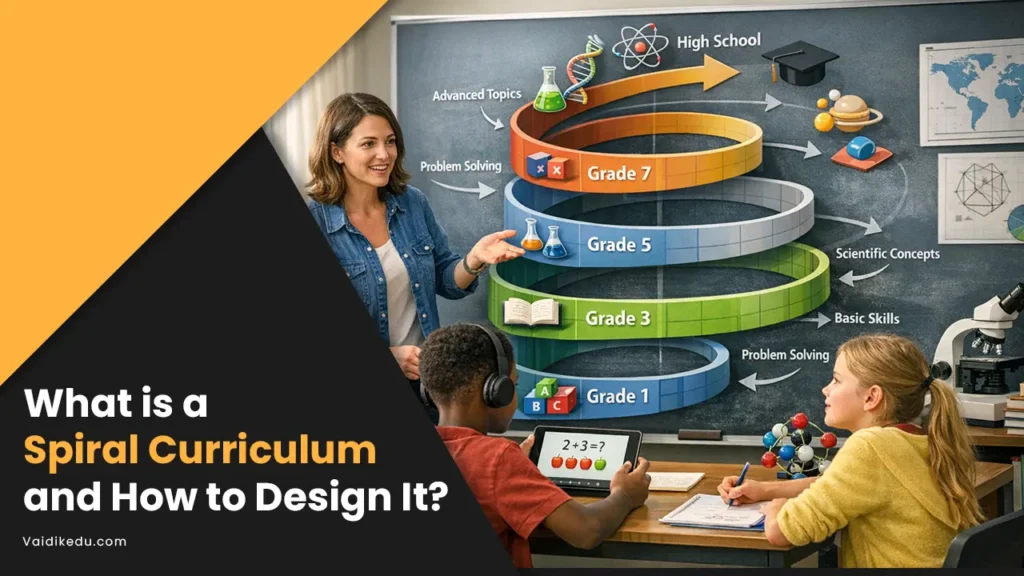
When an individual decides to learn a new language, they will start with the fundamentals, like the alphabet, grammar, etc. They would go over these fundamentals again as they advance and pick up more complex vocabulary, context-specific expressions, and grammar rules. The core of a spiral curriculum is this progressive method of instruction.
The spiral curriculum is one method that is effective in the constantly changing field of education. because it fosters in-depth, long-term learning. This instructional model was first introduced by psychologist Jerome Bruner in the 1960s.
What is a Spiral Curriculum
A spiral curriculum is a teaching strategy that allows students to build on past knowledge and gradually increase their comprehension by going over important ideas and abilities again at progressively more difficult levels. This method acknowledges that learning is a spiral process rather than a linear one.
Here, students are revisiting and improving their comprehension of fundamental ideas as they advance. Because it follows the brain’s natural learning process of reinforcement and elaboration, this approach promotes cognitive development.
Key Features of A Spiral Curriculum Are:
- The curriculum is organised around several fundamental ideas or abilities that are periodically reviewed.
- A topic is examined in more depth and complexity each time it recurs.
- The new learning is built on prior knowledge. This is known as cumulative learning.
- Subjects are organised to highlight relationships between various levels and fields.
How to Design a Spiral Curriculum:
- Identify the Fundamental Ideas and Abilities
Determine the core ideas and skills required in the field of study first. These ought to be ideas that students can use in a variety of contexts and that will benefit them in the long run.
- Create Learning Pathways
Divide each fundamental idea into stages of development. At what stage for example, in Grade 3, Grade 6, and Grade 9 should a student understand this concept? To scaffold complexity from recalling and comprehending to applying, analysing, and assessing use Bloom’s Taxonomy.
- Create Curriculum Maps
Make a curriculum map, either tabular or visual. It should outline the introduction, review, and extension of each concept across grade levels or units. Make sure that learning objectives increase in complexity and depth with each iteration.
- Include Evaluations
Incorporate summative and formative evaluations that are consistent with the spiral structure. Diagnostic tests can be used to guide instruction and assist in customising subsequent revisits to fit the needs of students.
- Maintain Interdisciplinarity
Create exercises that make connections between ideas from different subjects. This helps students see the wider relevance and reinforces what they have learnt.
- Use a Variety of Teaching Techniques
Utilise a variety of techniques, such as discussions, experiments, simulations, and projects, to approach the same subject from various perspectives over time. This keeps the experience interesting and accommodates different learning styles.
- Offer Reflection Opportunities
Students should be encouraged to compare what they currently know with what they previously understood. Reflection shows growth and aids in consolidating learning.
Conclusion
A spiral curriculum is an effective teaching strategy that enables students to expand on their existing knowledge and gain an in-depth understanding. In this case, students go over important concepts and abilities again at progressively higher levels.
By identifying key concepts, charting learning progress over time, and utilising a variety of strategies and assessments, it’s possible to design a spiral curriculum that ensures the deepening of understanding and knowledge with each cycle.
This method helps students build a more comprehensive and lasting understanding of the material, in addition to improving retention and comprehension.
Frequently Asked Questions
In the case of a spiral curriculum, students go over important ideas and abilities again at progressively harder levels. Over time, this leads to a deeper understanding and builds on existing knowledge.
Jerome Bruner, a psychologist, first proposed the spiral curriculum in the 1960s.
By coordinating with the brain’s innate reinforcement and elaboration processes, it facilitates learning by enabling students to go over and comprehend key concepts more thoroughly as they advance.
Reflection reinforces growth and solidifies understanding by allowing students to compare what they know now with what they knew previously.