

Think back to your school days for a moment. Remember flipping through those heavy textbooks, trying to memorise chapter after chapter even when half the time you couldn’t grasp what it all meant? Now, shift your focus to students today. Are things really that different? If anything, their pressure seems even heavier, more deadlines, expectations, and less time to truly understand.
Today, students are running(sprinting) down the hallway, from class to class, trying to keep up with stacked syllabi, multiple assessments back-to-back, etc. Teachers are also burdened by their timelines for covering course content. Rarely do they have the luxury of time to enjoy a deeper dialogue with students. The aim often becomes “covering the content,” but at what cost?
At some point, we began to confuse education with covering content instead of a place for education to recreate curiosity. We have shifted from a pedagogy based on quality learning to a measure of quantity. This is problematic. When we bombard the youthful mind with too much information, we deprive youth of the ability to reflect, ponder, explore, and enjoy the learning process.
So, what if we slowed down, trimmed the excess, and focused only on what truly matters? Could a reduced curriculum lead to richer learning experiences? That’s precisely what we’re here to explore. Let’s rethink the idea that “more” means “better” because sometimes, teaching less can help students learn more.
The Overcrowded Curriculum Crisis
Walk into almost any classroom today, and you’ll see students shuffling between subjects like a relay race, history, math, science, language, computers each packed with pages of information, assignments, and deadlines. It’s like we’re asking them to drink from a firehose no wonder they feel overwhelmed.
The truth is, our school curricula have become bloated. Over the years, more topics, subtopics, and “important chapters” have been crammed in, often without asking a crucial question: Is this necessary for deep learning?
Students aren’t just learning more, they’re learning faster, and often, without truly understanding.
They’re expected to jump from the French Revolution to quadratic equations in hours. Concepts are introduced, skimmed over, and rushed past so the syllabus can be “covered” before exams. But is anything sinking in?
Ask a student a question a month after an exam, and chances are, they won’t remember much. Why? They were never allowed to connect the dots, reflect on ideas, or apply what they learned to the real world. Everything becomes a memory game, not a learning journey.
Essential Learning: What Does It Mean?
Somewhere along the way, we started equating “learning” with “knowing a lot of things.” But is that really what education is about? Is a child truly educated just because they can rattle off the capital cities of fifty countries or list the parts of a flower?
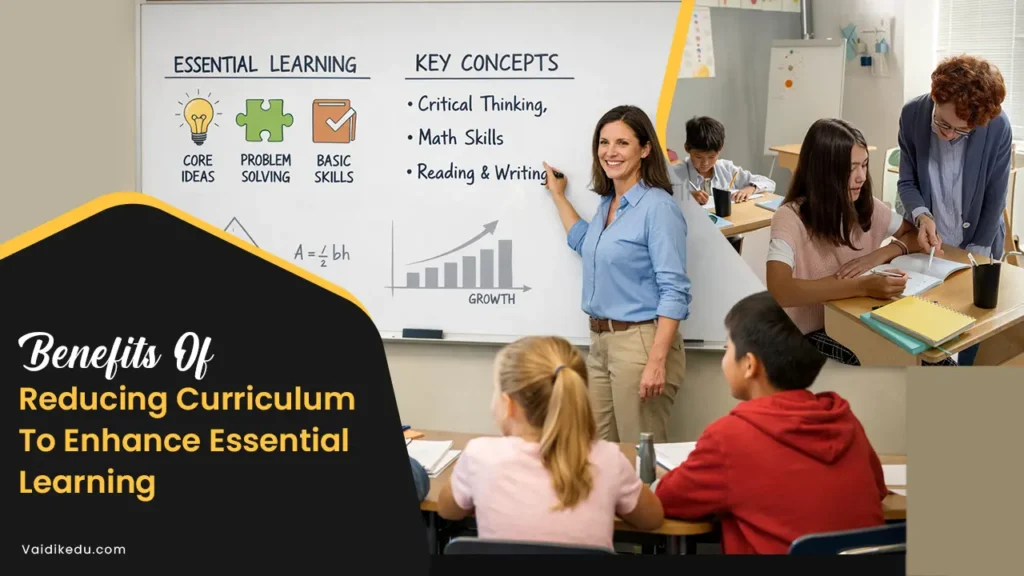
Essential learning isn’t about cramming in as much information as possible. It’s about giving students the tools to understand the world, solve problems, and confidently express themselves. It’s the kind of learning that sticks not because it was memorised for a test, but because it meant something.
At its core, essential learning focuses on foundational skills. Think about skills like critical thinking, clear communication, emotional intelligence, and the ability to collaborate with others. These aren’t just academic they’re life skills. They shape how students navigate relationships, careers, and challenges long after they’ve left the classroom.
Let’s take reading, for example. Teaching a student how to comprehend and engage with a text truly is far more potent than making them read five novels in a semester just for the sake of it. Similarly, understanding the “why” behind a math concept matters more than solving dozens of formulas they don’t get.
Essential learning also means leaving space for curiosity. When we’re not rushing to finish a bloated curriculum, students get the freedom to ask fundamental questions. Why did this event in history matter? How does this scientific concept show up in my everyday life? What can I do with this knowledge?
In short, essential learning is about depth, not just breadth. It’s about helping students build a strong foundation not just for exams, but for life. And to make room for that kind of meaningful education, we must be willing to let go of the excess and focus on what truly matters.
Benefits of Reducing Curriculum Load
When discussing cutting down the curriculum, the first reaction is fear: “Willn’t students fall behind?” But maybe we need to rethink what “behind” even means. Behind what? An overloaded syllabus? A rigid exam pattern? Or a system that values quantity over understanding?
The truth is, when we reduce the load, we make space for lasting learning. That shift has surprisingly powerful benefits for students, teachers, and the whole school ecosystem.
1. Learning Becomes Deeper and More Meaningful
When students aren’t sprinting from topic to topic, they finally get to slow down and think. They can ask “why,” make connections, and explore ideas without the pressure of “what’s next?” It’s the difference between skimming the surface and diving in. Real understanding happens when we give students time to breathe.
2. Better Mental Health and Less Burnout
We often forget that students are humans, not machines. The constant overload takes a toll stress, anxiety, lack of sleep, and even a growing dislike for learning itself. A lighter curriculum helps create a calmer classroom, where students feel less overwhelmed and more in control. And that peace of mind can make all the difference.
3. Teachers Get To Teach Not Just Deliver
Ask any passionate teacher, and they’ll tell you: they want to do more than just “complete the syllabus.” Teachers can get creative when the pressure to cover endless content is lifted. They can use storytelling, discussions, projects, and real-life examples to bring lessons alive. Teaching becomes a joy again, not just a race against time.
4. Students Build Stronger Core Skills
With fewer topics to juggle, there’s more time to work on what matters: critical thinking, communication, collaboration, and problem-solving. These aren’t just “extra” skills, they’re the foundation for success in any field, whether science, art, business, or life.
What Gets Lost in the Race To “Cover” Everything
The word “cover” became the classroom goal somewhere along the line. Teachers say it, administrators expect it, and students live under pressure. “We have to cover the syllabus.” But here’s the uncomfortable truth: we uncover very little when we try to cover everything.
In this mad rush to move from chapter to chapter, something essential gets left behind real learning, the kind that sticks, the kind that excites, the kind that transforms the way a student sees the world.
When every lesson becomes a checklist, there’s no time to pause and reflect. There’s no space for curiosity, no room to go down a rabbit hole of wonder. Students stop asking questions not because they don’t have any, but because they’ve been trained to keep moving. They learn quickly that lingering on a concept, or asking “what if,” will only slow them down.
And what about creativity? That gets pushed aside, too. There’s little time for imagination when the schedule is packed. Projects that could’ve brought joy are rushed. Discussions that could’ve sparked critical thinking are skipped. Even group work, which builds collaboration and empathy, feels like a luxury in a time-strapped classroom.
Teachers feel it, too. They may want to try a new method, introduce a game, or bring in a real-life connection, but when there’s a mile-long syllabus to complete, even the best ideas get shelved. Passion gets replaced by pressure.
Worse still, we lose the human connection. When teachers and students are constantly focused on what’s “next,” they miss what’s happening now, that small spark in a student’s eye when they finally “get it, ” that moment of insight during a class discussion. The pride of creating something meaningful all of it is lost in the rush.
In trying to teach everything, we often teach nothing deeply. We send students out into the world with packed notebooks but empty understanding. And that’s not just unfortunate, it’s unfair.
Maybe it’s time we stopped racing to cover and started choosing to uncover to dig deeper into fewer things and help students make sense of them. Real learning isn’t about racing through content; it’s about making it come alive.
Challenges of Reducing Curriculum (and Why They’re Worth Facing)
Reducing the curriculum isn’t as simple as hitting a delete button on a syllabus. It sounds good in theory, but in practice? It can get messy. There are concerns, pushbacks, and plenty of “what ifs.” And that’s okay. Change is rarely smooth, especially in education, where many systems, expectations, and emotions are involved.
One of the biggest challenges is fear, especially from parents and school boards. “If we remove topics, won’t students fall behind others?” “What about board exams, competitive tests, or college admissions?” These are valid questions. After all, for generations, academic success has been measured by how much a child knows, not necessarily by how well they understand or apply that knowledge.
Then there’s the pressure on teachers. Teachers are often concerned that reducing the curriculum makes it difficult to standardise goals or adequately prepare students for the assessment format. They are also still working with outdated assessment systems that reward memorisation instead of mastery. So, yes, it is complicated.
In some schools, there is potential confusion about reducing the curriculum. The misunderstanding often revolves around thinking that it is about doing less work or expecting less effort, when it is actually about expecting a greater depth of understanding of the curriculum, not a lesser commitment to their learning.
But here’s the flip side: these challenges are worth facing.
For I firmly believe that beneath all that resistance, we have an opportunity to rethink our concept of success in education. We can shift from too much information to intentional learning, from memorising facts to building skills, from rushing through content to creating curiosity.
The best part? Doubts fade once teachers, parents, and even students experience the benefits of less stress, more engagement, and more profound understanding. They start to see that reducing the curriculum doesn’t mean compromising quality. It means enhancing it.
Conclusion
Reducing content in the curriculum is not simply a rational decision but a brave decision. It requires us to stop, reflect, consider and I would even say embrace the idea that more is not always better. It challenges our unwavering commitment to our beliefs about education, unexamined beliefs about what success looks like, and what hard work and perseverance mean when we consider preparing children for the future.
But here’s the thing: real learning does not come from zooming through pages. It comes when we learn to take our time enough to understand, question, connect, and care. It comes from letting students mine their ideas deeply rather than just scratching the surface and moving on.
That kind of learning, which we remember, can only happen when we allow for it. This isn’t about lowering standards. It’s about raising the quality of education by letting go of the clutter. It’s about giving students and teachers the time and space to grow, think, and thrive.
Of course, it won’t be easy. Change never is. There will be hesitation, doubt, and maybe even resistance. But to raise curious, capable, and confident learners, not just test-takers we must be bold enough to do things differently.
Frequently Asked Questions
More knowledge isn’t always better if it’s not understood or remembered. A bloated curriculum often leads to rushed learning, surface-level understanding, and unnecessary stress. Reducing the curriculum allows students to truly grasp concepts, explore ideas, and apply what they learn, making education more meaningful and lasting.
Not at all. When we teach less but teach it well, students gain more. They develop stronger critical thinking, problem-solving, and communication skills. These foundational skills help them succeed long-term, in exams and beyond. Quality always trumps quantity in learning.
Identify the core concepts every student must understand to build a strong foundation. Focus on skills that promote real-world application and lifelong learning. Teachers, being closest to the learning process, can offer invaluable input on what’s essential and just filler.
By clearly showing the benefits of less stress, better understanding, and more confident and capable learners sharing real-life examples, involving parents in curriculum conversations, and showing improved student engagement can go a long way toward gaining their trust and support.