
In today’s dynamic and knowledge-driven world, education is not only about delivering information but also about creating meaningful and effective learning experiences. The foundation for instructional design was laid during World War II, when hundreds of thousands of people needed to be taught very specific tasks in a short time.
Instructional design plays a crucial role in achieving this by systematically planning, developing, and organising content in a way that enhances understanding and engagement.
Individual aspects of complex tasks were broken down, so soldiers could better understand and comprehend each step of the process. This approach leads to the development of instructional design, a field of study that marries education, psychology and communications to create the most effective teaching plans for specific groups of students.
This is vital because it ensures that students receive instructions in a form that is effective and meaningful to them, helping them better understand the topics and concepts being taught. The principles of instructional design consider how educational tools should be designed, created and delivered to any learning group, from grade school students to adult employees across all industry sectors. As per Robert Gagné, aptly stated, “The purpose of instruction is to facilitate learning.”
Instructional Design Meaning
matic process of planning, developing, and delivering instructional materials in a way that enhances learning. It focuses on understanding how people learn and then designing content, activities, and assessments that help learners achieve specific goals.
Rather than simply presenting information, instructional design ensures that learning is engaging, organised, and outcome-driven. Instructional design is crucial in the corporate sector and academic settings because it provides a systematic way to deliver effective training and learning.
It is vitally important in augmenting Subject Matter Expert (SME) knowledge, bridging the gap between their deep expertise and impactful learning delivery. An instructional designer’s work involves
- Transforming or modifying complex material into clear and engaging narratives.
- Using adult learning principles to ensure content resonates and drives retention.
- Designing any related or specific content and building interactions that directly align with the measurable objectives.
- Translating static information into dynamic elements and simulations for skill practice.
- Converting knowledge into reusable e-Learning for wider, cost-effective access.
Instructional Design Models
Instructional Design Models are structured frameworks that guide educators and designers in creating effective learning experiences. These models provide step-by-step processes to analyse learners, design content, deliver instruction, and evaluate outcomes. Some of the instructional design models are
1. Merrill’s Principles of Instruction
This theory focuses on problem-centred learning, where learning is promoted when learners:
- Solve real-world problems
- Activate prior knowledge
- Observe demonstrations
- Apply knowledge
- Integrate learning into real life
2. Gagné’s Nine Events of Instruction
This theory was developed by Robert Gagné. This model outlines the following steps for effective teaching as
- Gain attention
- Inform learners of objectives
- Stimulate recall of prior knowledge
- Present content
- Provide guidance
- Elicit performance
- Provide feedback
- Assess performance
- Enhance retention and transfer
3. Dick and Carey Model
This theory explains a systematic and detailed approach to instructional design. It is used in academic and professional training settings and focuses on
- Breaking instruction into smaller components
- Alignment between goals, instruction, and assessment
4. ADDIE Model
This theory is the most widely used model in instructional design and forms the foundation for many other models. The important postulates of this theory are
- A – Analyse: Identify learners’ needs and goals
- D – Design: Plan objectives, content, and assessments
- D – Develop: Create learning materials
- I – Implement: Deliver the instruction
- E – Evaluate: Assess effectiveness and improve.
5. SAM Model (Successive Approximation Model)
It shows an agile and iterative approach and is ideal for fast-paced and flexible learning environments. This theory includes
- Design → Prototype → Review → Improve
- Encourages continuous feedback and revisions
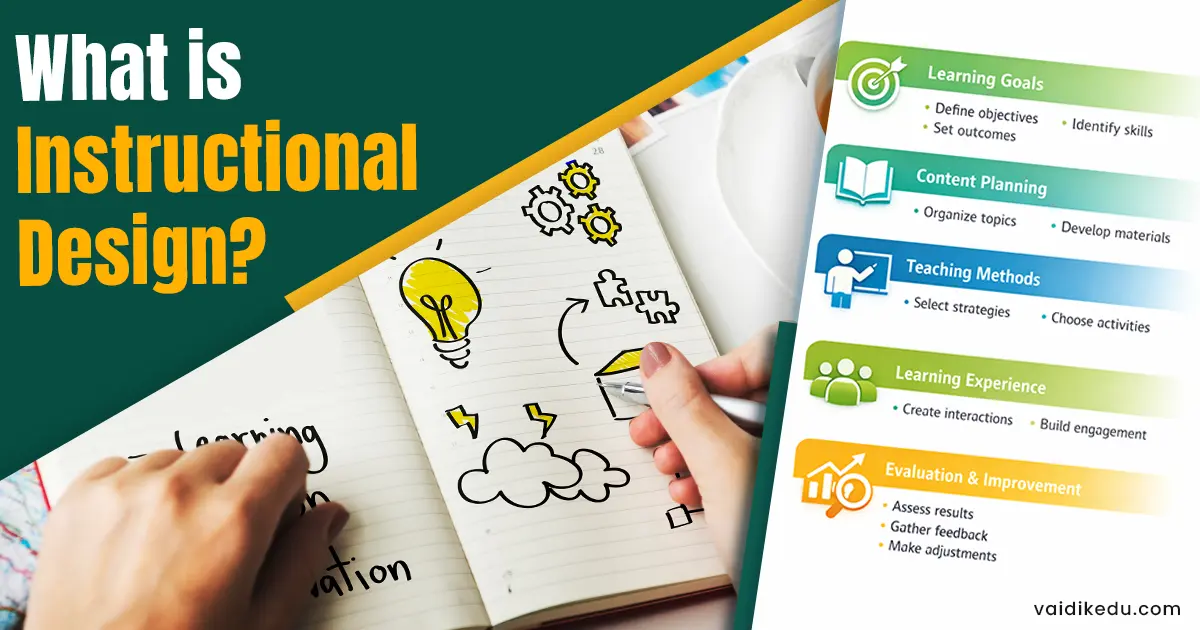
The Major Components of Instructional Design
This ensures learning experiences are effective, organised, and aligned with goals. From understanding learners to evaluating outcomes, each step plays a vital role in ensuring meaningful learning.
Some of the major components of instructional design are
1. Analysis – This is the foundation of instructional design, without which the learner does not meet the needs that
- Identifies who the learners are
- Their needs, prior knowledge, and learning gaps
- The learning problem and goals.
2. Learning Objectives – They specify what learners should achieve. It
- Focus on measurable outcomes
- Guide the design of content and assessments
- Align with the levels of thinking, such as understanding and applying.
3. Content Design and Organisation – This involves structuring the subject matter effectively with well-organised content that improves understanding and retention.
- Breaks content into logical sequences
- Ensures clarity and flow of information
- Uses appropriate formats like text, visuals, and multimedia.
4. Instructional Strategies – Methods used to deliver the content and choose the needs and objectives of learning.
- Lectures, discussions, case studies
- Interactive activities, simulations, and group work
- Use of technology and multimedia tools
5. Development of Materials – Creation of actual learning resources and materials like
- Slides, videos, handouts, e-learning modules
- Quizzes, assignments, and practice exercises.
6. Assessment and Evaluation – Assessment and evaluation ensure continuous improvement of the learning process.
- Measures learner performance such as quizzes, tests, and assignments.
- Checks if objectives are achieved.
- Reviews the overall effectiveness of instruction.
- Identifies areas for improvement.
Benefits of instructional design
Instructional design provides numerous advantages that improve both teaching and learning experiences. Using a structured and learner-centred approach ensures that education is effective, engaging, and goal-oriented.
- Learning Effectiveness helps to present information in a clear and organised way, and makes it easier for learners to understand complex concepts and achieve desired outcomes.
- Well-designed lessons use strategies like repetition, practice, and real-life application, which help learners remember information for a longer time and enhance knowledge retention.
- Interactive elements such as videos, discussions, quizzes, and activities keep learners actively involved and make learning more interesting and enjoyable.
- Instructional design incorporates various teaching methods (visual, auditory, kinesthetic), which can benefit all types of learners and thus support different learning styles.
- Educators can deliver content more effectively with proper planning, saving time and reducing confusion during instruction.
Conclusion
Instructional design plays a vital role in shaping modern education by transforming the way learning experiences are created and delivered. It goes beyond simply presenting information, focusing instead on designing structured, engaging, and goal-oriented instruction that meets the diverse needs of learners.
By incorporating clear objectives, effective strategies, and continuous evaluation, instructional design ensures that learning is meaningful, efficient, and impactful. Its benefits extend not only to students and educators but also to organisations and society as a whole, promoting lifelong learning and skill development.
In an increasingly digital and knowledge-driven world, instructional design serves as a powerful tool for improving the quality of education and making learning accessible to all. Ultimately, it lays the foundation for building informed, skilled, and adaptable individuals who can thrive in a rapidly changing global environment.
Frequently Asked Questions
Instructional design is the process of planning and creating learning experiences in a structured way to help people learn effectively.
Teachers, trainers, curriculum developers, and e-learning professionals use instructional design to create educational content.
The key components include analysis, design, development, implementation, and evaluation.
No, it is also widely used in corporate training, online courses, and professional development programs.