

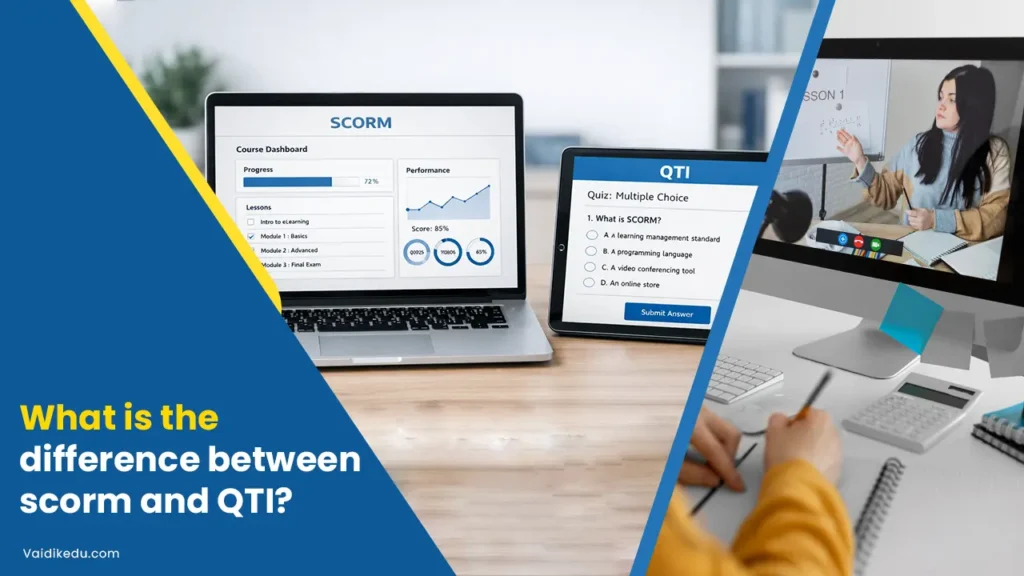
Online education is becoming really popular. A lot of people are using digital training programs. This means we need some rules to make sure everything works properly. We want to be able to use the learning materials and tests on different computers and systems.
When it comes to e-learning, there are two standards that people use a lot: SCORM and QTI. These standards, SCORM and QTI help make sure that learning content and assessments work well on platforms and systems.
They are both supposed to make things work together better. SCORM and QTI are actually used for very different things. This blog will tell you what SCORM and QTI are, and what makes them different from each other. It will help you figure out when you should use SCORM and when you should use QTI.
Why Are E-Learning Standards Important?
E-learning content is usually made with one tool. Given to people through another tool, like a Learning Management System. If we do not have standards, the e-learning content may not work correctly on platforms. E-learning standards are helpful because they do things like:
- They make sure e-learning content works on platforms
- They help people make e-learning content that can be used in many places
E-learning standards are important for e-learning content to work properly. E-learning content needs e-learning standards to be useful.
- Ensuring compatibility between systems
- Allowing content reuse
- Improving learner experience
- Enabling consistent reporting and tracking
SCORM and QTI deal with parts of making things standard. The SCORM and QTI standards are important for this. They help with things, so the SCORM standard and the QTI standard are used together. The main thing is that SCORM and QTI make things work better.
What is SCORM?
The Sharable Content Object Reference Model, which people call SCORM for short, is a standard for learning. This standard was created by the Advanced Distributed Learning initiative.
The main goal of SCORM is to figure out how to package online learning content, deliver it to people, and then track what they do with it in a Learning Management System, or LMS for short, which is where SCORM is typically used. SCORM is about making online learning content work well in an LMS.
SCORM makes sure that the learning modules you create in one system can be used in another system that’s compatible with SCORM. This means you can upload the learning modules and they will work fine in the new system without any technical problems. The reason this works is that the new system is also compatible with SCORM.
Key Characteristics of SCORM
They put all the courses into a format that is the same for everything. This format is easy to understand and use for all the courses. The courses are now in one standardized format.
- Launches learning content within an LMS
- Tracks learner progress, completion, scores, and time spent
- Supports the reuse of learning modules
Typical Uses of SCORM
- Corporate training programs
- Compliance and certification courses
- Online academic courses
- Employee onboarding modules
SCORM is really good for things like courses and training programs that teach you something from start to finish. The thing about SCORM is that it works well for learning experiences.
When you use SCORM, you can make a learning package that has everything you need to learn something new, and that is what makes SCORM so useful for complete learning experiences.
What is QTI?
The QTI, which stands for Question and Test Interoperability is something that was made by a group called IMS Global, also known as 1EdTech. The QTI is different from something called SCORM. The main thing the QTI does is help with assessments, as the QTI does with quizzes, and the QTI does with tests, and the QTI does with exams.
QTI is a way to make sure questions are set up in a manner. This means that questions are structured, stored, shared and scored in the way across different platforms.
The QTI does this by providing a format for the questions. This way the QTI helps questions to be shared and scored easily across platforms. The QTI defines how the questions are structured and scored.
Key Characteristics of QTI
- Standardizes question and test formats
- Supports multiple question types (MCQs, true/false, matching, essays)
- Allows assessments to move between systems
- Focuses only on evaluation, not course delivery
Typical Uses of QTI
- Online exams and quizzes
- Question banks
- Academic testing systems
- Assessment authoring tools
QTI is made for one thing: testing and evaluation of the QTI. The QTI is used to do this. The QTI is designed for the QTI to be used in testing and evaluation.
You should use SCORM when you need to make sure that your online courses and training programs work well with learning management systems. SCORM is really useful for companies and organizations that want to train their employees.
You can use SCORM to track what your employees have learned and how they are doing. SCORM is also good for schools that want to make courses for their students.
When you use SCORM, you can be sure that your online courses will work properly on all systems. You should use SCORM when you want to make your online training programs better.
SCORM is The Right Choice if:
You need to deliver courses. This means the courses should be organized in a way that’s easy to follow. The structured courses will have a plan, and the students will know what to expect. Structured courses are very important because they help students to learn in a structured way.
The goal of courses is to make sure the students understand the material and can use it in real life. Delivering courses is a big responsibility because it affects how well the students learn.
We need to keep an eye on how the learner’s doing.
The learner’s progress must be tracked so we can see how well the learner is learning. This way we can help the learner when the learner is having trouble with something.
The learner’s progress is very important to track. We need to have completion reports because they are necessary for our records. Completion reports are very important. We have to get them done.
The people in charge want to see these completion reports so they can keep track of things. We will use the information from the completion reports to make sure everything is okay. Completion reports are a must. We need to use the content on different Learning Management System platforms.
This means the content should work on all the Learning Management System platforms without any issues. We have to make sure the Learning Management System platforms can all use the content.
SCORM is really good for getting learning materials to people and keeping track of how they’re doing with the learning materials. SCORM is great because it helps with learning delivery and with monitoring the progress of the people who are using SCORM for learning.
So you want to know when to use QTI. Well, the thing is QTI is really useful in situations. You should use QTI when you need to make tests and exams that are fair and work well on computers. This means QTI is perfect for schools and companies that do a lot of testing.
You should use QTI when you have a lot of questions to ask, and you want to make sure they are all presented in a clear way. QTI helps make tests that are easy to understand and give to people.
For example, QTI is great for making quizzes and exams that students have to take on the computer. It helps teachers make these tests quickly and easily so they can focus on teaching and not spend all their time making tests. So to sum it up you should use QTI whenever you need to make tests and exams that are clear and work well on computers. QTI is a tool for this and it can really help you out.
QTI is The Right Choice if:
I think you want to know if I am focused on exams or quizzes. The thing is, I do not really take exams or quizzes. I am a computer program that helps people with information and tasks. So I do not have to worry about exams or quizzes as students do.
Exams and quizzes are a part of school and studying for students. Students have to study for exams and quizzes to get grades. You are in charge of collections of questions. These question banks have a lot of things in them. The question banks are very large and they need someone to take care of them.
That is what you do: you manage these question banks. We need to make sure that assessments are shared across all the platforms that we use. This is really important because assessments are a part of the work that we do. So assessments must be shared across platforms. You do not need to track the course. The course tracking is not necessary.
QTI is ideal for evaluation and assessment management. So I was wondering if SCORM and QTI can actually work together. What I mean is can SCORM and QTI be used at the same time? I want to know if SCORM and QTI are compatible with each other.
Can We Use SCORM And QTI Together In The Project?
I am looking for a way to make SCORM and QTI work together seamlessly. Yes. A lot of Learning Management System platforms use both of these standards at the same time.
For example, SCORM is a way to get the course content to people. The thing about SCORM is that it delivers the course content. This means that SCORM is really good at making sure people can see the course content.
SCORM gives people the course content they need
The course content is what SCORM delivers.
QTI is in charge of managing the assessments. These assessments are. Part of the course, or they are done at the same time as the course. QTI manages these assessments within the course or alongside the course.
This way of doing things brings together a planned method of learning and a way to judge that is not too rigid. The approach combines learning with flexible evaluation. It is a way that mixes learning and flexible evaluation to get good results.
Limitations of SCORM And QTI
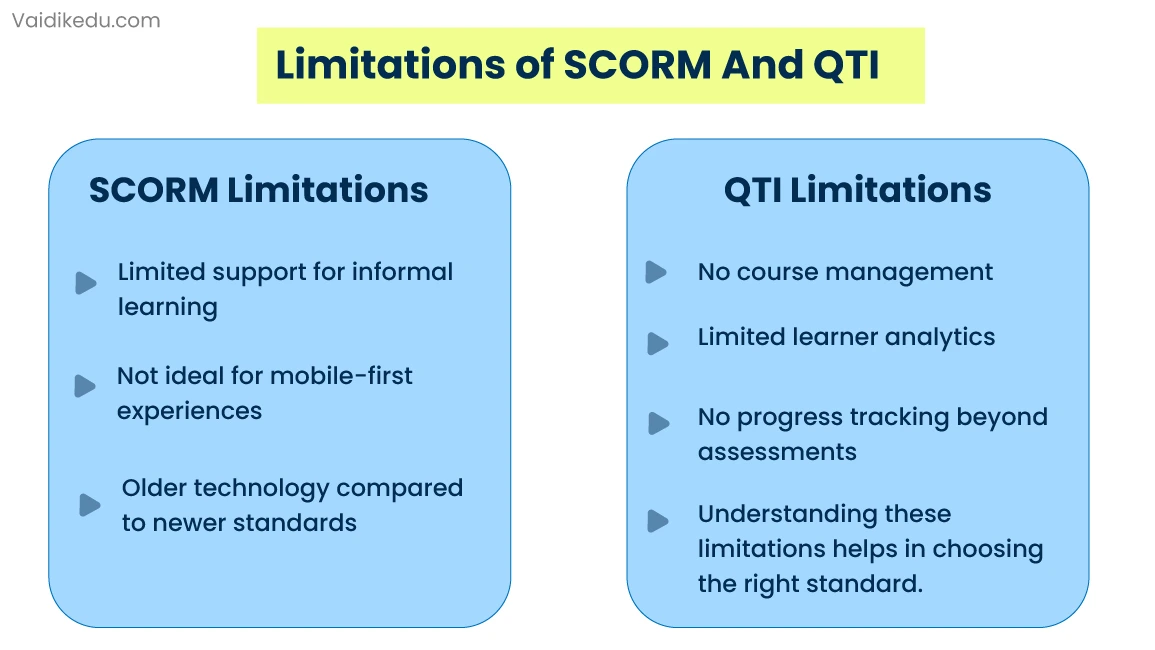
- SCORM Limitations
1. Limited support for informal learning
2. Not ideal for mobile-first experiences
3. Older technology compared to newer standards
- QTI Limitations
1. No course management
2. Limited learner analytics
3. No progress tracking beyond assessments
4. Understanding these limitations helps in choosing the right standard.
Conclusion
SCORM and QTI are two things in e-learning. They are important. They do different jobs. SCORM is used to send out learning stuff and keep track of it. On the other hand, QTI is used to make tests and share them with other people.
SCORM is really good at getting learning content to people and tracking what they do. QTI is really good at helping people make assessments and share them with others.
So SCORM and QTI are both useful, in different ways. Choosing the right standard depends on your goals. If you need structured learning and reporting, SCORM is the better option.
If you need flexible and portable assessments, QTI is the right choice. In many cases, using both together provides the most effective solution.