

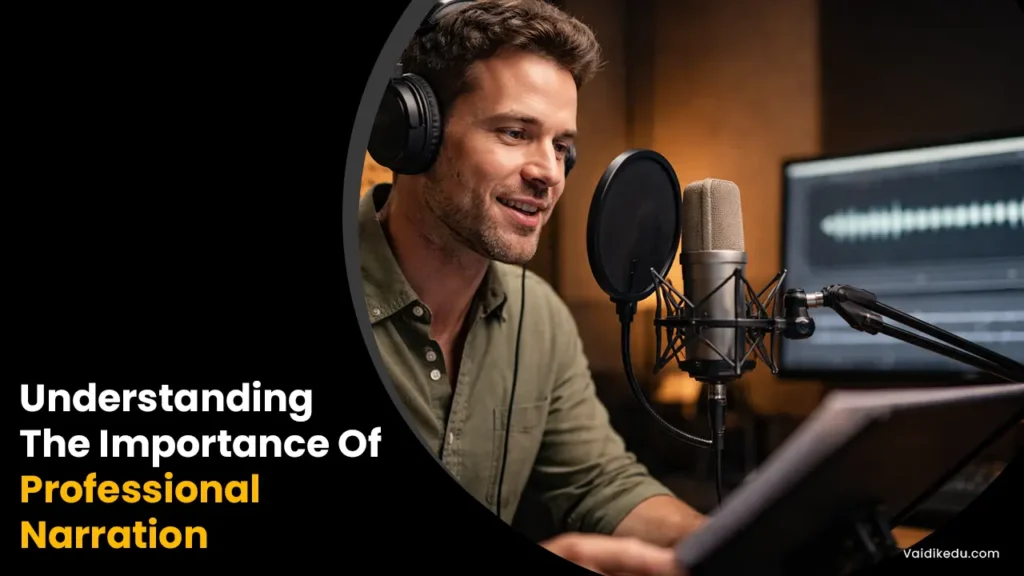
In today’s digital environment, people consume information through videos, eLearning courses, podcasts, audiobooks, presentations, advertisements and other forms of multimedia content.
Visuals are important, but the voice guiding an audience through that content can be just as influential.
A well-delivered narration can make information easier to understand, establish the right mood and help audiences stay engaged with a message.
This is where professional narration becomes valuable.
Professional narration is more than reading a script aloud.
It involves using tone, pacing, pronunciation, emphasis and emotion to communicate information in a way that suits the content, audience and purpose.
Whether it is an instructional video, corporate training module, audiobook or promotional video, the right narration can make the overall experience clearer and more polished.
What Is Professional Narration?
Professional narration is the process of delivering a written script using a trained voice artist who understands how to communicate meaning through vocal performance.
A professional narrator considers more than simply saying the words correctly.
They adjust their delivery according to:
- The purpose of the content
- The target audience
- The subject matter
- The desired emotional response
- The organisation’s brand voice
- The pace and complexity of the information
For example, an eLearning module may require a clear, calm and instructional delivery.
A promotional video may need a more energetic and persuasive voice, while an audiobook may require greater emotional range and characterisation.
The goal is to make the spoken content feel natural while ensuring that the intended message remains clear.
Why Does Professional Narration Matter?
1. Improves Audience Engagement
People are more likely to remain engaged when content is presented in a clear and compelling way.
A professional narrator knows how to vary pace, tone and emphasis so that important information does not sound flat or monotonous.This is particularly useful for longer-form content.
In an eLearning course, for example, consistent narration can guide learners through different sections and draw attention to important concepts.The voice should support the content rather than compete with it.
2. Makes Complex Information Easier to Understand
Narration can make information more accessible by guiding the audience through content in a logical sequence.
Professional narrators understand the importance of pronunciation, pauses, pacing and emphasis.
These elements can help listeners distinguish between key points and supporting information.
This is especially important for:
- eLearning courses
- Technical training
- Product demonstrations
- Explainer videos
- Corporate presentations
- Educational content
When the subject matter is complicated, clear delivery can make the learning experience less overwhelming.
3. Builds a Professional Image
The quality of the voice and recording contributes to how audiences perceive the content.
A poorly recorded or awkwardly delivered narration can make an otherwise well-produced video appear less professional. In contrast, clear audio and confident delivery can create a more polished experience.
For businesses, this can be particularly important when narration is used in marketing campaigns, training programmes, product demonstrations or customer communications.
Professional narration does not guarantee that an audience will trust a company, but it can help create a consistent and credible presentation.
4. Strengthens Brand Identity
A brand is not represented only by its logo, colours or visual design. The way it communicates also contributes to its identity.
The voice used in a company’s videos, training materials, advertisements or digital experiences can reinforce the personality the organisation wants to convey.
For example:
- A financial brand may prefer a confident and reassuring delivery.
- A children’s education brand may use a warm and energetic voice.
- A technology company may prefer a clear and modern tone.
- A healthcare organisation may require a calm and reassuring approach.
Maintaining consistency across different pieces of content can help create a recognisable brand experience.
5. Adds Emotion to Storytelling
Information becomes more engaging when the delivery reflects its meaning.
A professional narrator can use changes in tone, pace, pauses and emphasis to communicate emotions such as excitement, urgency, empathy or anticipation.
This is particularly important for storytelling-based content, including documentaries, audiobooks, promotional videos and educational narratives.
The objective is not to exaggerate the emotion. Good narration makes the delivery feel appropriate to the story.
6. Supports Learning and Training
Narration plays an important role in many digital learning experiences.
In an eLearning module, a voice can explain concepts while learners view animations, demonstrations, diagrams or other visual material.
Instead of forcing learners to read every piece of information on screen, narration can guide them through the material.
For training content, this can be particularly useful when explaining procedures, demonstrating processes or providing instructions.
However, narration should be designed carefully. Reading large blocks of on-screen text word-for-word can create an unnecessarily repetitive experience.
Effective instructional narration should complement the visuals and learning activities.
Where Is Professional Narration Used?
Professional narration is used across a wide range of industries and content formats.
eLearning and Training
Online courses, employee training programmes and educational modules often use narration to explain concepts and guide learners through activities.
Professional voice artists can help make instructional content consistent, clear and easier to follow.
For organisations developing custom eLearning, narration can also be adapted to the terminology, audience and tone of the course.
Corporate Presentations
Businesses use narrated presentations to introduce products, explain processes, train employees and communicate important information.
A professional voice can make a presentation feel more polished and can help guide viewers through information without requiring them to read every detail themselves.
Marketing and Promotional Videos
Marketing videos often have limited time to communicate a message.
Professional narration can help explain a product, describe its benefits or guide viewers through a brand story.
The appropriate voice depends on the audience and campaign. A corporate promotional video may require a confident tone, while a lifestyle campaign might benefit from a warmer and more conversational delivery.
Audiobooks
Audiobook narration requires more than clear pronunciation.
Narrators need to maintain listener interest across potentially several hours of content.
Depending on the book, they may also need to distinguish between characters, convey emotion and maintain consistency throughout the recording.
For this reason, audiobook narration requires strong vocal control and stamina.
Podcasts and Documentaries
Narration can provide structure to documentaries and certain podcast formats by introducing topics, connecting different sections and explaining background information.
The narrator’s tone can also contribute significantly to the overall atmosphere of the production.
IVR and Customer Support
Interactive Voice Response (IVR) systems rely on recorded spoken prompts to guide customers through menus and support processes.
Because customers may interact with these systems frequently, clear pronunciation, appropriate pacing and a professional tone are particularly important.
The voice should make instructions easy to follow without sounding unnecessarily slow or artificial.
Explainer and Instructional Videos
Explainer videos often need to communicate a process or product quickly.
Narration can connect the visuals and provide additional context, helping viewers understand what they are seeing and why it matters.
What Makes a Good Professional Narrator?
A strong professional narrator combines technical control with performance skills.
Clear Pronunciation
Words should be easy to understand, particularly when the content includes technical terminology, names or industry-specific language.
Appropriate Pacing
Speaking too quickly can make information difficult to follow, while speaking too slowly can reduce engagement.
Professional narrators adjust their pace according to the complexity and purpose of the content.
Tone and Vocal Variety
A consistent but varied delivery can help prevent narration from sounding monotonous.
The narrator should know when to emphasise important information and when to use a more neutral delivery.
Emotional Control
Different projects require different levels of emotion.
A narrator should be able to sound enthusiastic, authoritative, reassuring, conversational or serious without making the performance feel unnatural.
Script Interpretation
Professional narration involves understanding what the script means.
The narrator should know which words need emphasis, where a pause is appropriate and how a sentence should be delivered based on its context.
Professional Narration vs. Amateur Recording
With smartphones and inexpensive microphones widely available, almost anyone can record a voice track.
However, recording a voice and producing professional narration are not the same thing.
Professional voice artists typically have experience with vocal delivery, script interpretation, microphone technique and consistent performance.
Professional recording also involves appropriate acoustics and post-production to produce clean, usable audio.
For simple internal content, an amateur recording may be sufficient.
For public-facing, educational or commercially important content, professional narration can provide a more consistent and polished result.
Human Narration vs. AI-Generated Voices
AI voice technology has developed rapidly and can produce increasingly natural-sounding speech.
For some applications, synthetic voices can be useful. They may be suitable for rapidly producing certain types of content, creating multiple language versions or updating large amounts of instructional material.
However, human narration still offers advantages when a project depends heavily on emotional nuance, storytelling, characterisation or a distinctive brand voice.
The choice should therefore depend on the project’s purpose, audience, budget, update requirements and desired listening experience.
For high-value content, organisations may also choose a hybrid approach, using AI where appropriate while reserving professional human narration for content where vocal performance has a greater impact.
How to Choose the Right Narrator
Choosing a professional narrator should begin with the audience and purpose of the project.
Consider:
Who will listen to the content?
The voice should be appropriate for the age, background and expectations of the audience.
What tone does the project require?
Decide whether the narration should be authoritative, friendly, energetic, calm, conversational or emotional.
What is the content about?
A technical training module may require a very different delivery from an advertisement or audiobook.
Does the narrator have relevant experience?
Experience in a particular format or industry can be useful, especially when the script contains specialised terminology.
Can the narrator maintain consistency?
For longer projects or a series of videos, consistency in pronunciation, tone and pacing is important.
The Role of Audio Quality
Even excellent narration can lose its impact if the recording quality is poor.
Background noise, echoes, inconsistent volume and distracting editing can make content difficult to listen to.
Professional narration therefore involves both performance and production quality.
A suitable recording environment, appropriate microphone technique and post-production can help create clean and consistent audio.
For eLearning and other digital content, the narration should also be balanced appropriately with music, sound effects and other audio elements.
Making Narration More Effective
Professional narration works best when it is integrated into the overall content rather than added as an afterthought.
Before recording, organisations should:
- Define the purpose of the content.
- Identify the target audience.
- Establish the desired tone and brand voice.
- Prepare and review the script.
- Identify technical terms and pronunciation requirements.
- Match narration with visuals and on-screen text.
- Record using appropriate equipment and conditions.
- Review the audio for clarity, pacing and consistency.
- Edit and mix the final recording appropriately.
This process helps ensure that the voice supports the content rather than simply reading the script.
How Vaidik Eduservices Supports Professional Narration
Professional narration plays an important role in creating clear, engaging and accessible digital learning experiences.
The right voice and delivery can help learners understand complex information while maintaining attention throughout a course.
Vaidik Eduservices supports EdTech companies, training providers, publishers, schools and education platforms with narration-ready learning content and eLearning development, including:
- Professional narration scripts
- Voice-over-ready instructional content
- eLearning and multimedia content
- Scenario-based learning resources
- Course narration and instructional scripts
- Audio-supported learning materials
- Interactive digital learning content
Our instructional designers combine subject expertise, instructional principles and multimedia development to create narration that complements visual content and supports learning objectives.
By integrating professional narration with well-structured instructional content, Vaidik helps organisations deliver consistent, engaging and accessible digital learning experiences at scale.
Conclusion
Professional narration can significantly improve the quality and effectiveness of digital content.
A skilled narrator does more than read words. Through tone, pacing, pronunciation, emphasis and emotional delivery, they help audiences understand information and connect with the message.
From eLearning and corporate training to marketing videos, audiobooks, podcasts, documentaries and IVR systems, professional narration can make content clearer, more engaging and more polished.
The key is to choose narration based on the purpose of the project and the needs of the audience.
When the right voice, script, recording quality and delivery come together, narration becomes an important part of the overall content experience rather than simply an accompanying voice.
Frequently Asked Questions
Professional narration involves hiring a skilled voice actor to deliver a script, often in a studio setting with audio engineers. It is important because it converts dry text into an engaging, professional, and trustworthy message that resonates with the audience.
Yes. Professional voice artists use modulation, pacing, and tone to maintain listener interest, keeping them engaged from start to finish especially in long videos or presentations.
This thing is great, for people who’re blind or have trouble seeing. It gives them the words they need to understand what is going on in pictures and videos. Supports Impaired Learners by doing this one important thing: it tells them what is happening in the visual content with audio descriptions.
Voiceover is when you hear a voice in a movie or a show. You do not see the person who is talking. This can be in all sorts of things like commercials or documentaries. The voiceover is used to tell you something or to explain what is happening. Voiceover is really useful because it helps people understand what is going on in the production. You can find voiceover in different types of productions from commercials to documentaries and it is an important part of the way stories are told.
Narration: Specifically refers to guiding the audience through a story, educational content, or documentary in a structured, often linear way.
Yes. Professional voice artists are highly versatile. They can adapt their style to suit different needs, such as a casual tone for social media, a friendly, educational tone for e-learning, or a serious, authoritative tone for corporate presentations.