

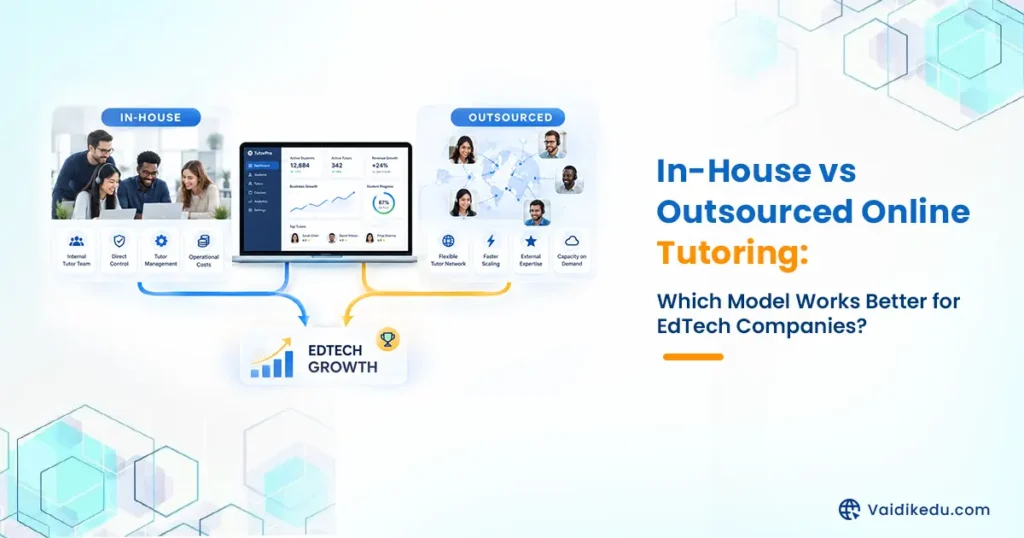
The demand for online tutoring continues to grow as schools, EdTech platforms, publishers, education marketplaces, and learning providers look for flexible ways to deliver academic support to students.
For EdTech companies, however, building a tutoring operation is not as simple as adding tutors to a platform. Companies need qualified educators, subject expertise, tutor training, scheduling systems, quality control, curriculum alignment, student support, and the ability to scale services as demand changes.
This creates an important strategic question:
Should an EdTech company build and manage its own tutoring team, or should it outsource online tutoring services to an experienced education services provider?
Both models have advantages. The right choice depends on factors such as business size, student volume, target curriculum, budget, required quality standards, and growth plans.
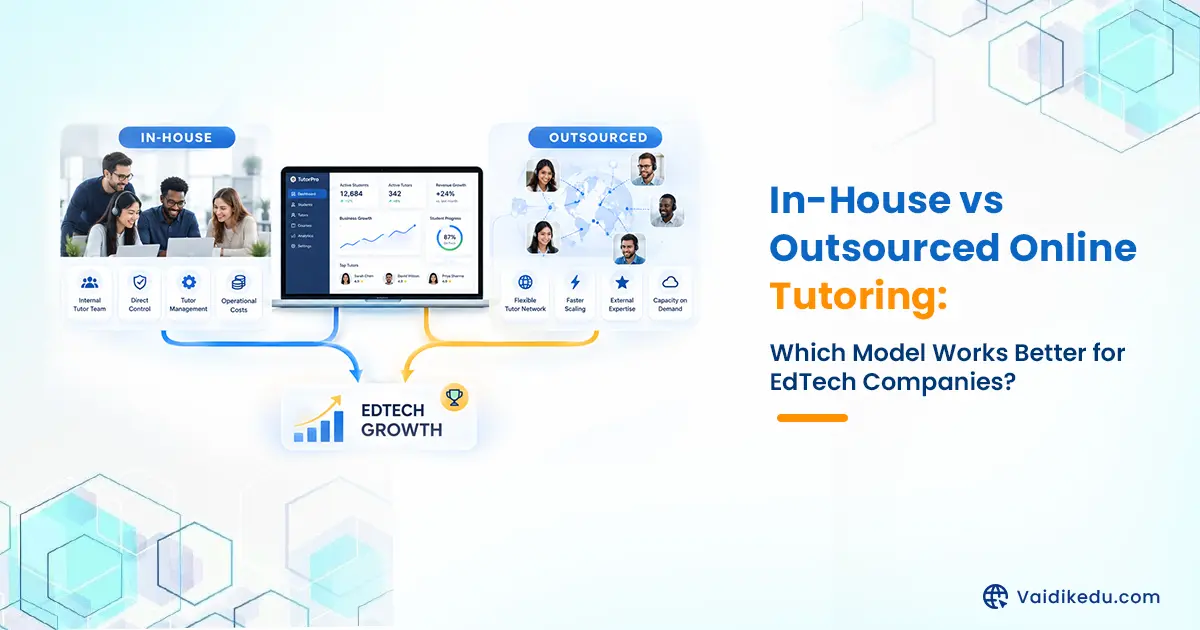
This guide compares in-house vs outsourced online tutoring and explains how EdTech companies can determine which model works best for their business.
What is In-House Online Tutoring?
In-house online tutoring means an EdTech company recruits, trains, manages, and supports its own team of tutors.
The company is responsible for the complete tutoring operation, including:
- Tutor recruitment
- Interviewing and subject assessments
- Background and qualification checks
- Tutor onboarding
- Training and professional development
- Student-tutor matching
- Scheduling
- Tutor performance monitoring
- Quality assurance
- Curriculum alignment
- Student progress tracking
- Tutor payments and administration
This approach gives the company direct control over the tutoring experience.
Types of Tutoring Outsourcing Models for EdTech Companies
Outsourcing online tutoring does not always mean handing the entire tutoring operation to an external provider. EdTech companies can choose different outsourcing models depending on their student volume, internal capabilities, and business objectives.
1. Fully Managed Tutoring
In a fully managed model, an education services provider manages most of the tutoring operation.
This may include:
Tutor recruitment
Tutor screening
Subject assessments
Training and onboarding
Scheduling
Tutoring delivery
Quality assurance
Performance monitoring
Student support
Reporting
This model can be suitable for EdTech companies that want to launch or expand tutoring without building a complete internal education operations team.
2. Tutor Staff Augmentation
Under a staff augmentation model, the external provider supplies qualified tutors while the EdTech company retains greater control over day-to-day operations.
The EdTech company may manage:
Student allocation
Scheduling
Platform operations
Student communication
Tutor performance requirements
The external provider focuses primarily on supplying qualified education professionals.
3. Subject-Specific Tutoring Outsourcing
An EdTech company may outsource only selected subjects instead of its entire tutoring operation.
For example, an EdTech platform could maintain an internal mathematics team while outsourcing additional support for:
Science
English
Computer science
STEM subjects
Advanced mathematics
Specialized examination preparation
This approach can help companies access specialist expertise without building every subject capability internally.
4. Overflow Tutoring
Overflow outsourcing is designed for periods when student demand temporarily exceeds internal tutor capacity.
For example, an EdTech company may use its internal tutors during normal periods and bring in external tutors during:
Examination seasons
Enrollment peaks
New student launches
Promotional campaigns
Seasonal demand increases
This allows the company to increase capacity without permanently expanding its internal workforce.
5. Geographic or Curriculum Expansion
An EdTech company entering a new country may require tutors who understand the local curriculum, examination system, academic expectations, and student schedules.
Instead of immediately building a local tutoring operation, the company can work with an education services provider that already has relevant subject and curriculum expertise.
6. Hybrid Tutoring Outsourcing
A hybrid model combines internal and outsourced tutoring.
For example:
Core tutoring programs → In-house
Specialized subjects → Outsourced
Peak demand → Outsourced
New market testing → Outsourced
High-volume established programs → In-house
This model allows an EdTech company to retain control over important tutoring functions while using external capacity where it provides greater flexibility.
How Does an In-House Tutoring Model Work?
A typical process looks like this:
- The EdTech company identifies the subjects and grades it needs to support.
- It recruits qualified tutors.
- Tutors complete interviews, assessments, and onboarding.
- The company trains tutors on its curriculum and platform.
- Students are matched with appropriate tutors.
- Internal teams monitor tutoring sessions and student outcomes.
- The company continuously manages tutor performance and capacity.
This can work well for companies with predictable demand and sufficient resources to operate a dedicated tutoring department.
What is Outsourced Online Tutoring?
Outsourced online tutoring involves partnering with an external education services provider that supplies qualified tutors and manages some or all of the tutoring operations.
Depending on the partnership, the provider may handle:
- Tutor sourcing
- Tutor screening
- Subject-matter assessments
- Tutor onboarding
- Training
- Curriculum-specific tutoring
- Scheduling support
- Quality assurance
- Performance monitoring
- Student support
- Reporting
The EdTech company can then focus more heavily on its core product, technology, marketing, sales, and customer relationships.
For companies that need to expand tutoring quickly, outsourcing can provide access to an established education delivery team without requiring the company to build the entire operation internally.
In-House vs Outsourced Online Tutoring: Key Differences
The biggest difference is operational responsibility.
With an in-house model, the EdTech company owns most of the tutoring operation.
With an outsourced model, an external education partner manages some or many of those responsibilities.
Factor | In-House Tutoring | Outsourced Tutoring |
Tutor recruitment | Internal team | Education services provider |
Tutor training | Internal | Provider or shared |
Quality management | Internal | Provider or shared |
Hiring scalability | Slower | Generally faster |
Operational workload | Higher | Lower |
Initial setup | More complex | Usually simpler |
Control | High | Shared |
Flexibility | Depends on internal capacity | Often high |
Geographic expansion | Requires additional recruitment | Easier with established tutor networks |
Core focus | Tutoring operations | Product and business growth |
What Are the Advantages of In-House Online Tutoring?
1. Greater Control Over Tutor Operations
One of the biggest benefits of an in-house tutoring model is control.
The company can directly define:
- Tutor qualifications
- Teaching methodology
- Lesson structure
- Communication standards
- Assessment processes
- Student engagement expectations
- Quality standards
This can be particularly valuable when tutoring is a core part of the company’s brand.
2. Stronger Integration With the Product
An internal tutoring team can work closely with the product and technology teams.
For example, tutors can provide direct feedback about:
- Platform usability
- Student engagement
- Learning resources
- Assessment tools
- Curriculum gaps
- Student difficulties
This information can help an EdTech company continuously improve its product.
3. Direct Relationship With Tutors
Internal teams can develop long-term relationships with educators.
This can help create consistency across tutoring sessions and allow the company to develop specialized training programs for its tutors.
4. Customized Teaching Processes
Companies with highly specialized educational products may prefer to create their own teaching methodology.
An internal team makes it easier to develop and enforce a proprietary tutoring framework.
5. Potential Long-Term Cost Efficiency at Scale
Although building an in-house team can be expensive initially, companies with consistently high tutoring volumes may eventually find internal operations more economical.
This is especially possible when the company has:
- Stable student demand
- High tutor utilization
- Strong internal recruitment capabilities
- Dedicated operations staff
- Established quality-control systems
What Are the Challenges of In-House Online Tutoring?
1. Higher Operational Complexity
Running an online tutoring operation requires much more than hiring teachers.
The company must manage recruitment, scheduling, training, quality assurance, payroll, performance monitoring, and student support.
This can become a significant operational burden.
2. Recruitment Can Be Difficult
Finding qualified tutors for specific subjects, grade levels, curricula, and time zones can take considerable time.
Demand can also change quickly.
For example, an EdTech company may suddenly need more:
- Math tutors
- Science tutors
- English tutors
- GCSE tutors
- IGCSE tutors
- A-Level tutors
- IB tutors
Building capacity for every requirement internally can be challenging.
3. Scaling Takes Time
If student enrollment increases rapidly, an internal team may not be able to recruit and onboard enough tutors quickly.
This can create capacity problems and negatively affect the student experience.
4. Higher Management Requirements
An in-house tutoring department usually requires dedicated personnel for:
- Tutor operations
- Recruitment
- Quality assurance
- Scheduling
- Student support
- Training
These additional functions increase management requirements.
5. Geographic Expansion Can Become Complicated
Serving students across multiple countries may require tutors who understand different curricula, time zones, academic expectations, and teaching requirements.
Building these capabilities internally can take significant time.
What Are the Advantages of Outsourced Online Tutoring?
1. Faster Access to Qualified Tutors
One of the primary benefits of outsourcing is access to an established tutor network.
Instead of starting recruitment from zero, an EdTech company can work with an education services partner that already has tutor sourcing and screening processes.
This can accelerate service launch and expansion.
2. Easier Scaling
Outsourcing can be particularly useful when tutoring demand fluctuates.
An EdTech company may needs
- 20 tutors during one period
- 50 tutors during an enrollment increase
- Additional subject specialists during exam season
An experienced outsourcing partner can help the company adjust tutoring capacity without requiring a permanent internal hiring expansion.
3. Lower Operational Burden
Outsourcing allows the EdTech company to delegate many operational responsibilities.
Instead of managing every tutor directly, the company can focus on:
- Product development
- Customer acquisition
- Marketing
- Sales
- Technology
- Student experience
- Business strategy
4. Access to Specialized Expertise
Education services providers may have experience supporting different:
- Grade levels
- Subjects
- Curricula
- Assessment systems
- Teaching formats
- Geographic markets
This expertise can be valuable for EdTech companies entering new education segments.
5. More Flexible Cost Structure
Outsourcing can reduce the need for significant upfront investment in recruitment infrastructure, tutor management teams, and internal operations.
This can be particularly attractive for growing EdTech companies that want to expand without significantly increasing fixed operational costs.
6. Faster Market Expansion
An EdTech company launching tutoring in a new market may not have enough local education expertise or tutor availability.
An experienced tutoring partner can help bridge that gap.
What Are the Challenges of Outsourced Online Tutoring?
Outsourcing is not automatically the right choice for every EdTech company.
1. Less Direct Control
When an external partner manages tutors, the EdTech company may have less direct control over day-to-day tutoring operations.
This makes partner selection extremely important.
2. Quality Depends on the Provider
The quality of the outsourcing partner directly affects the student experience.
Companies should carefully evaluate:
- Tutor qualification standards
- Screening processes
- Training procedures
- Quality assurance
- Performance monitoring
- Communication processes
3. Brand Alignment Must Be Managed
Tutors represent the EdTech company’s student experience, even when they are employed or managed by an external provider.
Clear guidelines are therefore needed around communication, teaching style, lesson delivery, and brand standards.
4. Communication Requires Strong Processes
An outsourced model requires clear communication between the EdTech company and the education services provider.
Without defined processes, issues involving student feedback, tutor performance, scheduling, or escalation can become difficult to manage.
In-House vs Outsourced Tutoring: Which Is More Cost-Effective?
Cost should not be evaluated only by comparing tutor salaries or hourly rates.
The total cost of ownership matters.
For an in-house tutoring model, companies may need to consider:
- Tutor salaries or payments
- Recruitment costs
- HR expenses
- Training costs
- Tutor management
- Quality assurance
- Scheduling systems
- Administrative staff
- Technology
- Employee benefits
- Recruitment replacement costs
Outsourcing may consolidate many of these costs into a service arrangement with an external provider.
However, the right comparison is not simply:
In-house tutor cost vs outsourced tutor cost.
Instead, EdTech companies should compare:
Total internal operating cost vs total outsourced service cost.
When Should an EdTech Company Choose In-House Tutoring?
An in-house model may make more sense when:
- Tutoring is a central part of the company’s business model.
- Student demand is stable and predictable.
- The company has sufficient operational resources.
- It needs extensive control over the tutoring experience.
- The company has strong recruitment capabilities.
- It wants to develop a proprietary teaching methodology.
- It has enough tutoring volume to justify a dedicated internal team.
For mature EdTech businesses, internal tutoring can become a strategic competitive advantage.
How to Calculate the Total Cost of an In-House vs Outsourced Tutoring Model
Comparing tutor hourly rates alone can produce a misleading result.
An EdTech company should evaluate the complete operating cost of delivering tutoring.
In-House Tutoring Cost Components
The total cost may include:
Tutor compensation
Recruitment and hiring
HR administration
Background and qualification checks
Tutor onboarding
Training
Scheduling
Tutor management
Quality assurance
Student support
Technology and software
Administrative staff
Tutor replacement
Workforce management
Outsourced Tutoring Cost Components
An outsourced program may consolidate several operational expenses into the service arrangement.
Companies should evaluate:
Tutor delivery cost
Recruitment and screening
Training and onboarding
Quality assurance
Scheduling support
Program management
Reporting
Student support
Replacement or additional tutor capacity
Technology integration requirements
A Better Cost Comparison
Instead of asking:
“Which tutor has the lower hourly rate?”
EdTech companies should ask:
“What is the total cost of operating the tutoring program at the required quality and scale?”
For example, a lower internal tutor rate may still result in higher overall costs if the company needs to hire separate recruitment, scheduling, QA, management, and support teams.
Similarly, outsourcing may not always be the cheapest option for a mature EdTech company with very high and predictable tutor utilization.
The correct decision depends on total operating costs, expected student volume, tutor utilization, quality requirements, and the level of operational support required.
When Should an EdTech Company Choose Outsourced Tutoring?
Outsourcing may be a better option when:
- The company is launching tutoring for the first time.
- Tutor demand is unpredictable.
- The company needs to scale quickly.
- It wants to enter new markets.
- It needs specialized subject or curriculum expertise.
- It does not have an internal recruitment team.
- It wants to reduce operational complexity.
- Its core strength is technology rather than education delivery.
For startups and growing EdTech companies, outsourcing can allow them to build tutoring capacity without building a large education operations department from scratch.
Can EdTech Companies Use a Hybrid Tutoring Model?
Yes. A hybrid model combines internal and outsourced tutoring.
For example, an EdTech company could keep a small internal team for its highest-priority subjects while outsourcing additional capacity during periods of high demand.
A hybrid approach might look like:
Core tutoring → In-house
Overflow demand → Outsourced
Specialized subjects → Outsourced
New market testing → Outsourced
High-volume established programs → In-house
This approach provides a balance between control and scalability.
What KPIs Should EdTech Companies Track in Online Tutoring?
Whether tutoring is managed internally or outsourced, EdTech companies should establish measurable performance indicators.
Tracking operational and academic KPIs makes it easier to identify problems and evaluate whether the tutoring model is delivering the expected results.
1. Tutor Utilization
Tutor utilization measures how effectively available tutor capacity is being used.
Low utilization may indicate excess capacity, while consistently high utilization may indicate a need for additional tutors.
2. Session Completion Rate
This measures the percentage of scheduled tutoring sessions that are successfully completed.
A lower completion rate may indicate scheduling problems, tutor availability issues, technical problems, or student attendance challenges.
3. Student Attendance
Attendance helps measure student engagement and the reliability of the tutoring program.
4. Student Satisfaction
Student and parent feedback can provide insight into teaching quality, communication, responsiveness, and the overall tutoring experience.
5. Tutor Retention
Tutor retention can indicate whether the tutoring operation has stable educator capacity and effective tutor support processes.
6. Learning Progress
Where appropriate, EdTech companies should monitor academic indicators such as assessment performance, skill development, assignment completion, or other learning outcomes.
7. Response Time
For tutoring programs that include student or parent support, response time can help measure operational efficiency.
8. Cost Per Student
Cost per student can help an EdTech company evaluate the financial efficiency of its tutoring operation.
A combination of operational, financial, and learning KPIs provides a more complete picture than any single metric.
How to Choose the Right Online Tutoring Model
Before making a decision, EdTech companies should evaluate several factors.
1. Student Volume
How many students require tutoring today?
More importantly, how many students are expected over the next 12–24 months?
2. Subject Requirements
Does the company need general tutors or highly specialized educators?
A broader subject portfolio may make outsourcing more attractive.
3. Curriculum Coverage
Consider whether the tutoring program needs to support:
- Common Core
- State curricula
- GCSE
- IGCSE
- A-Level
- IB
- AP
- CBSE
- Other national or international curricula
The more diverse the curriculum requirements, the more important specialized tutor availability becomes.
4. Geographic Coverage
If students are located across multiple countries, evaluate:
- Time zones
- Local curriculum requirements
- Tutor availability
- Language requirements
- Regional academic expectations
5. Speed to Market
If tutoring needs to launch within weeks rather than months, outsourcing can provide a faster route to operational readiness.
6. Internal Resources
Ask whether the company already has people who can manage:
- Tutor recruitment
- Training
- Scheduling
- Quality assurance
- Student support
- Tutor performance
If not, outsourcing may reduce the operational burden.
7. Quality Requirements
Define measurable quality standards before selecting a model.
These may include:
- Tutor qualifications
- Student attendance
- Session completion
- Student satisfaction
- Parent feedback
- Learning progress
- Tutor retention
- Response times
What Should EdTech Companies Look for in an Outsourcing Partner?
Choosing the right education services partner is critical.
Tutor Qualification and Screening
Ask how tutors are:
- Recruited
- Interviewed
- Subject-tested
- Verified
- Trained
- Monitored
Curriculum
Expertise
The partner should understand the curricula and academic standards relevant to the company’s students.
Quality Assurance
Ask whether the provider has a structured system for evaluating tutoring quality.
Scalability
The provider should be able to increase or decrease tutor capacity based on student demand.
Reporting
Look for clear reporting around:
- Sessions delivered
- Attendance
- Tutor performance
- Student feedback
- Progress
- Issues and escalations
Technology Compatibility
The tutoring operation should integrate smoothly with the company’s existing technology and workflows.
Data Security
Student information should be handled according to applicable privacy and data protection requirements.
Communication and Escalation
There should be clearly defined processes for resolving:
- Tutor issues
- Student complaints
- Scheduling problems
- Performance concerns
- Technical problems
What Should an EdTech Tutoring Outsourcing Partnership Include?
A successful tutoring outsourcing partnership should be structured around clear responsibilities, measurable outcomes, and communication processes.
Before starting a partnership, EdTech companies should clarify:
Scope of Services
Define exactly what the provider will manage.
This may include:
Tutor recruitment
Tutor screening
Tutor training
Tutoring delivery
Scheduling
Quality assurance
Student support
Reporting
Tutor Requirements
Document the required:
Qualifications
Subject expertise
Teaching experience
Curriculum knowledge
Language capabilities
Availability
Time-zone coverage
Service-Level Expectations
Establish measurable expectations for:
Tutor availability
Session completion
Response times
Replacement requirements
Quality standards
Reporting frequency
Communication Structure
Define who is responsible for communication between the EdTech company, tutors, students, and parents.
Reporting
Regular reporting should provide visibility into:
Sessions delivered
Attendance
Tutor performance
Student feedback
Capacity
Issues and escalations
Scalability
The partnership should also define how additional tutoring capacity will be added when student demand increases.
A clearly defined operating model reduces misunderstandings and makes it easier for both organizations to maintain consistent tutoring quality as the program grows.
How Vaidik Edu Services Can Support EdTech Companies
For EdTech companies that want to expand their tutoring offerings without building a complete tutoring operation internally, an education services partner can provide additional operational capacity.
Vaidik Edu Services can support EdTech businesses with education-focused services designed around their specific requirements.
Depending on the engagement, support can include:
- Online tutoring support
- Subject-specific tutoring
- K–12 academic support
- Curriculum-aligned instruction
- Tutor sourcing and support
- Educational content services
- Assessment-related support
- Flexible education delivery models
The goal is not simply to provide tutors. The focus should be on helping EdTech companies build a reliable and scalable education delivery operation.
A Practical Decision Framework
EdTech companies can use the following framework:
Choose in-house tutoring if:
You have stable demand, strong internal resources, and need maximum control over your tutoring operation.
Choose outsourced tutoring if:
You need speed, flexibility, specialized expertise, or additional capacity without building a large internal team.
Choose a hybrid model if:
You want to retain control over core tutoring while using an external partner for scalability and specialized requirements.
Vaidik Edu Services can work with EdTech companies that require flexible education delivery support across different subjects, grade levels, curricula, and student volumes.
Depending on the program requirements, an engagement can be structured around specific subjects, additional tutor capacity, ongoing tutoring delivery, or broader education operations support.
This flexibility allows EdTech companies to choose the level of external support that fits their existing internal capabilities rather than adopting a one-size-fits-all outsourcing model.
Conclusion
There is no universal answer to whether in-house or outsourced online tutoring is better.
The best model depends on the EdTech company’s scale, resources, student demand, curriculum requirements, operational capabilities, and growth strategy.
In-house tutoring provides greater control and can work well for established companies with predictable demand.
Outsourced tutoring provides flexibility, scalability, and access to education expertise without requiring the company to build every operational function internally.
For many growing EdTech companies, outsourcing or starting with a hybrid model can be a practical way to launch and scale tutoring services while keeping internal teams focused on their core business.
The key is to evaluate tutoring not simply as a staffing decision, but as a strategic education delivery model.
Frequently Asked Questions
Yes. Outsourcing can help startups access tutoring expertise and operational capacity without immediately building a large internal tutoring department.
Not necessarily. Quality depends on tutor selection, training, curriculum alignment, monitoring, and quality assurance. Both models can deliver high-quality tutoring when managed properly.
Yes. Companies can outsource specific subjects, grade levels, curricula, geographic markets, or overflow demand while keeping other tutoring operations in-house.
Partnering with an experienced education services provider can help companies increase tutoring capacity without building every recruitment and operational function internally.
Accordion Content