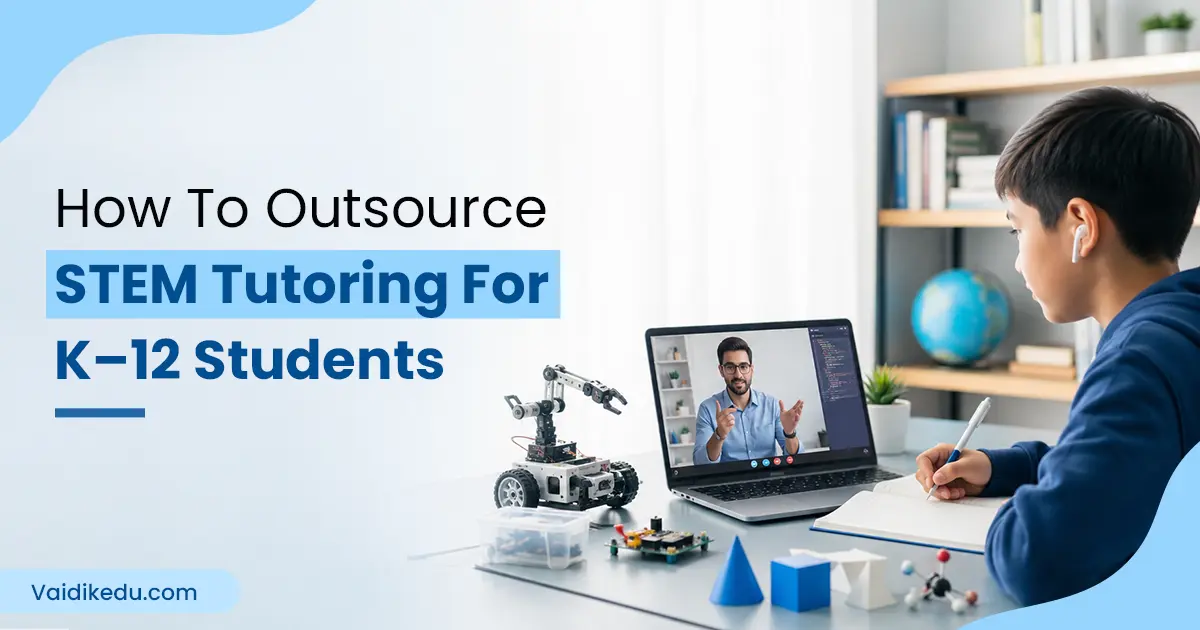

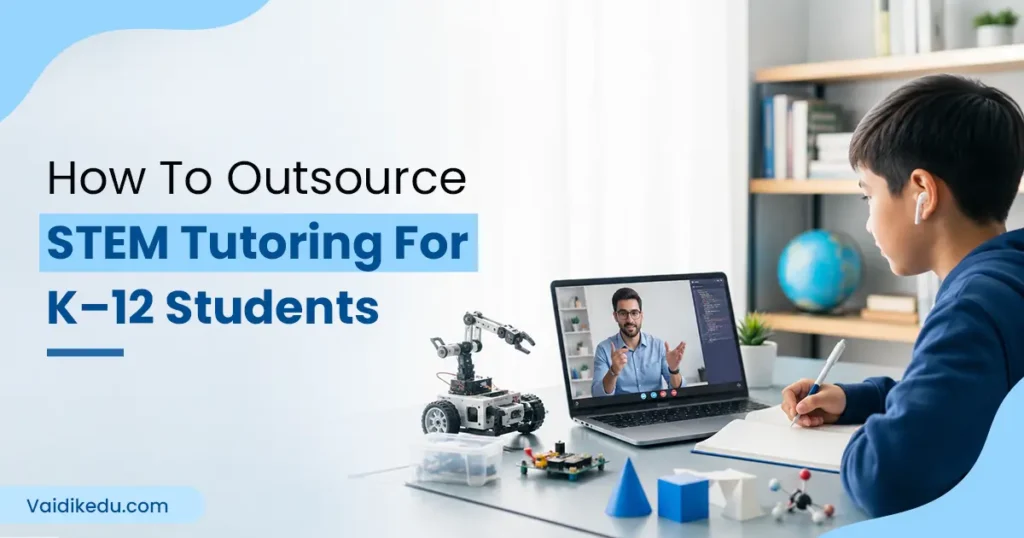
STEM education plays an important role in preparing K–12 students for future academic and career opportunities. Mathematics, science, technology, engineering, coding, and computer science help students develop problem-solving, analytical thinking, creativity, and practical skills.
However, providing high-quality STEM tutoring at scale can be challenging for schools, school districts, EdTech companies, educational publishers, and tutoring organizations.
An organization may need additional mathematics tutors before standardized assessments, science instructors for an intervention program, coding tutors for an online learning platform, or specialized support for advanced high school STEM courses. Recruiting, training, scheduling, and managing all these tutors internally can require significant time and resources.
This is where STEM tutoring outsourcing can provide a practical solution.
Instead of building and managing a complete tutoring operation internally, organizations can partner with an experienced education services provider to access qualified tutors and scalable instructional support.
In this guide, we will explain how to outsource STEM tutoring for K–12 students, what to look for in an outsourcing partner, how the process works, how to maintain instructional quality, and how organizations can use outsourced tutoring to expand their educational services.
What is STEM Tutoring Outsourcing?
STEM tutoring outsourcing is the process of partnering with an external education or tutoring provider to deliver STEM learning support to K–12 students.
Rather than managing every part of the tutoring program internally, an organization can outsource selected services such as:
- Tutor recruitment and coordination
- STEM subject-matter expertise
- Tutor onboarding
- Curriculum alignment
- Live online tutoring
- One-on-one tutoring
- Small-group tutoring
- Student scheduling
- Progress tracking
- Quality assurance
- Student assessments
- Reporting and program management
The exact scope depends on the organization’s requirements and the services offered by the outsourcing partner.
For example, a school may outsource online math tutoring for middle school students, while an EdTech company may outsource a broader K–12 STEM tutoring program covering mathematics, science, coding, and computer science.
The goal is not simply to find tutors. A successful outsourcing model should connect qualified educators with the right students, curriculum, technology, and learning objectives.
How Vaidik Edu Services Supports STEM Tutoring Outsourcing
Organizations do not always have the resources to recruit, train, manage, and scale a complete STEM tutoring team internally. Vaidik Edu Services can support education organizations looking to expand their K–12 tutoring capabilities through a flexible outsourcing model.
Depending on program requirements, STEM tutoring outsourcing can include support across:
- K–12 STEM subjects
- Mathematics tutoring
- Science tutoring
- Computer science and coding
- Online tutoring
- One-on-one and small-group tutoring
- Curriculum-aligned instruction
- Tutor coordination
- Student progress tracking
- Quality assurance
- Scalable tutoring support
This model can help schools, EdTech companies, publishers, tutoring organizations, and other education businesses extend their instructional capacity without building every part of the operation internally.
The specific scope of support can be customized according to the organization’s grade levels, subjects, curriculum, student volume, schedule, and learning objectives.
Why Are Schools and Education Companies Outsourcing STEM Tutoring?
Running a tutoring program internally can involve much more than teaching students. Organizations may need to recruit tutors, evaluate subject expertise, manage schedules, provide training, monitor quality, collect student data, and prepare reports.
Outsourcing can help simplify these operational requirements.
Access to Qualified STEM Tutors
A specialized tutoring provider may have access to educators and subject-matter experts across multiple STEM disciplines.
Depending on program requirements, organizations may need tutors for:
- Elementary mathematics
- Middle school mathematics
- Algebra
- Geometry
- Precalculus
- Calculus
- Biology
- Chemistry
- Physics
- Computer science
- Coding
- Robotics
- Engineering
- Statistics
This can be particularly useful when an organization needs specialized expertise that may be difficult to recruit internally.
Flexible Tutoring Capacity
Student demand can change throughout the academic year.
A school may require additional tutoring before assessments, while an EdTech company may experience increased enrollment during certain periods.
Outsourcing can provide greater flexibility to increase or reduce tutoring capacity based on program requirements.
Reduced Administrative Work
Managing tutors internally requires time for:
- Recruitment
- Interviews
- Scheduling
- Onboarding
- Training
- Performance monitoring
- Attendance tracking
- Reporting
An outsourcing partner can take responsibility for agreed-upon operational activities, allowing the internal team to focus on its core educational priorities.
Greater Subject Coverage
Organizations do not always need to employ full-time specialists for every STEM subject.
Outsourcing can provide access to specialized tutoring support when required.
Outsourcing STEM Tutoring for U.S. K–12 Education
U.S. schools and education organizations can have different requirements depending on their state, district, grade levels, curriculum, and student population.
For this reason, outsourced STEM tutoring should be designed around the organization’s specific instructional requirements rather than delivered as a one-size-fits-all program.
A STEM tutoring outsourcing partner supporting U.S. students may need to work with:
- K–12 grade levels
- State-specific academic standards
- District curriculum requirements
- Mathematics and science intervention programs
- After-school tutoring
- Summer learning programs
- Online learning programs
- Advanced high school STEM courses
- EdTech platforms serving U.S. students
- Educational publishers
Organizations serving students across multiple states or districts may also benefit from a flexible tutoring model that can adapt as student demand and program requirements change.
What Types of STEM Tutoring Can You Outsource?
A strong K–12 STEM tutoring service can support multiple subjects and grade levels.
The exact subject coverage depends on the tutoring provider and program requirements.
Mathematics Tutoring
Mathematics is one of the most common areas for outsourced tutoring.
Services may include:
- Elementary math
- Middle school math
- Pre-algebra
- Algebra
- Geometry
- Trigonometry
- Precalculus
- Calculus
- Statistics
- Problem-solving
- Homework support
- Test preparation
Effective math tutoring should help students understand concepts and develop independent problem-solving skills rather than simply providing answers.
Science Tutoring
Science tutoring can cover foundational and advanced subjects, including:
- Elementary science
- Middle school science
- Life science
- Earth science
- Physical science
- Biology
- Chemistry
- Physics
- Environmental science
Tutors should help students understand scientific concepts, interpret information, analyze problems, and apply scientific reasoning.
Computer Science and Coding Tutoring
Technology and computer science are increasingly important components of K–12 education.
Depending on the student’s grade level, tutoring may include:
- Computer science fundamentals
- Programming
- Python
- Java
- Scratch
- Web development
- Computational thinking
- Coding projects
- Robotics
- Data science fundamentals
- Artificial intelligence fundamentals
For younger learners, tutoring may focus on computational thinking, logic, creativity, and problem-solving before moving into advanced programming.
Engineering and Robotics Tutoring
STEM tutoring can also include engineering and robotics-related learning.
Potential areas include:
- Engineering fundamentals
- Robotics
- Design thinking
- Electronics
- STEM projects
- Engineering challenges
- 3D design
- Problem-based learning
These areas can be useful for students who benefit from hands-on, project-based learning.
Who Can Outsource K–12 STEM Tutoring?
STEM tutoring outsourcing is not limited to traditional schools.
Several types of organizations can use an outsourced tutoring model.
K–12 Schools
Schools can outsource tutoring when they need additional academic support without expanding their permanent instructional staff.
Common use cases include:
- Mathematics intervention
- Science intervention
- After-school tutoring
- Summer learning
- Homework support
- Test preparation
- Academic enrichment
School Districts
School districts may require tutoring support across multiple schools, grade levels, and subjects.
A district-focused outsourcing program may include:
- Tutor staffing
- Student matching
- Scheduling
- Instruction
- Progress reporting
- Quality monitoring
- Program management
EdTech Companies
EdTech companies often have strong technology and digital learning content but may not want to build and manage a large tutoring workforce.
An outsourced tutoring partner can provide the human instructional component behind the technology.
For example:
EdTech Platform → STEM Tutor → Student → Progress Data
This model can support platforms offering:
- Live tutoring
- Homework assistance
- Personalized learning
- Virtual classrooms
- Test preparation
- STEM enrichment
Educational Publishers
Educational publishers can use outsourced tutors to provide additional instructional support around their digital curriculum, textbooks, assessments, and other learning products.
This approach can work particularly well alongside educational content development and digital learning solutions.
Tutoring Companies
Existing tutoring companies may also outsource specific subjects when student demand exceeds their internal tutor capacity.
This allows them to expand their service offerings without recruiting a permanent team for every specialized subject.
Why Choose Vaidik Edu Services for STEM Tutoring Outsourcing?
Choosing a STEM tutoring outsourcing partner is not simply about finding tutors. Education organizations need a partner that understands instructional requirements, student needs, curriculum expectations, and the operational demands of delivering tutoring at scale.
Vaidik Edu Services can support organizations looking to expand their K–12 tutoring capabilities through a flexible education outsourcing model.
Flexible STEM Tutor Support
Organizations can access tutoring support across relevant STEM subjects and grade levels based on their program requirements.
Curriculum-Aligned Instruction
Organizations that need additional support with curriculum development services can also work with specialized education partners.
Scalable Delivery
An outsourced model can help organizations increase tutoring capacity when student demand grows or when specialized subject support is required.
Online Tutoring Support
Virtual tutoring can help organizations provide students with access to STEM educators without being limited entirely by local tutor availability.
Quality-Focused Delivery
A structured quality process can help organizations maintain consistency across tutors, sessions, and student groups.
B2B Education Support
Vaidik EduServices supports education-focused organizations looking for scalable solutions across tutoring and other education service requirements.
How to Outsource STEM Tutoring: Step-by-Step
Outsourcing works best when organizations approach it as an educational partnership rather than simply purchasing tutoring hours.
Step 1: Define Your Tutoring Requirements
Start by identifying exactly what you need.
Consider:
- Grade levels
- STEM subjects
- Curriculum
- Number of students
- Number of sessions
- Session duration
- Student location
- Time zones
- Academic goals
- Assessment requirements
- Reporting requirements
For example:
“We need online mathematics tutors for 250 middle school students following a U.S. curriculum, with two 45-minute sessions per week.”
A specific requirement makes it easier for a tutoring provider to build the right program.
Step 2: Decide Which Subjects to Outsource
You do not necessarily need to outsource every STEM subject.
An organization might keep core instruction internally while outsourcing specialized or high-demand subjects such as:
- Algebra II
- Calculus
- Physics
- Chemistry
- Computer science
- Coding
This hybrid approach can provide flexibility while maintaining internal control over core instruction.
Step 3: Determine the Grade Levels
STEM tutoring requirements change significantly as students progress through school.
Elementary School
Students may need support with:
- Number sense
- Arithmetic
- Fractions
- Measurement
- Elementary science
- Introduction to technology
Middle School
Tutoring may cover:
- Pre-algebra
- Algebra
- Geometry
- Physical science
- Life science
- Coding
- Robotics
High School
Students may require specialized support in:
- Algebra II
- Geometry
- Precalculus
- Calculus
- Statistics
- Biology
- Chemistry
- Physics
- Computer science
- Engineering
Your outsourcing partner should be able to match tutors to the appropriate grade and subject level.
Step 4: Establish Curriculum Alignment
One of the most important questions to ask is:
Can the tutoring provider work with our curriculum?
A tutor may have strong subject knowledge but still need to understand the curriculum, pacing, assessments, and learning objectives used by your organization.
Provide relevant curriculum materials, learning objectives, and instructional guidelines before tutoring begins.
Step 5: Evaluate Tutor Qualifications
Do not select a provider based only on the number of tutors available.
Quality and subject expertise matter.
Ask about:
- Academic qualifications
- Teaching experience
- STEM expertise
- K–12 experience
- Curriculum familiarity
- Communication skills
- Tutor training
- Screening processes
Step 6: Test the Tutor Matching Process
A strong tutor-matching process should consider more than the subject.
Relevant factors may include:
- Grade level
- Academic ability
- Learning goals
- Subject difficulty
- Availability
- Curriculum
- Student learning needs
A high school calculus student, for example, requires a different tutor profile from an elementary student learning multiplication.
Step 7: Choose the Right Delivery Model
There are several ways to deliver outsourced STEM tutoring.
One-on-One Tutoring
One student works directly with one tutor.
This provides personalized instruction and can be useful for students with specific learning gaps.
Small-Group Tutoring
A tutor works with several students who have similar learning needs.
This can provide a balance between personalization and scalability.
Online Live Tutoring
Students and tutors meet virtually using video, screen sharing, digital whiteboards, and other online learning tools.
Hybrid Tutoring
Organizations can combine:
- Live tutoring
- Digital practice
- Assessments
- Recorded learning resources
- Homework support
- Technology-assisted learning
The right delivery model depends on the organization’s goals and student requirements.
Step 8: Establish Technology Requirements
Technology should make tutoring easier rather than create additional barriers.
An online STEM tutoring program may require:
- Video conferencing
- Digital whiteboards
- Screen sharing
- File sharing
- Learning management systems
- Student dashboards
- Attendance tracking
- Progress reporting
- Assessment tools
Before launching the program, test the complete student experience from login through the end of a tutoring session.
Step 9: Create a Student Progress System
Tutoring should not become a series of disconnected sessions.
Each session should contribute to a broader learning objective.
Track metrics such as:
- Attendance
- Session completion
- Skills covered
- Assessment scores
- Learning gaps
- Student participation
- Homework completion
- Tutor observations
Step 10: Establish Quality Assurance
Quality assurance is essential when tutoring is outsourced.
Your provider should have a process for monitoring tutor performance.
This can include:
- Tutor observations
- Session reviews
- Student feedback
- Academic assessments
- Tutor evaluations
- Attendance monitoring
- Performance reporting
- Regular quality reviews
Do not wait until the end of a semester to identify quality problems.
What Should You Look for in a STEM Tutoring Outsourcing Partner?
Choosing the right provider can determine whether an outsourced tutoring program succeeds.
1. K–12 Experience
The provider should understand how children and teenagers learn.
Teaching a university student is different from teaching a fourth-grade student. Look for experience across the K–12 age range.
2. STEM Subject Expertise
Make sure the provider can support the specific STEM subjects you require.
These may include:
- Mathematics
- Science
- Computer science
- Coding
- Engineering
- Robotics
3. Curriculum Alignment
The provider should be able to adapt instruction to your curriculum rather than relying entirely on a generic tutoring program.
4. Scalability
Consider whether the provider can increase tutor capacity when student demand grows.
This is especially important for:
- School districts
- EdTech platforms
- Publishers
- Tutoring companies
5. Tutor Screening
Ask how tutors are recruited and evaluated.
Important considerations include:
- Qualifications
- Experience
- Subject expertise
- Communication
- Screening procedures
- References
- Teaching demonstrations
6. Technology Capabilities
For online tutoring, technology is part of the student experience.
Ask whether the provider can support the technology required for:
- Virtual classrooms
- Digital whiteboards
- Screen sharing
- Scheduling
- Attendance
- Reporting
- LMS integration
7. Reporting
A professional outsourcing partner should provide useful information about program performance.
Reports may include:
- Student attendance
- Sessions delivered
- Skills covered
- Student progress
- Tutor performance
- Engagement
- Assessment results
What Are the Benefits of Outsourcing STEM Tutoring?
A well-managed outsourced tutoring program can provide several operational and educational benefits.
Lower Operational Complexity
The organization does not have to manage every part of the tutoring operation internally.
Flexible Access to Tutors
Organizations can access tutoring capacity based on their current requirements.
Greater Subject Coverage
Specialized STEM subjects can be supported without hiring permanent full-time staff for every area.
Flexible Scaling
Tutor capacity can increase or decrease according to student demand.
Personalized Student Support
Students can receive targeted support based on their academic needs.
Reduced Teacher Workload
Additional tutoring capacity can supplement classroom instruction and reduce pressure on teachers.
Wider Geographic Access
Online tutoring can help organizations access tutors beyond their immediate geographic area.
Consistent Program Management
An experienced provider can support scheduling, staffing, quality assurance, and reporting according to the agreed program structure.
What Does Outsourced STEM Tutoring Cost?
The cost of outsourced STEM tutoring depends on several factors.
There is no single price that applies to every organization.
Pricing may depend on:
- Grade level
- Subject
- Tutor qualifications
- Session duration
- Number of students
- Number of sessions
- One-on-one versus group tutoring
- Online versus in-person delivery
- Curriculum requirements
- Reporting requirements
- Technology requirements
- Program duration
- Overall tutoring volume
For example, a high school calculus program requiring specialized tutors may have different costs from a large elementary mathematics intervention program.
Organizations should therefore evaluate total program value, not just the hourly tutoring rate.
How to Measure the ROI of Outsourced STEM Tutoring
Cost is only one part of evaluating an outsourced tutoring program.
Schools and education businesses should also consider the operational and educational value generated by the partnership.
Important metrics can include:
- Cost per student
- Tutor utilization
- Student attendance
- Session completion
- Student engagement
- Assessment performance
- Skill improvement
- Administrative time saved
- Tutor recruitment costs
- Program scalability
- Student satisfaction
For an EdTech company or education business, ROI can also be evaluated by how efficiently the organization expands tutoring capacity without significantly increasing its internal operational workload.
Outsourcing vs. Hiring STEM Tutors Internally
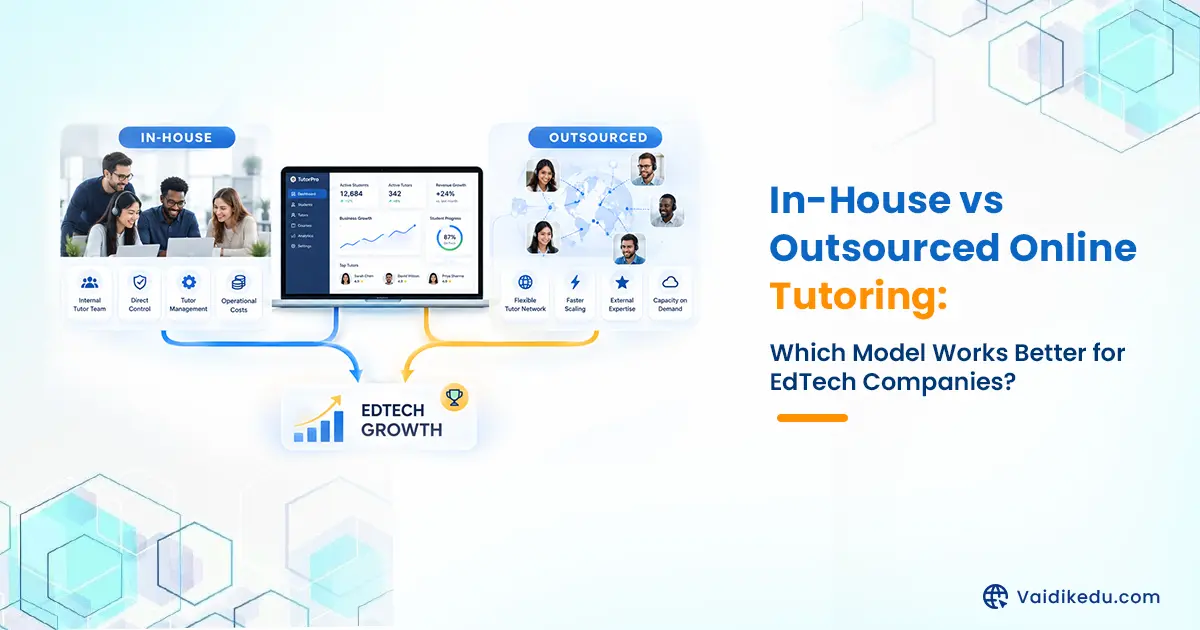
Organizations considering whether to build an internal STEM tutoring team or work with an external provider should consider factors such as scale, flexibility, recruitment resources, specialized subject requirements, and operational capacity.
Factor | Outsourcing | Internal Hiring |
Recruitment | Provider manages agreed recruitment activities | Organization manages recruitment |
Tutor pool | Potentially broader | Dependent on internal recruitment |
Scaling | Generally more flexible | May take more time |
Administrative workload | Lower | Higher |
Direct control | Shared | Greater direct control |
Specialized subjects | Easier to access | May be difficult to staff |
Technology | May be supported by provider | Organization manages |
Quality assurance | Provider can manage agreed processes | Internal team manages |
Long-term staffing | Flexible | More permanent |
Program management | External support available | Internal responsibility |
For many organizations, a hybrid approach can provide the best balance.
Common Mistakes When Outsourcing STEM Tutoring
Choosing the Cheapest Provider
Low cost does not automatically mean good value.
If students receive inconsistent instruction, the organization may spend more time and resources fixing the problem.
Focusing Only on Tutor Quantity
A provider may have a large tutor network, but that does not necessarily mean it has enough qualified tutors for your specific subjects and grade levels.
Ignoring Curriculum Alignment
Generic tutoring may not adequately support students who need instruction based on a specific curriculum.
Not Defining Success Metrics
Before tutoring begins, determine what success means.
Possible KPIs include:
- Attendance
- Session completion
- Skill mastery
- Assessment performance
- Student engagement
- Student satisfaction
Poor Communication
The outsourcing partner should have a clear communication structure covering:
- Main point of contact
- Reporting frequency
- Escalation process
- Student support
- Technical support
- Tutor communication
How to Maintain Quality When STEM Tutoring Is Outsourced
Outsourcing does not mean giving up control over educational quality.
The organization should establish clear expectations from the beginning.
Create Tutor Standards
Define what tutors are expected to deliver.
For example:
- Follow the provided curriculum.
- Begin sessions with clear learning objectives.
- Check student understanding.
- Encourage students to explain their reasoning.
- Provide appropriate practice opportunities.
- Record relevant progress information.
- End sessions with a clear next step.
Use Regular Assessments
Assessments help identify whether students are progressing.
Useful approaches can include:
- Diagnostic assessments
- Formative assessments
- Practice tests
- Skill checks
- End-of-program assessments
Collect Student Feedback
Students can provide useful information about:
- Tutor clarity
- Engagement
- Session difficulty
- Technology issues
- Learning confidence
Student feedback should complement academic performance data rather than replace it.
How Outsourced STEM Tutoring Supports Different K–12 Learners
Not every student requires the same type of support.
Students With Learning Gaps
Tutors can identify missing prerequisite skills and provide targeted instruction.
Advanced Students
Advanced learners may benefit from enrichment beyond the standard classroom curriculum, including:
- Advanced mathematics
- Competitive mathematics
- Coding
- Robotics
- Physics
- Advanced science
- Engineering projects
Students Preparing for Assessments
Tutors can provide structured preparation for assessments and standardized tests.
Students Who Need Homework Support
Tutors can help students understand difficult concepts and develop independent problem-solving skills instead of simply providing answers.
How EdTech Companies Can Use Outsourced STEM Tutors
For EdTech companies, outsourcing tutoring can provide an additional human instructional layer around an existing digital product.
An EdTech platform may already provide:
- Curriculum
- Digital content
- Assessments
- Learning analytics
- Student dashboards
However, students may still need direct human support.
An outsourced tutor can help students understand difficult concepts, complete guided practice, and receive personalized feedback.
Example Model
Digital Lesson
↓
Student Completes Activity
↓
Platform or Teacher Identifies Learning Need
↓
Student Receives STEM Tutoring
↓
Tutor Provides Feedback
↓
Student Returns to Digital Learning
↓
Progress Is Monitored
This model can help EdTech companies combine digital learning with personalized human instruction.
How Publishers Can Use Outsourced STEM Tutors
Educational publishers can use outsourced tutoring to extend the value of their educational products.
For example, a publisher could provide a mathematics curriculum together with access to live tutoring.
The tutor can work from the publisher’s instructional framework and help students understand difficult concepts.
This can create a broader learning solution around textbooks, digital curriculum, assessments, and other educational resources.
How School Districts Can Use Outsourced STEM Tutoring
School districts often need tutoring programs that can work across multiple schools and grade levels.
A district-focused outsourcing model can provide:
- Centralized tutor management
- Multiple STEM subjects
- Multiple grade levels
- Student scheduling
- Progress reporting
- Quality monitoring
- Scalable staffing
The tutoring program should fit into the district’s existing instructional calendar, intervention strategy, and operational processes.
Online STEM Tutoring vs. In-Person STEM Tutoring
Both online and in-person tutoring can support K–12 STEM learning.
The right model depends on student needs, program objectives, technology, and available resources.
Online STEM Tutoring
Potential advantages include:
- Access to a broader tutor pool
- Flexible scheduling
- Remote delivery
- Easier geographic scaling
- Digital learning resources
- Centralized reporting
- Convenient student access
In-Person STEM Tutoring
Potential advantages include:
- Face-to-face interaction
- Physical classroom activities
- Access to physical equipment
- Hands-on learning opportunities
For some organizations, a hybrid model can provide a balance between flexibility and direct interaction.
How to Build a Successful Outsourced STEM Tutoring Program
A successful program should be designed around the student’s learning needs and the organization’s objectives.
1. Identify the Learning Need
Determine the academic or operational problem you are trying to solve.
2. Define the Student Population
Identify the grades, subjects, student groups, and learning needs that require support.
3. Select the Delivery Model
Choose between one-on-one, small-group, online, in-person, or hybrid tutoring.
4. Define the Tutor Profile
Establish the qualifications, subject expertise, experience, and availability required.
5. Align With the Curriculum
Provide standards, pacing guides, learning objectives, and
instructional materials where applicable.
6. Establish Technology
Make sure students and tutors can connect easily and access the required learning resources.
7. Create KPIs
Define how you will measure program performance.
8. Monitor Quality
Review tutoring performance regularly.
9. Analyze Student Outcomes
Use relevant data to understand what is working and where improvements are needed.
10. Improve the Program
Adjust tutor matching, scheduling, curriculum support, and instructional strategies based on results.
Conclusion
Outsourcing STEM tutoring can help schools, school districts, EdTech companies, educational publishers, and tutoring organizations expand their instructional capacity without building an entire tutoring operation internally.
However, successful outsourcing requires more than simply finding tutors. The right partner should understand K–12 education, STEM subjects, curriculum alignment, student needs, quality assurance, technology, scheduling, and measurable learning outcomes.
For organizations looking to expand their STEM tutoring capabilities, Vaidik EduServices can provide flexible education outsourcing support based on specific program requirements.
Whether you need support with mathematics, science, coding, computer science, or other K–12 STEM learning needs, an experienced outsourcing partner can help you build a more scalable and manageable tutoring program.
Need to Scale Your STEM Tutoring Program?
Talk to Vaidik Edu Services about your K–12 STEM tutoring requirements and explore a flexible outsourcing model for your organization.
Frequently Asked Questions
Outsourcing STEM tutoring means partnering with an external tutoring or education services provider to deliver STEM instruction and related support to students. Depending on the agreement, the provider may support tutor coordination, instruction, scheduling, quality assurance, progress tracking, and reporting.
Yes. Schools can outsource tutoring for mathematics, science, computer science, coding, engineering, and other STEM subjects. Outsourcing can provide additional instructional capacity without requiring the school to manage every aspect of tutor recruitment and administration internally.
Yes. School districts can work with external tutoring providers to deliver programs across multiple schools, grade levels, and subjects. The scope can include tutoring delivery, staffing support, scheduling, reporting, and quality management.
Yes. EdTech companies can use outsourced tutors to add live instructional support to their digital learning platforms.
Common subjects include mathematics, biology, chemistry, physics, computer science, coding, engineering, robotics, statistics, and general science.
Look for a provider with relevant K–12 experience, qualified STEM tutors, curriculum alignment capabilities, appropriate technology, quality assurance processes, progress reporting, clear communication, and the ability to scale according to your requirements.