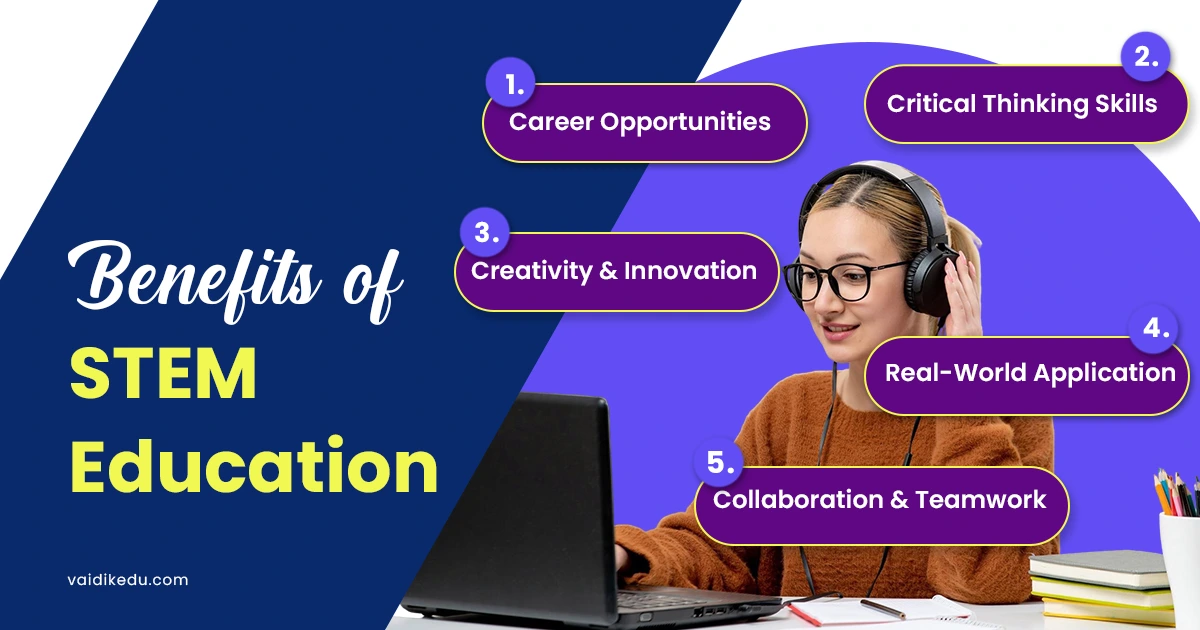

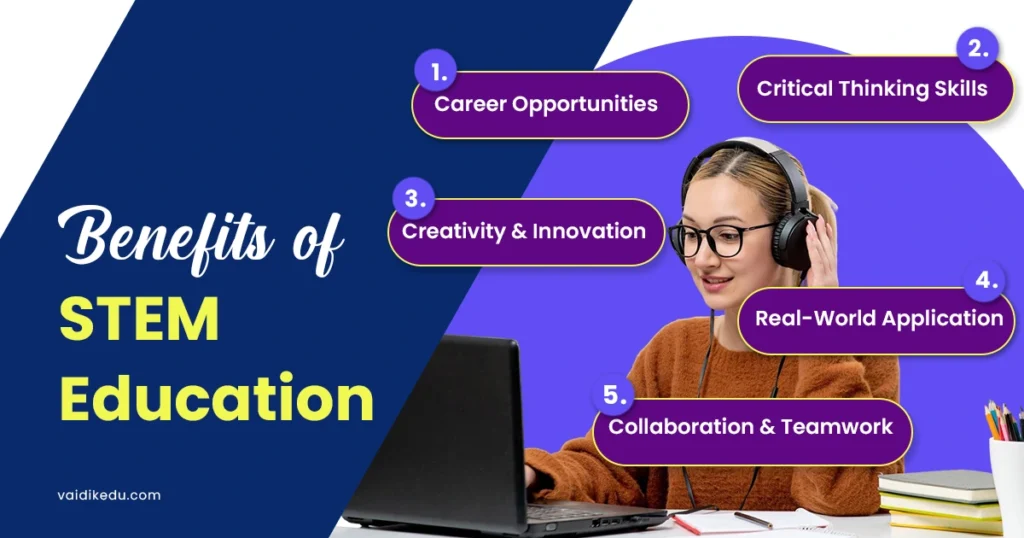
STEM stands for Science, Technology, Engineering, and Math. In the fast-changing world, STEM education marks an important step. It includes a consolidation of all the important subjects such as science, technology, engineering, and mathematics. It allows students to develop key skills and prepares them for future challenges and needs.
STEM education fosters critical thinking and problem-solving. It applies knowledge to real-world problems. This builds up the personality of the students and excels them in their school and careers.
STEM education is an interdisciplinary approach to learning with integrated subjects into cohesive, hands-on experiences. Rather than teaching each subject individually, STEM emphasises the overall development through problem-solving, collaboration, and innovation.
Nowadays, with project-based learning, students can gain a deep understanding of the concepts and develop critical thinking and skills which are essential for both academic success and future careers.
What is STEM education?
STEM education focuses on aspects such as hands-on learning, critical thinking, creativity, and problem-solving. Working on projects, experiments, and design challenges, the students combine concepts from multiple STEM fields and thus go beyond the book.
STEM has been part of education programs for more than two decades, but many schools are implementing this policy now, which works to adopt these standards. It integrates these subjects rather than teaching them separately, helping students apply their knowledge to real-world problems.
Therefore, STEM education as a teaching approach combines science, technology, engineering, and mathematics to help students solve real-world problems and develop practical skills for personality development. You can contact us For STEM Curriculum design and development Services.
The 10 Benefits of STEM Education
The following are the benefits of STEM education are
1. Ignites curiosity and innovation
Students can think through perceived horizons, explore new ideas and innovations and develop new products and technologies. It generates curiosity and encourages students to become interactive and discover solutions and outcomes. STEM projects ignite creativity and reward experimentation.
Curious minds today become tomorrow’s inventors.
2. Real-World Problem-Solving Skills
Students build their skills through hands-on experiences. STEM classes teach students to solve complex problems and are taught to analyse data, test theories, and refine their solutions, similar to engineers and scientists in the field.
Students learn how to approach complex problems step-by-step and find practical solutions. This method boosts their grasp of STEM concepts and prepares them for STEM careers and a problem-solving approach.
3. Prepare Future Careers
STEM education not only builds up concepts and problem solving approaches but also is considered one of the fastest-growing job markets in any other industry. Early exposure matters. Introducing AI literacy and hands-on STEM tools in primary and middle grades inspires students to pursue careers in science, engineering, technology, and math.
4. Promotes Digital Literacy
In today’s world, it is essential to understand technology as it is not an optional choice. The STEM education gives an easy access to learn coding, data analysis, digital tools, and internet safety. This makes these topics easier and more interesting. STEM activities help students develop their communication skills. In STEM education, ideas can be expressed through writing and presentations.
5. Independent and Collaborative Learning
STEM not only teaches knowledge but also expresses how to learn. Students gain confidence in solving challenges, making decisions that reflect on results. STEM projects motivate students to work together, share ideas, and solve problems as a group, which helps them to develop communication, leadership, and interpersonal skills.
6. Resilience and Growth Mindset
STEM projects often involve trial and error. Students learn to view failure not as a setback but as part of the discovery process when they are engaged in any project or in their career growth. This resilience helps them in all areas of life, from academics to emotional development and thus, makes them emotionally strong.
7. Improves Math and Science Performance
The students, when exposed to integrated STEM education, score higher in math and science assessments. This is because they are learning concepts in depth rather than just memorising the formulas. It also provides interactive simulations, visual models, and real-world data that bring math and science to life.
8. Improves adaptability
STEM education teaches students how to adapt to new technologies and rapidly changing industries. This process helps students think critically. It also lets them approach problems thoughtfully.
STEM education enables students to build technology, a valuable skill that helps them navigate the technological world. It builds resilience, autonomy, and a proactive mindset, which carries the students into this world beyond the classroom.
9. Enhances Communication and Collaboration Skills
STEM education is a collaboration of teamwork. STEM tasks require students to explain their ideas, present findings, or debate design choices. For STEM students, a common goal is essential for the preparation of collaborative problem-solving in both academic and professional aspects and also involves dividing tasks, sharing ideas, etc.
10. Builds a Lifelong Love of Learning
Solving problems and developing projects helps them develop communication, leadership, and interpersonal skills. It also helps students to see learning as an exciting journey, but not a chore.
When kids build rockets, create websites, or explore ecosystems virtually, learning becomes joyful and meaningful, and they get highly motivated, so that they have enormous abilities to think beyond to become young scientists.
How STEM education is advantageous at the school level
From a school’s perspective, STEM education improves how the school teaches, operates, and prepares its students for the future, as it is not only focused on student learning.
It also creates a modern, engaging, and future-ready learning environment, while improving teaching quality, student outcomes, and the school’s overall growth.
The following are the benefits or advantages of STEM education at the school level
- Helps meet educational standards and emphasises STEM skills. Implementing STEM education at the school level helps schools meet curriculum standards and government expectations more effectively.
STEM provides those skills which can lead students to succeed in a tough job market. By solving real-world problems with STEM, students build a strong, sought-after skill set.
Thus, by combining technical skills with design thinking and project-based learning, students develop innovation and creativity.
Therefore, STEM education prepares students for high-demand careers and empowers them to succeed.
- Prepares Students for Future Success aims to prepare students for higher education and careers. STEM helps schools fulfil this goal by equipping students with skills needed in modern industries.
- Increases Student Engagement and Performance, which makes the learning process interesting and leads to higher student participation, better attendance, and improved academic performance.
Frequently Asked Questions
STEM stands for Science, Technology, Engineering, and Mathematics. It is an approach to learning that integrates these subjects in a practical and application-based way.
It prepares students for modern careers, improves problem-solving skills, and helps them adapt to a technology-driven world.
- Building models or robots
- Coding simple programs
- Conducting science experiments
- Solving real-world math problems
- Schools can improve STEM by:
- Using hands-on learning methods
- Providing modern technology
- Encouraging project-based learning
- Training teachers effectively.