
In today’s fast-changing phase of Education, traditional curriculum designs often fail to meet the broad needs of today’s learners in the classroom. Each learner learns differently, that is, to their strengths and weaknesses.
Therefore, a different approach is often needed. But this is how artificial intelligence will change the rules of education- personalised learning.
An AI-managed curriculum is modifiable, according to the learner’s learning style, and pays for proper content and support: adaptive learning platforms and intelligent tutoring systems. Supported by real-time data analysis, it enables educators to identify learning gaps and intervene appropriately.
Understanding Individual Learning Needs:
All students have different cognitive abilities, learning styles, and comprehension skills. Traditional education models often struggle with this variability, leaving gaps in the amount of learning versus participation needed to create realistic learning experiences. Thus, it is fundamental to recognise the diversity of factors that affect individual needs.
1. Learning Styles: Students learn information differently. Various learning styles encompass the following:
- Visual Learners- They want to see images, diagrams, charts and videos.
- Auditory Learners- Learn better by listening in lectures or discussing.
- Kinesthetic Learners- Learn better by doing and moving.
- Reading/Writing Learners- They memorise using text-based material such as books and notes.
2. Learning Paces And Abilities: Students learn differently. Some grasp concepts quickly, whereas others require much time and repetition. AI-powered systems can track student progress and adjust the content accordingly, ensuring no student is left behind or held back.
- Cognitive and Affective Factors:
- Pre-existing knowledge: The student’s previous knowledge influences his ability to acquire new information.
- Attention Span: Many students prefer more interactive engage in content that would hold them in their seats.
- Motivation and Interest: Personalised learning engages by matching content with a student’s interests.
- Limitations of Traditional Education:
- Standard curricula are not flexible to accommodate individual differences.
- Teachers do not have enough time for each pupil individually.
- The lack of real-time feedback makes it hard to adjust teaching strategies.
Understanding individual learning needs will help develop an effective AI-driven curriculum, thereby individualising support for all students going through education.
Role of AI in Personalizing Education:
Artificial intelligence transforms education to personalise the process rather than impart standard knowledge. Every tool in its toolbox allows AI to study students’ behaviour, learn how to react to that behaviour, and offer customised learning paths where the child learns at their own pace.
1. Adaptive Learning Platforms: Adaptive learning platforms use AI and real-time assessment of student’s strengths and weaknesses to alter content accordingly.
- Modify difficulty levels as a function of the student’s performance.
- Offer additional resources or exercises for struggling learners.
- Offer more challenging materials to advance student’s learning speed.
2. AI-Driven Assessment and Feedback System: Traditional assessment does not give timely and qualitative feedback.
- AI elevates evaluation by using machine learning to determine student response patterns.
- Giving instantaneous elaborate feedback for improvement purposes.
- Identifying specific problem areas and suggesting targeted interventions.
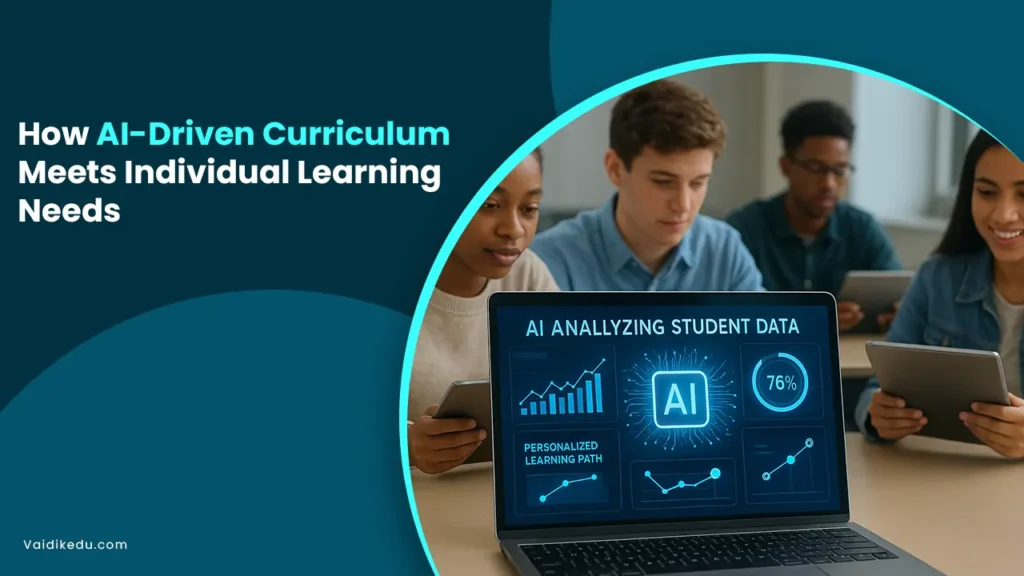
3. Real-Time Progress Tracking and Data Analysis: AI collects and analyses vast amounts of student data to help educators and students track their progress effectively.
This includes the following:
- Personalised progress reports highlighting strengths and weaknesses.
- It involves predictive analytics on students at risk of falling behind.
- Self-learning recommendations for additional study or practice.
4. AI-Based Tutoring and Chatbots: AI-driven tutors and chatbots provide 24/7 learning support by:
- Answering student queries instantly.
- Explaining complex ideas through interactive discussions.
- Providing practice exercises and quizzes based on individual needs.
5. Personalised Content Delivery: AI personalises learning content by:
- Video articles or exercise recommendations based on student preferences.
- Curating relevant learning paths tied to a specific student’s professional goals or interests.
- Adapt teaching methods to accommodate different learning styles: visual, auditory, and kinesthetic.
With AI in education, learning becomes more student-centric, efficient, and engaging. AI ensures that the right content reaches every learner at the right time and in the right way, improving comprehension, retention, and academic success.
AI Tools and Technologies in Curriculum Design:
In the newly evolving world, AI is revolutionising education to make it more individualised, interactive, and data-driven. Numerous AI tools and technologies analyse a student’s performance, adapt the curriculum, and offer and enhance participation, providing customised support for each learner.
The curriculum uses the machine learning algorithm, which follows the student’s progress and forecasts where the students are likely to struggle in this way. The algorithm adjusts the lesson plan in real time to be at the right challenge level and with the proper support for the student.
Platforms such as Knewton and DreamBox learning help enhance this by dynamically adjusting the content according to the individual learning speed and the learner’s comprehension levels. Secondly, AI applications such as Blackboard Learn and Google Classroom automation for grading attendance tracking and personalised content deployment will free the instructor to focus more time on teaching than administrative work.
ITS, including Carnegie Learning’s MATHia and Squirrel AI, functions as virtual tutoring By providing instant feedback and step-by-step solutions based on individual student needs.
These systems respond to various learning styles and spaces. Hence making education more effective and accessible. Additionally, AI-driven chatbots and virtual assistants, including IBM Watson, tutor and chat. Gpt-based bots offer 24/7, providing instant answers to student queries and helping them efficiently get through coursework.
Natural Language Processing is another important AI technology applied to education, mainly in language learning. Grammarly and Duolingo are good examples of tools that rely on NLP for grammar correction, real-time translation and pronunciation feedback to improve a student’s line with skills.
AI is also applied to generate and curate content by creating personalised study materials, quizzes, and summaries by Quillionz and Perplexity AI to ensure the provision of relevant and engaging resources to students.
Moreover, AI-based tools revolutionise the learning landscape by making it happen through immersive simulation learning. Through platforms such as Google Expeditions and merging EDU, students can view intricate scientific facts, historical activities, engineering models, and designs in engaging spaces for experiential learning.
By taking up AI-driven tools and technologies, curricula design adapts dynamically to individual learning needs. This makes it more efficient and accessible while providing deeper long-term knowledge retention.
Benefits of AI-Driven Curriculum:
An AI-powered curriculum offers many benefits that contribute to enhanced learning experiences and better educational outcomes using data-driven insights and adaptive technologies. AI ensures the learning process is engaging, efficient and aligned with the learner’s requirements.
The great benefit of an AI-led curriculum is enhanced student engagement. In traditional curricula, little content captures a student’s imagination or interest unless it addresses a student’s ability or is similar to something a student will relate to, thus making engagement challenging.
However, AI learning platforms are characterised by gamification, personalised content recommendation, and adaptive assessments dash factors that promote the motivation to learn and enhance the enjoyment of learning.
One significant benefit is that student learning paths are tailored to individual strengths and weaknesses. AI monitors students’ performance in real-time and matches the curriculum, providing additional resources to students with special needs and more challenging materials to advanced students so that everyone is not stuck or lagged. Since adaptive learning takes care of three kinds of learners, education is now for everyone.
Integrating AI into education provides a more engaging, personalised, and efficient learning experience. Ensuring it is aligned with individual learning needs also turns education into an all-inclusive, data-driven, future-ready system.
Frequently Asked Questions
With an AI-driven curriculum, adaptive algorithms assimilate student growth, learning style, and performance data. The AI adapts to the difficulty by recommending personalized learning resources and offering targeted feedback to meet individual learning needs.
The main advantage of AI in education is its high engagement in studies. Real-time feedback offers a personalized learning path and administrative support to relieve teachers’ burdens. It even improves accessibility to assistive technology for students with disabilities or is multilingual supported.
Substantial implementation costs, digital divide problems, data security issues, and the possibility of algorithm bias are the biggest challenges. Educators may also resist this change because they lack Education or fear reduced human intervention.