
Education provides a comprehensive roadmap for the student that ensures learners acquire the essential competencies needed to navigate and excel in an ever-changing world. Teachers, more than anyone, understand the extensive planning and execution involved in the learning process.
Curriculum development consists of numerous knowledge blocks, meticulously arranged to suit each student’s educational stage. These blocks collectively form the curriculum for a specific grade or class, each serving a vital role in the students’ educational journey. Thus, by implementing a thoughtful and well-designed curriculum, the path can lead to the student’s success.
Understanding the Curriculum Framework
Education in the United States is guided by a strong emphasis on structured learning outcomes, flexibility, and student-centred instruction. A curriculum framework serves as the backbone of an educational programme by outlining what students should learn, how learning should occur and how progress will be measured.
It plays a pivotal role in shaping the experience in shaping the educational experience of students across various levels of education.
Developing an effective curriculum framework requires thoughtful planning, collaboration, and alignment with national or state educational standards.
It is not a stagnant approach and includes continuous improvement wherein the content is reviewed, revised and updated according to the needs and demands.
In education, curriculum is critical in guiding teachers and students by providing a clear structure that helps faculty to create coherent instruction, meaningful learning opportunities and outcomes aligned with educational standards.
Meaning and scope in Education
Curriculum development is a process that aims to improve the curriculum through various approaches. The first step in developing a curriculum framework is to establish a clear educational goal. These goals reflect what students should know and be able to do by the end of the course or grade level.
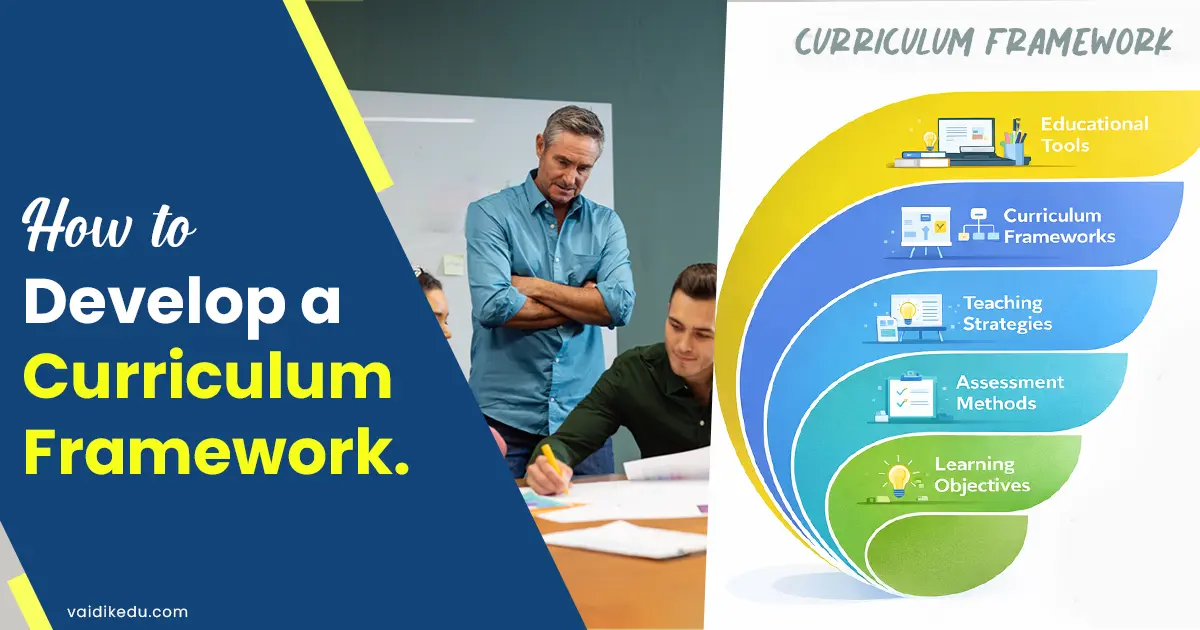
Rather than prescribing exact lesson plans, a framework offers flexibility so schools and teachers can adapt instructions to meet the needs of diverse learners. It provides educators with a roadmap that includes learning goals, content standards, teaching strategies and assessment methods.
It is the process of designing, organising and refining educational content and learning experiences students encounter within a structured curriculum framework of an academic programme. It outlines what is to be taught, the method of instruction, and the expected outcome.
Objective and Principles of an Effective Curriculum Framework
There are three types of curriculum development that offer unique approaches to shape educational experience, which cater to different learning needs and objectives. They are
1. Learner-centred Design – This method prioritises the unique characteristics and the needs of each of the students. It is framed by keeping the focus on the student’s needs, interests, and abilities. The teachers or instructors are given the opportunity, on behalf of the learners, to take ownership of a project or assignment.
Thus, with the help of this, teaching methods and content are adapted to meet students’ diverse learning styles and foster engagement, motivation, and a deeper understanding of the material, ultimately leading to improved educational outcomes.
Under this model, students play an active role in their education, guided by the instructor.
There are four distinct attributes of learner-centred design: they are
- Context: It is related to the assignments and the tasks given in the classroom to have real-world applications, helping students to connect their learning to the practical world.
- Construction: In this, students are encouraged to link their own experience and prior knowledge with the new information, which enhances a deeper understanding.
- Collaboration: This promotes the collaboration of the classroom through group discussions and team assignments, and thus, allows students to learn from one another’s methods and appreciate different perspectives.
- Conversation: An approach to improve communication skills is important and mandatory.
2. Subject-centred Design – This method is a traditional method that focuses on delivering the content in a systematic and organised manner. It focuses on specific subjects or disciplines rather than individual student needs. The subtypes of this model are as follows
- Subject-Area Design: It concentrates on a particular subject to ensure in-depth coverage.
- Discipline Design: It focuses on broader academic disciplines.
- Broad-Field Design: Integrates related subjects to provide a more holistic understanding.
- Correlation Design: This helps to connect different subjects.
This model is closely related to state and government education policies, standardising curricula across schools. It also emphasises the cognitive abilities of students at specific ages, and makes it easier to implement with standardised materials and teacher training.
3. Problem-centred Design – This design method involves real-world problems and challenges, and encourages students to think critically and develop problem-solving skills. In this design, the students are presented with real-life problems and encouraged to devise solutions through careful observation and analysis. Therefore, it helps in making learning more engaging and relevant to life.
Curriculum development process – Steps and stages
Curriculum development is a systematic process that involves several stages to provide effective educational planning and implementation. The following 6 crucial stages meet the educational needs of the students.
Stage 1: To assess educational needs.
In this stage, we identify the targeted audience’s (or students’) needs by analysing their learning requirements. To evaluate the existing curricula to fill the gaps and areas of improvement. To ensure that the future needs of the student are relevant and beneficial.
Stage 2: Developing a core team
To develop a core team for curriculum development, the multidisciplinary team should be equipped with experienced educators, policy experts, content creators and administrators. They should be aware of their role, duties and responsibilities within the time boundations. They should meet their goals with educational standards and institutional objectives.
Stage 3: Assessment and analyse
To provide a detailed analysis of the learning objective and goals as per the new technology and to assess the feasibility of emerging technologies and pedagogical approach.
Stage 4: To organize the content and the structural framework
A well organised and planned content or curriculum helps the student to connect the ideas and to understand the subject better.
Stage 5: Define learning outcomes
This requires careful planning and execution, with educators employing various teaching strategies to deliver the content effectively.
Stage 6: Evaluation of the curriculum
To monitor and evaluate the effectiveness of the curriculum in achieving the learning objectives. With continuous evaluation of the content and the feedback from the students and their needs, the curriculum meets its objectives and provides insights into areas needing adjustment or improvement.
Principles of Curriculum Development
The principles include not only the knowledge but also provides the holistic development of students, which prepare them to thrive in both personal and social contexts. Thus, the principles of curriculum development are
- Totality of Experiences
Apart from the academic subjects, extracurricular and co-curricular activities also, fosters comprehensive student development.
- Child-Centeredness
This helps to understand and meet the diverse needs, interests, and developmental stages of learners.
- Conservation and Creativity
Balance cultural preservation with adaptability to global trends.
- Integration
Curriculum integrates various subjects and disciplines to promote interdisciplinary learning and deepen understanding.
- Flexibility
Curricula should be flexible and adaptable to accommodate changing educational goals, societal demands, and learner needs.
- Character Formation
The curriculum not only imparts knowledge but also fosters ethical values, social responsibility, and personal integrity in students.
- Mental Discipline
Intellectual development through structured learning experiences and cognitive training.
- Social Fulfillment
Create social awareness of social issues and responsibilities, nurturing their role as active and contributing members of society.
- Principle of utility
To follow the principle of utility, according to which educators must include content that is useful to the individual and society.
Conclusion
Developing a curriculum framework is a complex but essential task that shapes the quality of education students receive. From defining learning goals to aligning with standards and designing assessments, each step contributes to building a coherent and effective educational program.
In the United States, successful curriculum frameworks balance structure with flexibility, allowing educators to innovate while maintaining consistent learning outcomes.
Ultimately, a well-designed curriculum framework empowers teachers, supports students, and prepares the next generation to thrive in an increasingly complex and interconnected world.
This holistic approach aims not only to impart knowledge but also to cultivate values of social responsibility and ethical integrity, equipping students with the tools they need to navigate an increasingly interconnected world.
Frequently Asked Questions
A curriculum framework is a structured guide that outlines the goals, content, teaching methods, and assessment strategies used in an educational program. It helps educators to understand what students should learn and how instruction should be organized.
Developing a curriculum framework ensures that education is organized, consistent, and aligned with learning standards. It helps teachers deliver lessons effectively and ensures students achieve the intended learning outcomes.
The main components include learning objectives, subject content, instructional strategies, assessment methods, and guidelines for implementation.
Curriculum frameworks are usually developed by educational experts, teachers, curriculum designers, policymakers, and sometimes community members to ensure that the curriculum meets both academic and societal needs.