

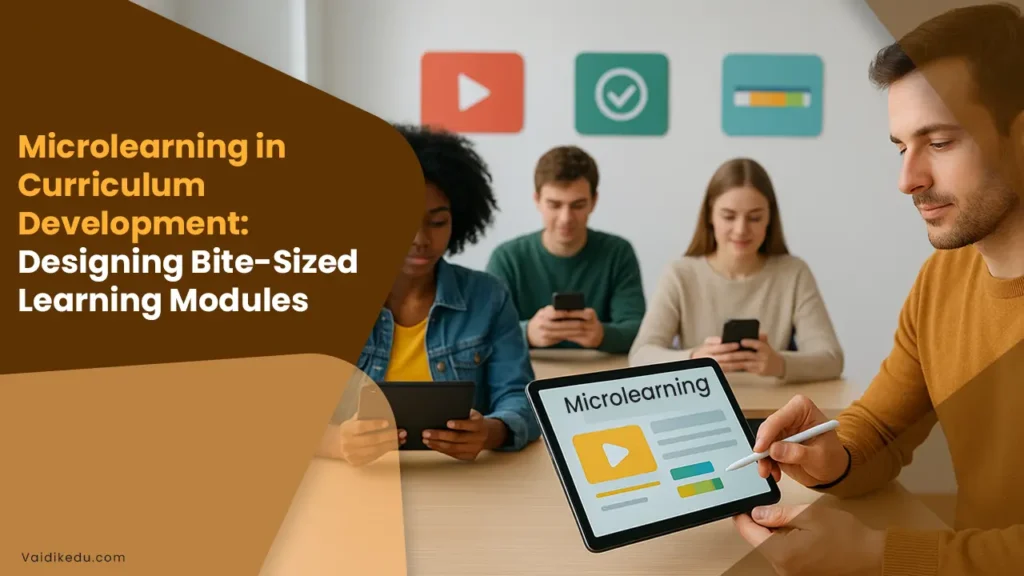
Innovative teaching strategies that prioritize engagement, efficiency, and retention are redefining the traditional model of curriculum development in today’s fast-paced educational landscape. One of the most transformative approaches is microlearning, which divides learning into bite-sized, easily digestible modules.
In contrast to conventional education, which frequently relies on lengthy lectures or extensive reading materials, microlearning splits complex topics into smaller, focused lessons that students can absorb in a matter of minutes.
This shift is particularly important in modern curriculum development, where the focus is on flexibility, learner-centered education, and effective knowledge retention.
The ability to deliver short, targeted lessons through a variety of formats including videos, quizzes, infographics, interactive simulations, and flashcards makes microlearning an indispensable component of curriculum design.
The rapid advancement of digital education tools, the increased adoption of mobile learning, and the growing demand for personalized learning experiences have all made microlearning a crucial component of curriculum design.
Microlearning is ideal for learners of all ages, from college students and working professionals seeking ongoing skill development to schoolchildren and college students. More importantly, it enhances traditional education by offering reinforcement and targeted learning, ensuring students understand important concepts without feeling overwhelmed.
This blog examines the role of microlearning in curriculum design, its advantages, implementation strategies, and best practices for creating bite-sized learning modules that maximize knowledge acquisition.
As educators and curriculum developers look for new ways to create effective courses, integrating microlearning offers several benefits, including improved retention through spaced repetition, increased engagement by giving learners easily digestible content, and the ability for students to learn at their own pace.
What is Microlearning and Why is It Essential in Curriculum Development?
Microlearning is a learning strategy that offers knowledge in short, focused parts, often lasting anywhere from a few seconds to 15 minutes. Unlike traditional learning techniques that require extensive study sessions, microlearning helps learners to grasp crucial concepts swiftly and efficiently. Modern educational psychology, which places a strong emphasis on managing cognitive load and encouraging active learning, is in line with it.
Microlearning is a flexible and modular method to material structure in curriculum creation. Instead of structuring a syllabus around long lectures or reading lists, teachers should divide topics into more manageable, goal-oriented sessions.
By concentrating on a single idea, ability, or subject, each module helps students better understand, apply, and retain information. Furthermore, microlearning can be used for a wide range of courses, including language acquisition, professional skill development, science, and mathematics.
Microlearning’s compatibility with contemporary learner behavior is a major factor in its importance in curriculum creation. Because of the abundance of information and digital distractions, today’s professionals and students frequently have trouble focusing.
Their shortened attention spans are accommodated by microlearning, which offers succinct but powerful content. Additionally, microlearning facilitates learning at any time and from any location by utilizing multimedia-based and mobile-friendly formats, whether a professional is watching a brief instruction during a work break or a student is studying a subject on their phone in between sessions.
Benefits of Microlearning in Curriculum Development
1. Improved Retention of Knowledge
Through the use of periodic repetition and active recall strategies, microlearning enhances retention. Research indicates that learning in brief, repetitive bursts improves memory retention far more than standard one-time exposure. Because microlearning concentrates on a single subject at a time, students have ample opportunity to comprehend and solidify each idea before one to the next.
2. Increased Motivation and Involvement
Disengagement and cognitive weariness can result from lengthy lectures and thick textbooks. On the other hand, microlearning maintains student motivation by providing brief, interactive courses that are gratifying and doable. Students stay actively engaged in the learning process when gamification components like challenges, quizzes, and progress tracking are used.
3. Tailored and Flexible Education
Students can advance at their own rate thanks to microlearning’s ability to create personalized learning pathways. Microlearning modules in a curriculum can be created such that students advance according to how well they do on brief tests. This minimizes knowledge gaps by ensuring that students grasp one idea before moving on to the next.
4. Time-Saving Education
Both students and teachers benefit from time savings when microlearning is incorporated into curriculum design. Lessons are brief, allowing students to learn in shorter study sessions, which makes learning easier to obtain and more manageable. Students juggling several studies or working professionals will especially benefit from this.
5. Increased Flexibility and Accessibility
Online learning management systems (LMS), smartphone apps, and digital platforms are frequently used to deliver microlearning modules, increasing accessibility to education. Whether in class, at home, or while on the go, learners can interact with the information whenever they want. Because of its versatility, microlearning is perfect for both conventional and online learning settings.
How to Create Curriculum Development Microlearning Modules That Work
1. Establish Specific Learning Goals
Every microlearning module ought to concentrate on a single, clearly stated learning goal. Prior to producing material, curriculum designers had to inquire:
- By the end of this module, what should the student have accomplished?
- What is the relationship between this module and the broader curriculum?
Lessons stay organized and purposeful when they have a clear goal, which guarantees that students understand important ideas without being overloaded with material.
2. Employ Captivating Multimedia Formats
A variety of content forms are ideal for microlearning, including:
- Quick films (2–5 minutes) that highlight important ideas
- Visual tools and infographics for easy access Interactive tests and evaluations for active memory.
- Flashcards to help reinforce concepts or terminology Students stay interested and learn in many ways when the content is varied.
3. Make Use of Spaced Reinforcement and Repetition
Curriculum designers ought to spread out learning across time rather than delivering it all at once. Throughout a course, learners can periodically review and reinforce knowledge by strategically utilizing microlearning modules. This improves long-term retention and keeps forgetting from happening.
4. Include Components of Active Learning
It is not enough for students to passively consume content; they also need to be encouraged to actively participate with it. Microlearning is made more dynamic and efficient by including components like hands-on activities, real-world applications, and problem-solving exercises.
5. Verify Mobile Accessibility
Microlearning should be created with mobile-first usability in mind, as many students access content through smartphones or tablets. Learning flexibility is further increased with offline accessibility, downloadable information, and responsive design.
Conclusion
Microlearning is a novel method to education that improves engagement, retention, and adaptability; it is not merely a fad. Microlearning offers an organized yet adaptable method of delivering instruction as curriculum designers work to produce more successful and learner-centered programs.
Teachers can accommodate a range of learning demands, increase accessibility, and promote lifelong learning habits by decomposing difficult subjects into digestible modules.
Combining microlearning with conventional techniques to produce thorough, well-rounded learning experiences is the way of the future for curriculum development.
Microlearning makes sure that students successfully assimilate, apply, and retain information in any setting classrooms, corporate training programs, or online courses.
Frequently Asked Questions
In curriculum development, microlearning is the process of creating instructional materials in brief, targeted learning units that help students better understand and remember the material.
To strengthen learning, microlearning makes use of interactive content, spaced repetition, and active recall. Students learn better when material is presented in manageable portions and important ideas are routinely reviewed.
Microlearning is a supplement to regular education, not a substitute for it. By dividing difficult subjects into digestible, interesting modules that complement conventional teaching, it improves learning.
Short films, tests, infographics, interactive activities, flashcards, and gamified learning components are all examples of effective microlearning content. These methods reinforce important topics while maintaining student engagement.
By breaking lengthy lectures up into manageable courses, adding interactive exercises, and utilizing digital tools to present brief, captivating content modules in addition to conventional teaching techniques, educators can use microlearning.