
If there’s one thing the pandemic taught us, it’s that learning doesn’t always happen smoothly or equally for everyone. When schools shut their doors and shifted online, millions of students worldwide struggled to keep up.
Some managed fine, but for others, the gaps widened fast. Subjects like math, reading, and science started feeling like uphill battles, especially without the’ daily structure and support.
In response to this crisis, educators and policymakers began looking for ways to catch students up and truly support them where they were falling behind. That’s when high-dosage tutoring started gaining serious attention.
This wasn’t just the typical after-school help or homework club. We’re talking about regular, focused sessions sometimes even daily with tutors who guide students through lessons, break down complex concepts, and track progress closely.
Think of it as having a personal academic coach, someone who knows where you’re struggling and is there every step of the way to help you improve.
Although the concept is not new, its mass use is a revolutionary change in how we support students. Schools are finally beginning to see tutoring as no longer a luxury but an essential component of the educational equation, particularly for those behind. While several parties are hailing the successes, the road is not without potholes.
This blog explores both sides of the story how high-dosage tutoring is making a difference in classrooms across the country and what challenges lie ahead as we try to scale it up meaningfully.
What Exactly Is High-Dosage Tutoring
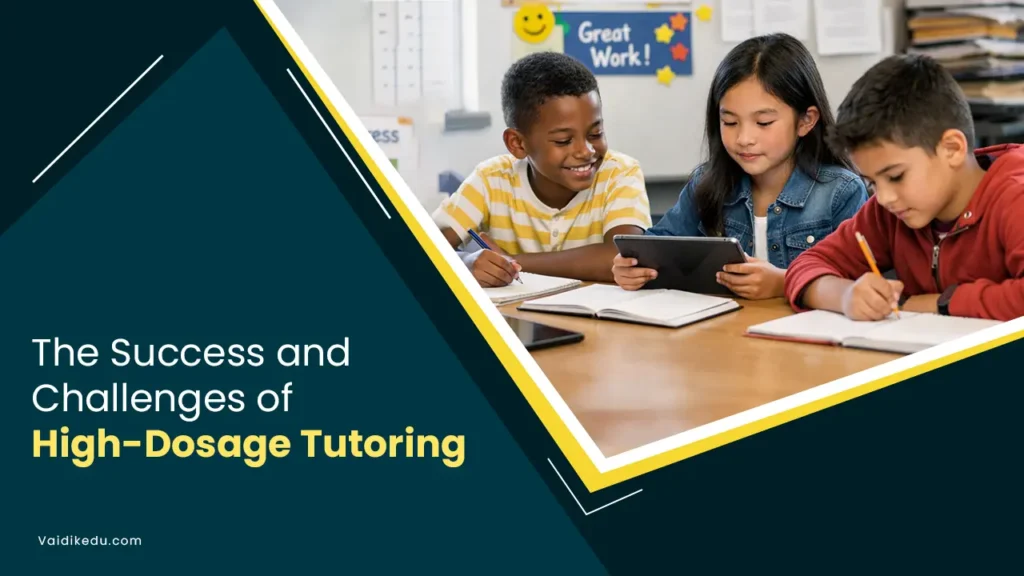
At its core, high-dosage tutoring is exactly what it sounds like tutoring that happens often and consistently, not just once in a while. Imagine a student sitting down with a tutor three or more times a week, every week, working on the same subject with the same person. That’s what sets this approach apart.
Unlike traditional tutoring, usually once a week or only during exam season, high-dosage tutoring is built into the routine. It’s part of the student’s schedule, not something squeezed in between sports practice or dinner. The goal isn’t just to help a student finish homework or pass a test, it’s to close learning gaps and build long-term understanding.
Most programs allow one tutor to tutor one or two students at any time. Working in small groups allows the tutor to cater to each learner’s uniqueness. Tutors can examine sticky math problems, re-read paragraphs, or simply take a few extra minutes to explain something, encouraging understanding, without feeling rushed. And that matters!
Another key part? Consistency. High-dosage tutoring works best when the same tutor stays with the same student over time. That relationship creates trust. When students know their tutor cares, they’re more likely to open up, ask questions, and stay motivated even when things get tough.
This kind of tutoring isn’t just extra help, it’s a personalised support system. It’s about meeting students where they are, and walking with them until they feel confident enough to move independently.
The Backbone of Success Why It Works
So, what exactly makes high-dosage tutoring work? Why is it turning heads in schools and communities worldwide?
The answer lies in something surprisingly simple: personal attention.
Even the best teachers face a tough challenge in a regular classroom trying to meet the needs of 25 or 30 students at once. Some kids move ahead quickly, others get stuck, and before long, a few just start slipping through the cracks. It’s not a lack of effort; it’s just the reality of limited time and too many demands.
High-dosage tutoring flips that script. With one-on-one or tiny group sessions, tutors can focus entirely on the student in front of them. They can slow down, revisit old lessons, or take a new approach if something isn’t clicking. There’s no pressure to keep up with the rest of the class. It’s just the tutor, the student, and the goal of fundamental understanding.
And then there’s the trust factor. A relationship is built when students meet with the same tutor regularly, say three or four times a week. That tutor becomes more than just a teacher; they become a coach, a cheerleader, a mentor. That bond can build confidence for a student far more than any textbook could ever do.
It also helps that tutors can give instant feedback. Instead of waiting days to determine if they did something right or wrong, students immediately get clear answers and encouragement, keeping the learning momentum going.
Let’s remember that this practice elevates academic achievement, too.
Students’ overall perspectives towards school considerably change when they feel supported and understood. Supported learners are far more engaged and motivated and more likely to take risks, even when the work is challenging.
In the end, it’s not about fancy programs or complicated strategies. It’s about showing up, paying attention, and ensuring no student feels invisible. That’s the real magic behind why high-dosage tutoring works.
The Flip Side Real-World Challenges
As promising as high-dosage tutoring sounds and often is, it’s not without its fair share of challenges. Like most good ideas in education, making it work in the real world is more complicated than it looks on paper.
First, scaling it up is difficult.
Yes, operating a successful tutoring program with a small number of students and a few passionate tutors is simple enough. But what if an entire school system wants to make this happen?
Suddenly, you must find hundreds of qualified tutors, stable schedules, classroom space, and someone to oversee everything. You can’t just see that many people, let alone keep them trained and motivated.
Then there’s the cost. High-dosage tutoring isn’t cheap. You’re talking about paying tutors several hours a week per student, sometimes with added fees for materials, platforms, or transportation.
This kind of investment can feel out of reach for underfunded schools that are already stretched thin. And while some government and nonprofit funding has stepped in, it’s not always consistent or long-term.
Another challenge is equity. Ironically, the students who could benefit the most from tutoring those in rural areas, low-income neighbourhoods, or overcrowded schools are often the least likely to access it. There’s a real risk that, without thoughtful planning, high-dosage tutoring could widen gaps instead of closing them.
We can not overlook the fact that it is also the students themselves. Not every kid will be thrilled about extra lessons, especially if they struggle at school. In its own right, keeping students engaged and coming to lessons regularly is work. If the student-tutor bond isn’t strong, or the sessions are cancelled, the whole system can be unhinged!
Even things like time and scheduling become hurdles. Schools need to find space in the day for tutoring sessions without cutting into other subjects or lunch breaks. That’s not always easy, especially in schools already on tight timetables.
This isn’t to say that high-dosage tutoring isn’t worth the effort, because it is. But it’s essential to go into it with eyes open. The impact can be powerful, but it takes planning, resources, and persistence to work on a large scale.
Tech To The Rescue? Maybe.
In today’s world, whenever a problem pops up especially in education, technology is usually right around the corner, promising to fix it. And with high-dose tutoring, it’s no different. As schools struggle to meet demand with limited tutors and shrinking budgets, a new question has surfaced: Can technology step in and make this work on a larger scale?
To some extent, it already has. Virtual tutoring platforms have enabled students to connect with tutors from anywhere, sometimes late at night when they’re stuck on homework.
AI-powered tools are popping up too, offering instant explanations, personalised quizzes, and even chatbots that can walk students through challenging math problems. This feels like a lifeline for schools in remote areas or places where it’s hard to find qualified tutors.
But here’s the catch: technology can help, but doesn’t fully replace the human element.
A tutor isn’t just there to explain things; they read students’ expressions, notice when attention starts to drift, and adjust their tone or approach on the fly. They laugh with the student, celebrate small wins, and offer encouragement when things get frustrating. That kind of connection doesn’t come from an algorithm.
There’s also the issue of access. Not every student has a quiet place to learn at home, a stable internet connection, or even a device. For tech-driven tutoring to be fair and practical, these basic needs must be met first, and that’s not always the case.
That said, when used thoughtfully, technology can be a powerful partner. It can make tutoring more flexible, cut down on costs, and even support tutors with helpful tools. The key is to see it not as a replacement, but as a support system, a way to enhance human teaching, not eliminate it.
So, can tech come to the rescue? Maybe. But only if we remember that at the heart of any good learning experience is a relationship between a student who’s trying and an adult who believes they can.
What Does The Future Look Like
Looking ahead, it’s clear that high-dose tutoring is more than just a temporary fix; it’s a sign that education is slowly shifting toward something more personalized, compassionate, and effective. But where it goes from here will depend on how willing we are to invest not just money but time, effort, and care.
In an ideal world, every student who needs help would have access to a dedicated tutor who sticks with them, understands their struggles, and helps them grow at their own pace. We’re not there yet, but closer than a few years ago.
Schools are starting to see the value of targeted support. Communities are stepping up. Even government policies are catching on.
Nevertheless, running pilots and collecting data will not be sufficient if we want this model to make more than superficial changes. Real change requires long-term strategies to prioritise tutoring as part of the educational process, not just an add-on for struggling students.
This includes sustainably funding tutoring programs, training tutors, finding better uses for technology, and ensuring we get tutoring to those who need it most.
There is also optimism about reconsidering what success looks like in education. In high-dose tutoring, we don’t expect all students to learn the same way; it is okay for there to be a difference because learning is an individual process.
Learning is messy, inconsistent and does not exist in a tidy little box. Just that shift in perspective can influence how schools look for years to come.
Of course, there are still plenty of hurdles, access, logistics, equity, burnout but the progress so far is promising. And if we continue to listen to what students need and build around that, the future could be brighter than we think.
Conclusion:
No teaching method is perfect, and high-dose tutoring is no exception. It will not close all learning gaps or fix all system flaws in the flash of an instant. But it offers something irresistible hope addressed by action.
It reminds us that learning does not need to happen quickly or in the limelight.
Sometimes, a student needs someone who will consistently sit beside them, explain things slowly, and believe in them when they don’t believe in themselves. That kind of support not only raises results on assessments but also builds confidence, resilience, and a deeper relationship with the act of learning.
Indeed, we cannot pretend there are no practical concerns: money, staffing, logistics, and access. However, high-dosage tutoring demonstrates how much we can achieve together, not by delaying action until a perfect solution is identified but by taking the first step by supporting one student at a time with fidelity and high quality.
Frequently Asked Questions
High-dosage tutoring means providing students with frequent, personalised tutoring sessions usually several times a week to help them catch up or deepen their understanding in subjects like math or reading.
While many students gain from extra support, those struggling academically or from underserved communities tend to see the most significant improvements with high-dosage tutoring.
Because it offers personal attention, instant feedback, and tailored pacing, high-dosage tutoring addresses individual student needs more effectively than a busy classroom setting.
Some key challenges include the cost of hiring enough qualified tutors, scheduling sessions within school days, maintaining student engagement, and ensuring equitable access across different communities.
Typically, students meet with tutors 3 to 5 times weekly, each lasting 30 to 60 minutes, depending on the program.
The future looks promising with growing awareness, better funding strategies, and the intelligent integration of technology, but success will depend on continued commitment to equity and personalised support.