

Curriculum development in school education is a dynamic, multi-stage process that includes analysis, design, implementation, and evaluation, which define what and how students learn, aiming to enhance conceptual understanding, skill acquisition, and holistic development to meet societal demands.
What is taught, how it is taught, and assessment strategies all come under the role of curriculum development.
It serves as a blueprint for educators to deliver consistent, relevant, and engaging learning experiences that focus on student-centred and integrated approaches. Thus, with curriculum development, it means that “If you fail to plan, then you plan to fail”.
What is Curriculum Development?
Curriculum development is the systematic process of designing, implementing, and evaluating educational programs to improve student learning experiences. It involves assessing needs, defining goals, selecting content, and organising activities to ensure a balanced approach to knowledge and skills.
Key stages of curriculum development are evaluation, analysis, design, and implementation for the pedagogical practices and assessments designed to meet specific educational goals. It means
- Analysis (learner needs), design (setting objectives), implementation, and evaluation.
- It is a continuous or ongoing process of refinement based on the student’s performance and new knowledge. Therefore, it is not a static document.
- It is a holistic framework that goes beyond the academic subjects to include school values, social environment, and the total learning experience.
- It is a strategic plan to translate the educational aims into actionable, structured and learning outcomes.
Curriculum development as per the learners and scientists,
- Newman and Ingram define curriculum development as “an organic process by which learning is offered, accepted and internalised.”
Thus, the foundation of effective teaching and learning lies in a well-crafted curriculum, as it is not just about building lesson plans but also engaging the students based on experience to foster growth and lead to success.
Types of Curriculum Development in Schools
- Written/Official format involves the formal documentation, such as textbooks, syllabi, etc.
- Hidden includes unwritten, implicit lessons in values, behaviours, and social skills.
- Integrated involves Interlinking of the concepts across different subjects for deeper understanding and concept building.
- Student-Centred focuses on learner needs and activity-based learning
How is the curriculum related to the Student?
Learning with playing or activity-based learning is a central component of the curriculum that incorporates strategies to extend the process of learning through play across the full age and grade span of early education. It also relates the student to what they have previously acquired.
A well-designed developmentally and culturally relevant curriculum avoids and counters cultural or individual bias or stereotypes. Think of curriculum as the plan, and the student as the centre of that plan. They are related as
- A good curriculum is framed by focusing on student-centred learning, as it depends on students’ age and level, needs and interests, and learning abilities.
- It guides what students should learn (knowledge), what they should be able to do (skills) and what values they should develop.
- A well-designed curriculum helps students to apply concepts to real-world situations and to understand practical uses.
- A flexible curriculum includes varied teaching methods that support different learning styles and help both slow and advanced learners, such as Communicative Language Teaching (CLT) and Task-Based Learning (TBL).
Curriculum Development and the Impact on Language Acquisition
The way a curriculum is designed determines what, how, and how well learners develop their listening, speaking, reading, and writing skills.
A well-developed curriculum defines Communication skills such as speaking, listening, etc, Literacy skills like reading and writing and cultural understanding.
- A good curriculum follows a sequence and progression, as the curriculum starts with basic vocabulary and simple structures and gradually moves to complex grammar and advanced communication.
- To evaluate a child’s performance, curriculum development includes evaluation methods such as Formative assessments (ongoing) and Summative assessments (final exams).
- To foster the child in the outer world and to provide exposure, modern curricula integrate Language learning apps, Audio-visual tools and interactive platforms.
Therefore, Curriculum development directly impacts language acquisition by shaping how language is taught, practised, and assessed.
Principles of Curriculum Development.
The principles of curriculum development are
Learner-centred – It should match their age, level, and learning styles.
Clear Objectives – Learning goals should be specific, measurable, and achievable.
Flexible – Curriculum should be adaptable to different learners and changing needs, and allow teachers to modify their learning strategies as required.
Integration of different subjects and skills to promote holistic learning.
Balancing the knowledge, values and skills to provide scholastic, physical, and emotional development.
Evaluation and Feedback – Continuous assessment and evaluation are also one of the necessary parts of the curriculum development.
Importance of Curriculum Development
Curriculum development is essential for effective education. It is important in various aspects such as
- Provides Direction in Education – It means it acts as a roadmap for teachers and students and defines what to teach and how to teach.
- Promotes Student Development – By supporting intellectual, emotional, social, and physical growth, it leads to the holistic development of a child.
- Skill development – Encourage skill development such as critical thinking, problem-solving, and communication.
- Adapt to change – Helps to stay updated with the latest Technology, Global trends, and new knowledge.
How is it beneficial in early childhood education?
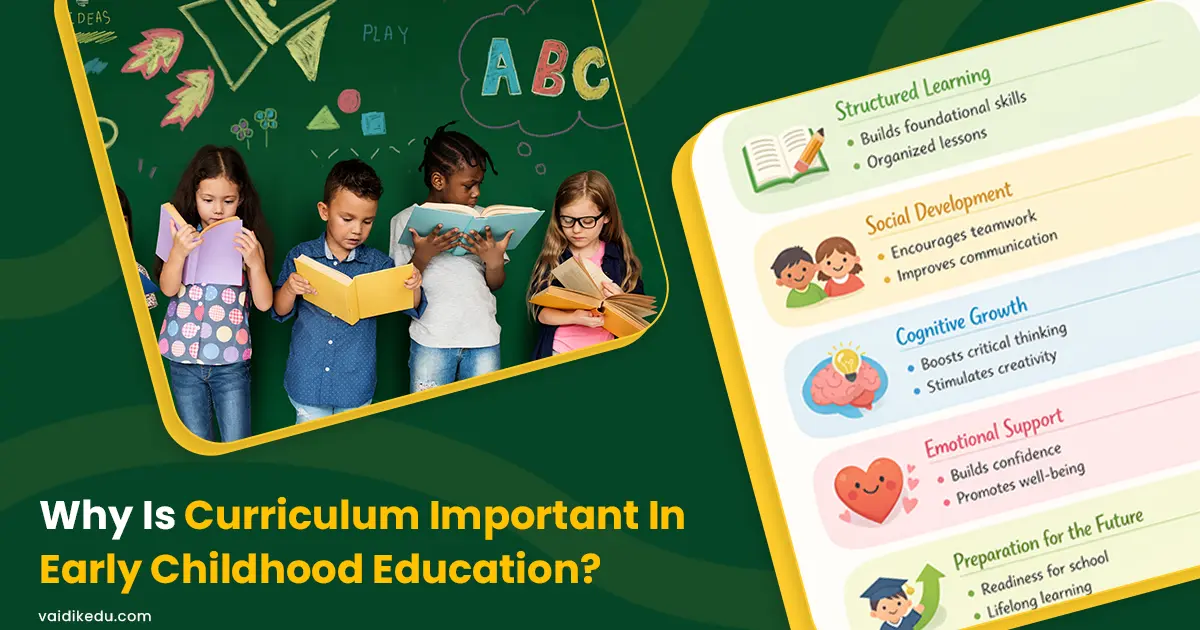
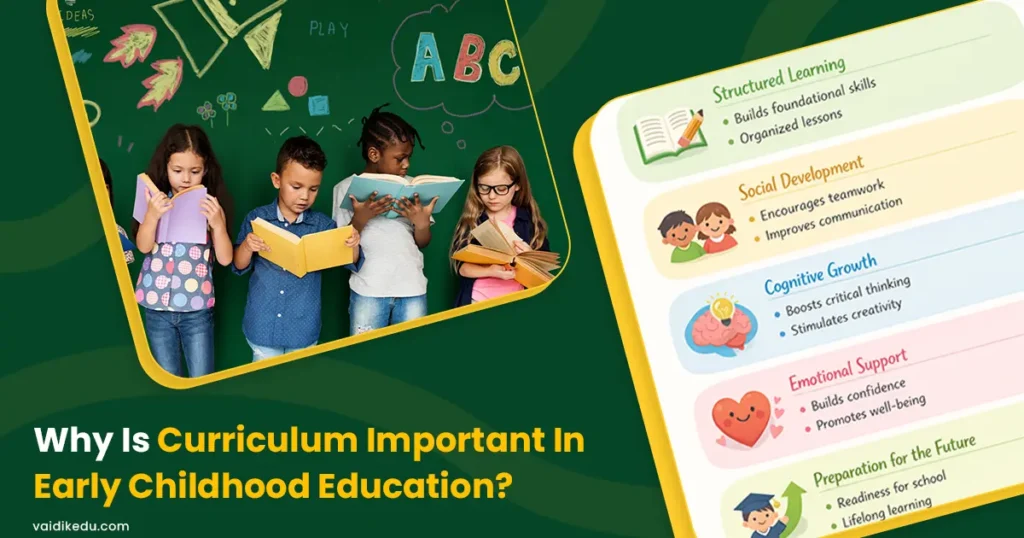
Curriculum development is important in early childhood education because it shapes a child’s first learning experiences and builds the foundation for lifelong learning. Also, it creates a strong, balanced, and enjoyable learning environment that supports a child’s overall growth.
- A well-designed curriculum helps young children grow in all areas, like
- Cognitive skills that provide thinking and understanding,
- Physical skills like motor skills,
- Social and emotional interaction and confidence.
- Builds Strong Learning Foundations in the early childhood curriculum by introducing
- Basic literacy that is knowing letters and sounds,
- Numeracy is numbers and counting.
- Encourage play-based learning as children learn best through play. This include
- Games and Activities
- Storytelling.
- Promote creativity and curiosity – This encourages children to think creatively and ask questions.
- Provides Structure and Routine, a curriculum which helps children to
- Feel secure and comfortable.
- Understand daily routines.
- Prepares for Formal Education like
- Develop discipline.
- Follow instructions.
- Build confidence.
Impact of Curriculum development on a child’s well-being.
A well-designed curriculum supports mental, emotional, social, and physical health in the following ways
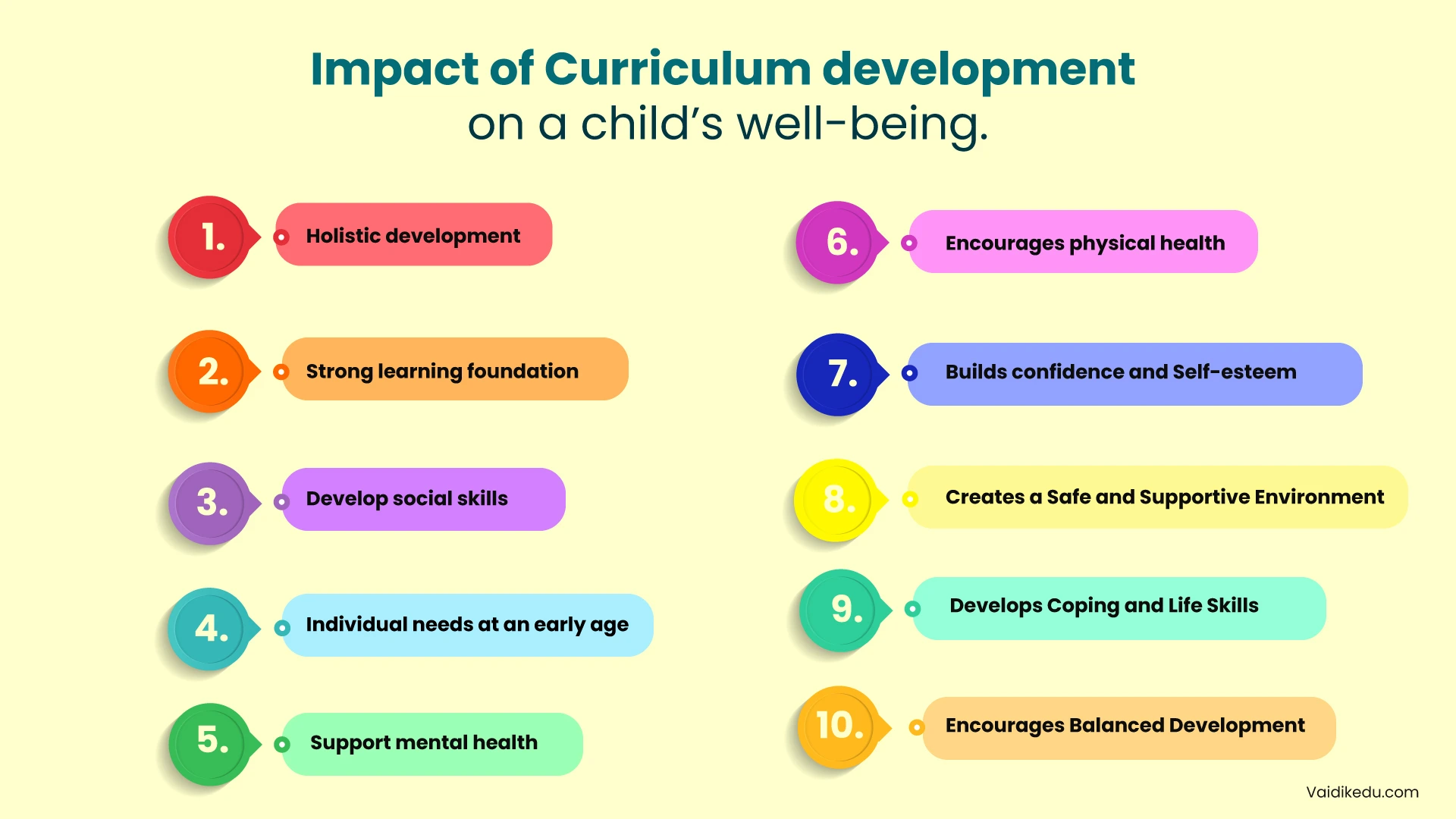
1. Holistic development – In aspects like cognition, physical, social and emotional, the child builds a strong hold on the concepts, personality and abilities. It sets a positive mindset to tackle all the obstacles in the life of an individual. Thus, it ensures balanced development, not just academics.
2. Strong learning foundation – This prepares children for future school learning by knowing basic literacy and numeracy skills.
3. Develop social skills – The social skills, such as sharing, cooperation, and communication, are built up that help them adjust better in school and society. It also helps children to develop healthy relationships.
4. Individual needs at an early age – This helps teachers to notice learning difficulties and to support the learning speeds differently, ensuring early intervention and support.
5. Support mental health – A balanced curriculum avoids excessive academic pressure and encourages enjoyable and meaningful learning, reducing stress and anxiety.
6. Encourages physical health – It promotes playing sports, and movement activities to improve motor skills, fitness and overall physical development.
7. Builds confidence and Self-esteem – Achievement in small tasks gives children a sense of success and positive feedback to boost self-confidence.
8. Creates a Safe and Supportive Environment – A good curriculum promotes Inclusivity and respect for diversity in which the children feel safe, valued, and accepted.
9. Develops Coping and Life Skills – Problem-solving and decision-making activities help children to handle challenges and manage emotions.
10. Encourages Balanced Development – It focuses on both academic learning and personal growth. This balance is essential for overall well-being.