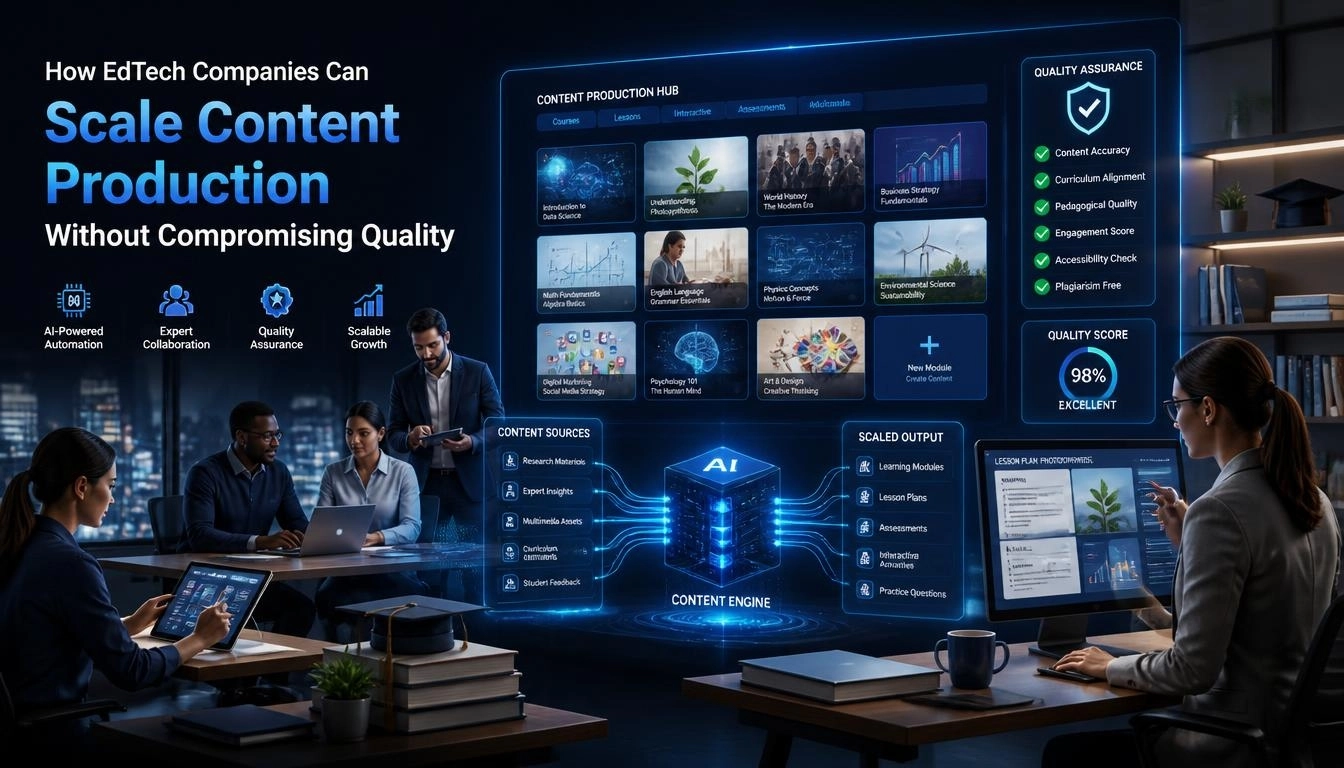



Higher education institutions are continuously evolving to meet the changing expectations of students, educators, and the professional world. Universities and colleges must deliver high-quality academic programs, develop comprehensive learning resources, update course materials, and provide engaging digital learning experiences.
Managing all these responsibilities internally can become challenging, particularly when institutions operate multiple academic departments and offer online, hybrid, and traditional learning programs.
This is where academic content development outsourcing becomes a valuable solution.
By partnering with professional academic content development companies, universities and colleges can access subject matter experts, instructional designers, academic writers, curriculum specialists, and assessment developers without expanding their internal teams for every project.
Professional academic content development outsourcing services help higher education institutions create structured course materials, academic study resources, instructional content, question banks, assessment materials, eLearning modules, and faculty support resources.
For universities looking to expand online education, improve course quality, modernize existing learning materials, or manage large-scale academic content projects, outsourcing provides a flexible and scalable approach.
At Vaidik Eduservices, we support educational institutions, universities, colleges, publishers, and EdTech organizations with customized educational content development, curriculum development, instructional design, and assessment solutions.
What is Academic Content Development Outsourcing?
Academic content development outsourcing is the process of partnering with an external educational content development company to research, design, create, review, and manage academic learning materials for universities and colleges.
Instead of handling every content development activity internally, institutions work with experienced academic writers, subject matter experts (SMEs), instructional designers, and educational specialists.
These professionals develop learning resources according to the institution’s academic requirements, course objectives, subject specifications, learner levels, and delivery formats.
Academic content development outsourcing can cover:
- University course content development
- College curriculum development
- Higher education instructional materials
- Academic textbook and eBook development
- Lecture notes and study materials
- Assessment and question bank development
- Online course content development
- eLearning module development
- Faculty teaching resources
- Academic content editing and proofreading
- Curriculum mapping and alignment
- Digital learning resource development
The primary objective is to help universities and colleges maintain academic quality while managing content production efficiently.
Why Are Universities and Colleges Outsourcing Academic Content Development?
Higher education institutions manage complex academic requirements. Developing content for multiple programs, subjects, departments, and student levels requires specialized expertise and considerable resources.
Outsourcing provides access to additional content development capabilities without requiring institutions to manage every production activity internally.
1. Increasing Demand for Online and Digital Learning
The growth of online degrees, hybrid learning, distance education, and digital learning platforms has increased the demand for well-structured academic content.
Universities need more than traditional lecture notes and textbooks. They require interactive learning modules, digital presentations, recorded lecture scripts, multimedia resources, online assessments, and LMS-compatible course materials.
An academic content development outsourcing partner can help institutions transform traditional educational materials into engaging digital learning resources.
2. Limited Internal Academic Content Development Resources
University faculty members and academic departments already manage teaching, research, student support, academic administration, and curriculum responsibilities.
Creating extensive learning materials alongside these responsibilities can increase workloads.
Outsourcing allows institutions to delegate selected content development activities to specialist teams while faculty members retain control over academic direction, subject requirements, and final approvals.
3. Maintaining Academic Quality and Consistency
Academic content must be accurate, logically structured, relevant, and aligned with course learning objectives.
When multiple departments develop materials independently, maintaining consistent formatting, terminology, assessment standards, and instructional quality can become difficult.
Professional educational content development teams follow structured research, writing, editorial review, subject validation, and quality assurance processes.
4. Scaling Academic Programs More Efficiently
Universities expanding their academic offerings may need to develop content for new courses, qualifications, specializations, and online learning programs.
Building an internal team for every new project may not be practical.
Academic content outsourcing provides access to additional subject expertise and production capacity based on project requirements.
5. Updating Existing Course Materials
Academic subjects, industry practices, research findings, and professional standards continue to evolve.
Universities must periodically review and update their course materials to maintain relevance.
Outsourcing partners can help revise existing content, improve instructional structure, update references, develop new learning activities, and modernize traditional academic resources.
What Academic Content Development Services Can Universities and Colleges Outsource?
Universities can outsource individual content development activities or complete academic content production projects depending on their requirements.
Here are the major academic content development services that higher education institutions can consider.
1. University Course Content Development
University course content development involves creating structured academic materials for undergraduate, postgraduate, and professional degree programs.
Content developers work with course outlines, learning objectives, subject specifications, and academic requirements to produce comprehensive instructional resources.
Deliverables may include:
- Course descriptions and outlines
- Module-wise learning materials
- Lecture notes and reading resources
- Subject-specific study guides
- Learning objectives and outcomes
- Case studies and practical examples
- Academic assignments and activities
- Instructor support materials
Professional course content development helps universities maintain consistency across different subjects and academic programs.
2. Higher Education Curriculum Development
Curriculum development is essential for creating structured academic programs that support institutional learning objectives and student progression.
Universities can outsource curriculum development to specialists who understand instructional frameworks, subject requirements, academic progression, and curriculum mapping.
Higher education curriculum development services may include:
- Undergraduate curriculum design
- Postgraduate curriculum development
- Course structure and module planning
- Learning outcome development
- Curriculum mapping
- Subject sequencing
- Competency-based curriculum design
- Curriculum review and modernization
For institutions planning new academic programs or revising existing courses, professional curriculum development services can support the development of organized and outcome-focused learning frameworks.
3. Academic Instructional Design Services
Instructional design focuses on organizing academic information into effective learning experiences.
Universities increasingly need instructional design expertise to convert traditional academic materials into engaging online and blended learning resources.
Academic instructional design services include:
- Course structure and instructional planning
- Learning objective development
- Instructional storyboarding
- Lesson and module design
- Interactive learning activity development
- Scenario-based learning
- Multimedia learning design
- Student engagement strategies
- Assessment integration
Instructional designers collaborate with subject matter experts to ensure that academic content supports the intended learning outcomes.
Institutions can explore instructional design services to develop structured and engaging learning experiences for different academic programs.
4. Academic Assessment and Question Bank Development
Assessment development is an important component of university course design.
Colleges and universities require reliable assessments to evaluate student understanding, subject knowledge, analytical thinking, and practical application.
Academic assessment outsourcing can help institutions develop:
- Multiple-choice questions (MCQs)
- Short-answer questions
- Long-answer and essay questions
- Case-based assessments
- Scenario-based questions
- Formative assessments
- Summative assessments
- Online examination question banks
- Answer keys and detailed explanations
- Rubrics and marking guidelines
Assessment content should align with course learning objectives, academic standards, subject difficulty, and the intended assessment method.
Universities can leverage assessment development services to support the creation of structured assessment materials and question banks.
5. Textbook and Academic eBook Development
Textbooks and academic eBooks remain important learning resources across higher education programs.
Developing comprehensive academic publications requires subject expertise, structured writing, academic research, editing, and content organization.
Outsourced textbook and eBook development can include:
- University textbook content writing
- Academic eBook development
- Chapter-wise content creation
- Reference and bibliography formatting
- Academic illustrations and diagrams
- Practice questions and exercises
- Case studies and examples
- Instructor manuals
- Student workbooks
- Digital textbook conversion
Professional academic content developers can help institutions and educational publishers create structured, publication-ready learning materials.
6. eLearning Content Development for Universities
Online education requires digital learning materials that are accessible, interactive, and compatible with learning management systems.
Universities can outsource eLearning content development to create digital courses that support online, hybrid, and distance learning programs.
Common eLearning deliverables include:
- Interactive online learning modules
- Video-based learning content
- Lecture scripts and storyboards
- Microlearning resources
- Interactive presentations
- Digital learning activities
- Knowledge checks and quizzes
- Scenario-based learning modules
- SCORM and xAPI-compatible content
These resources can help institutions organize digital learning experiences and deliver course materials through their existing LMS platforms.
7. Academic Content Editing, Proofreading, and Quality Assurance
Academic content quality assurance ensures that educational materials meet the required standards for accuracy, clarity, consistency, and instructional effectiveness.
Universities may outsource content review when preparing new courses, publishing academic resources, or updating existing materials.
Academic content quality assurance may include:
- Subject accuracy verification
- Grammar and language editing
- Academic proofreading
- Reference and citation checks
- Content consistency review
- Curriculum alignment verification
- Assessment validation
- Accessibility review
- Formatting and presentation checks
A structured review process helps identify content gaps and inconsistencies before learning materials are delivered to students.
Explore educational content quality assurance services to understand how professional content review can support academic resource quality.
Which Academic Departments Can Benefit from Content Development Outsourcing?
Academic content outsourcing is not limited to a particular subject or department. Universities and colleges can use external subject matter expertise across different academic disciplines.
1. Science and Technology Departments
Science and technology programs require accurate subject explanations, practical examples, diagrams, laboratory resources, and technical learning materials.
Outsourcing can support:
- Physics course content
- Chemistry learning materials
- Biology study resources
- Computer science course development
- Information technology learning modules
- Engineering study materials
- Laboratory manuals
- Technical assessments
2. Business and Management Departments
Business schools and management departments require practical learning materials that connect academic concepts with real-world business applications.
Potential deliverables include:
- Business administration course materials
- Marketing and management content
- Accounting and finance learning resources
- Human resource management modules
- Entrepreneurship case studies
- Business strategy assessments
- Economics study materials
3. Healthcare and Medical Education
Healthcare and medical education require specialized subject knowledge and careful content validation.
Academic content outsourcing can support:
- Nursing education materials
- Anatomy and physiology content
- Medical terminology resources
- Healthcare case studies
- Clinical learning scenarios
- Public health study materials
- Healthcare assessment development
Highly specialized medical content should undergo appropriate subject-expert and institutional review before publication or instructional use.
4. Humanities and Social Sciences
Humanities and social science programs require well-researched academic resources, critical thinking activities, and analytical assessments.
Content development may include:
- History course materials
- Psychology learning resources
- Sociology study guides
- Political science content
- Literature and language resources
- Research-based assignments
- Critical analysis questions
5. Education and Teacher Training Programs
Universities offering education degrees and teacher preparation programs need structured instructional resources and practical teaching materials.
Outsourcing can support:
- Educational theory content
- Teaching methodology resources
- Lesson planning materials
- Pedagogy-based assessments
- Classroom management case studies
- Teacher training modules
- Educational psychology resources
How Does the Academic Content Development Outsourcing Process Work?
A structured outsourcing process helps universities maintain control over academic requirements, project timelines, and content quality.
A professional academic content development project generally follows these stages.
Step 1: Requirement Analysis and Project Planning
The first stage involves understanding the university’s academic requirements, target learners, subject areas, course structure, and expected deliverables.
The outsourcing partner evaluates:
- Subject and academic level
- Course objectives and learning outcomes
- Existing academic resources
- Curriculum and syllabus requirements
- Content volume and complexity
- Delivery format and timeline
- Review and approval requirements
This stage establishes the project scope and development expectations.
Step 2: Academic Research and Subject Matter Expert Allocation
After understanding the requirements, suitable academic writers and subject matter experts are assigned according to the subject and project complexity.
Subject matter experts contribute their knowledge to ensure that learning materials are relevant, accurate, and appropriate for the intended academic level.
Step 3: Instructional Design and Content Structuring
Before content production begins, the development team creates a content structure based on the course requirements.
This may involve:
- Defining learning objectives
- Organizing course modules
- Structuring chapters and lessons
- Mapping content to learning outcomes
- Planning learning activities
- Identifying assessment requirements
This ensures that academic materials follow a logical learning progression.
Step 4: Academic Content Creation
Academic writers and subject specialists develop the required learning materials.
Depending on the project, this may include lecture notes, course modules, textbook chapters, question banks, case studies, digital learning resources, and instructional materials.
Step 5: Academic Review and Quality Assurance
The developed content undergoes review to identify subject inaccuracies, unclear explanations, inconsistencies, and gaps in learning objectives.
Quality checks may include:
- Subject matter review
- Academic accuracy verification
- Editorial proofreading
- Instructional design review
- Assessment alignment
- Accessibility checks
- Formatting and technical review
Step 6: Final Delivery and Revision Support
After completing quality checks, the content is delivered in the agreed formats.
Depending on institutional requirements, deliverables may include DOCX, PDF, PPTX, digital learning modules, question banks, or LMS-ready packages.
Feedback and revision cycles help ensure that the final materials meet the university’s expectations.
In-House Academic Content Development vs Outsourcing: Which Is Better?
Universities can develop academic content internally, outsource selected activities, or combine both approaches.
The right model depends on institutional resources, academic requirements, project volume, and delivery timelines.
Comparison Factor | In-House Development | Outsourced Development |
Team management | Managed internally | Managed through an external partner |
Subject expertise | Depends on internal availability | Access to additional subject specialists |
Scalability | Depends on internal capacity | Flexible project-based capacity |
Project workload | Shared with existing faculty and staff | Selected tasks delegated externally |
Content production | Managed by internal teams | Supported by specialist teams |
Quality control | Internal review processes | Agreed review and QA processes |
Project flexibility | Depends on available resources | Can scale according to project scope |
Is a Hybrid Content Development Model Better?
For many universities, a hybrid approach can provide a practical balance.
Under this model, faculty members and academic departments retain responsibility for academic direction, subject requirements,
institutional standards, and final approval.
External content development teams support research, content drafting, instructional design, assessment creation, editing, formatting, and digital production.
This arrangement allows universities to retain academic oversight while increasing content development capacity.
Benefits of Choosing a Professional Academic Content Development Outsourcing Company
Selecting an experienced outsourcing partner can help universities manage complex academic content requirements more efficiently.
Access to Subject Matter Experts
Professional content development companies can provide access to specialists across science, technology, business, healthcare, humanities, and other academic disciplines.
Flexible Content Production Capacity
Institutions can outsource individual courses, complete academic programs, or ongoing content production requirements depending on their needs.
Improved Content Consistency
Structured development guidelines and quality assurance procedures help maintain consistent academic terminology, formatting, instructional structure, and assessment standards.
Support for Digital Transformation
Outsourcing partners can assist universities in converting traditional learning materials into interactive digital courses and LMS-compatible resources.
Reduced Internal Production Workload
Delegating selected content development activities allows faculty members and academic staff to focus on teaching, research, student engagement, and academic management.
Support for Multiple Academic Programs
Universities offering different degree programs can access additional subject expertise and content production support without maintaining a separate development team for every project.
How to Choose the Right Academic Content Development Outsourcing Partner?
Selecting the right academic content development company is important because the quality of learning materials directly influences the educational experience.
Before outsourcing, universities should evaluate the following factors.
1. Higher Education Content Development Experience
Choose a partner with experience creating academic resources for colleges, universities, educational publishers, and higher education learning platforms.
2. Subject Matter Expertise
Check whether the company has access to qualified subject matter experts across the required academic disciplines.
3. Instructional Design Capabilities
The partner should understand instructional design principles, learning objectives, course structuring, and student engagement strategies.
4. Academic Quality Assurance Process
Evaluate the company’s approach to subject review, editorial quality checks, plagiarism screening, curriculum alignment, and content validation.
5. Digital Learning and LMS Compatibility
If the university offers online education, check whether the partner can develop interactive learning materials and deliver them in the required technical formats.
6. Data Confidentiality and Intellectual Property
Discuss confidentiality agreements, data security, content ownership, intellectual property rights, and permission to use academic materials before starting the project.
7. Flexible Pricing and Project Scalability
Look for a partner that can support pilot projects, individual course development, large academic content projects, and ongoing production requirements.
Why Choose Vaidik Eduservices for Academic Content Development Outsourcing?
Vaidik Eduservices provides educational content development and academic outsourcing solutions for universities, colleges, educational publishers, schools, and EdTech organizations.
We understand that higher education institutions require more than basic content writing. They need structured academic materials that support course objectives, subject accuracy, instructional effectiveness, and diverse learning requirements.
Our team brings together subject matter experts, academic content developers, instructional designers, and educational specialists to support different stages of academic content production.
Our Academic Content Development Capabilities
We support universities and colleges with:
- University course content development
- Higher education educational content development
- Academic curriculum design and development
- Instructional design and storyboarding
- Textbook and eBook content development
- Academic study materials and lecture notes
- Question bank and assessment development
- eLearning content development
- Digital learning resource creation
- Academic content editing and proofreading
- Educational content quality assurance
Our Approach to Academic Content Projects
Subject-Specific Expertise: We align content development with the subject, academic level, and project requirements.
Customized Content Solutions: We develop learning materials based on institutional requirements rather than relying on generic templates.
Structured Quality Assurance: Our development approach includes subject review, editorial checks, instructional quality evaluation, and agreed project-specific validation.
Flexible Project Support: We support individual content requirements as well as larger educational content development projects.
Digital Learning Readiness: We develop digital learning resources and support delivery in agreed formats for online and blended learning environments.
With experience across educational content development, curriculum development, assessment development, and instructional design, Vaidik Eduservices helps educational organizations manage their learning content requirements.
Partner with Vaidik Eduservices for Academic Content Development
Looking for a reliable academic content development outsourcing company for your university or college?
Whether you need university course content development, academic curriculum design, assessment development, textbook content creation, or digital learning materials, Vaidik Eduservices can support your project requirements.
Frequently Asked Questions
Academic content development outsourcing is the process of hiring an external educational content development company to create, review, organize, and update learning materials for universities, colleges, and other higher education institutions.
Universities outsource academic content development to access subject matter expertise, manage large content projects, support online learning programs, improve content consistency, and reduce the workload associated with internal content production.
Universities can outsource course materials, lecture notes, textbooks, eBooks, curriculum frameworks, question banks, assessments, case studies, eLearning modules, study guides, and faculty teaching resources.
Yes. Academic content can be customized according to the university’s subject requirements, academic level, course objectives, syllabus, learning outcomes, and institutional guidelines.