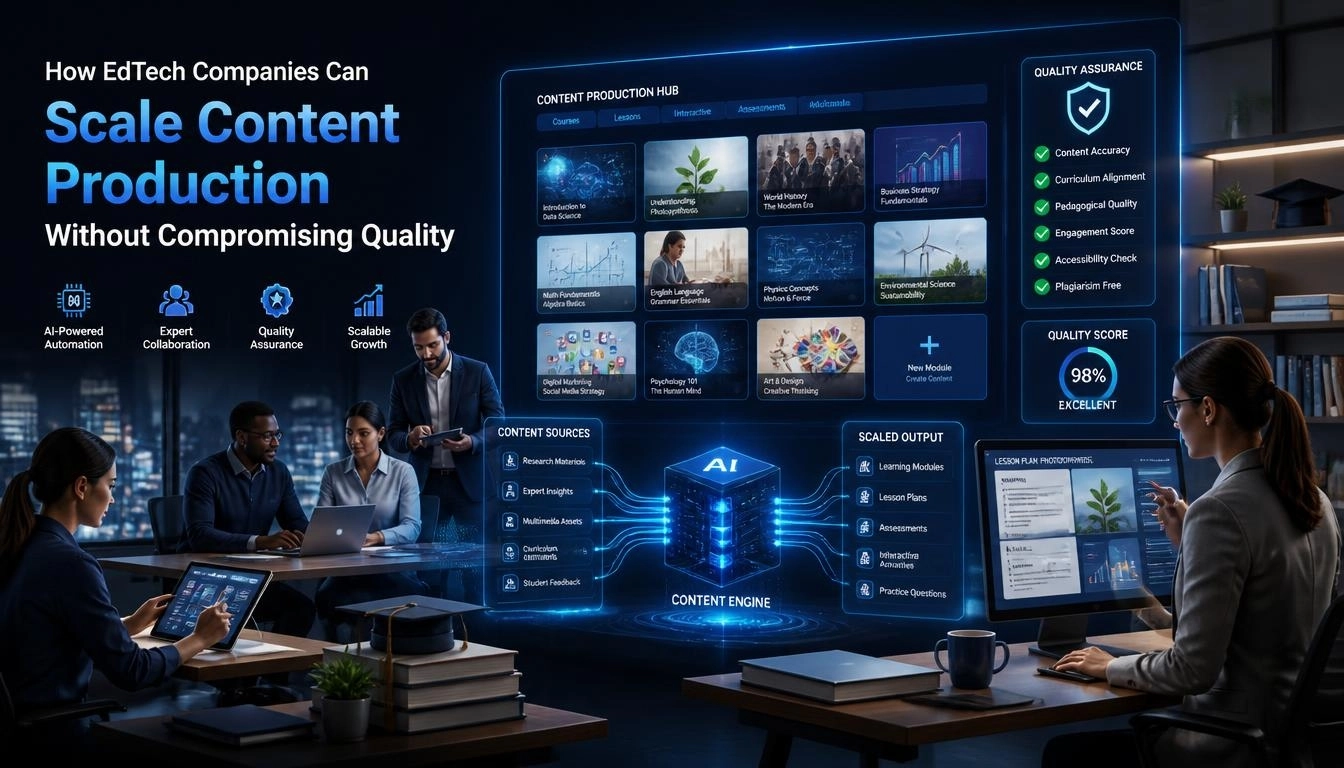



The demand for digital learning resources is transforming how educational publishers, universities, colleges, and online learning platforms create and distribute educational materials.
Traditional textbooks and printed learning resources are increasingly being complemented by digital textbooks, interactive eBooks, and multimedia-rich educational publications that learners can access across computers, tablets, smartphones, and e-readers.
For educational publishers and EdTech companies, developing high-quality digital books involves more than converting a Word document or PDF into an electronic format.
It requires professional content preparation, educational editing, eBook formatting, digital publishing, interactive elements, accessibility considerations, and quality assurance.
This is where professional eBook development services become valuable.
Vaidik Eduservices provides eBook publishing and digital content solutions to help educational institutions, publishing houses, and learning platforms transform their educational materials into professionally formatted digital publications.
From eBook creation and EPUB conversion to formatting, editing, and digital publishing support, organizations can streamline their publishing workflows and deliver better digital learning experiences.
In this guide, we explore the importance of eBook development services, their key components, benefits, formats, and how educational publishers and learning platforms can choose the right eBook development partner.
What Are E-Book Development Services?
E-Book development services involve planning, creating, editing, designing, formatting, converting, and preparing digital books for electronic distribution and consumption.
Unlike basic document conversion, professional eBook development focuses on creating structured, readable, device-compatible digital publications that maintain content accuracy, visual consistency, and a positive reading experience.
For educational organizations, eBook development includes transforming textbooks, academic resources, course materials, student workbooks, study guides, research publications, and instructional materials into digital formats.
Professional eBook development services typically include:
- Educational eBook content development
- eBook editing and proofreading
- Digital textbook development
- eBook formatting and layout design
- EPUB and PDF conversion
- Kindle eBook formatting
- Interactive eBook development
- Educational illustrations and graphic integration
- Digital publishing and content preparation
- eBook quality assurance and testing
By outsourcing these activities, educational publishers and learning platforms can manage large-scale digital publishing projects while maintaining consistent quality.
Why Educational Publishers Need Professional E-Book Development Services
Educational publishers manage extensive content libraries, including textbooks, supplementary learning materials, teacher resources, academic publications, and digital course materials.
Converting these resources into digital formats requires specialized publishing knowledge, technical expertise, and an organized production workflow.
Professional eBook development services help publishers address several challenges.
1. Transforming Traditional Textbooks into Digital Learning Resources
Printed textbooks often contain complex layouts, tables, diagrams, mathematical equations, illustrations, and structured chapters.
Converting these materials into digital publications requires careful formatting to maintain their original educational value.
Professional eBook developers help publishers transform printed textbooks and existing manuscripts into digital textbooks that are easier to access and navigate.
2. Improving Digital Reading Experiences
Learners access educational content through different devices and screen sizes.
A professionally developed eBook should provide:
- Consistent typography and formatting
- Clear chapter and section navigation
- Interactive table of contents
- Clickable internal and external links
- Readable images and illustrations
- Responsive layouts where supported
- Consistent presentation across compatible devices
These features help improve usability and make educational resources more convenient for learners.
3. Supporting Large-Scale Digital Publishing Projects
Educational publishing companies frequently manage multiple titles, subjects, grade levels, and academic programs.
Managing all these projects internally can increase production workloads and operational costs.
Outsourcing eBook development services gives publishers access to additional production capacity for formatting, conversion, editing, and quality assurance without expanding their permanent teams.
4. Expanding Digital Content Distribution
Digital publications allow educational organizations to distribute learning resources through online bookstores, institutional platforms, eLearning portals, and digital libraries.
Preparing content in the required digital formats helps publishers support different distribution channels and reach broader audiences.
Types of E-Book Development Services for Educational Publishers
Different educational publications require different development approaches. A school textbook, university reference book, interactive workbook, and professional training manual may have completely different formatting and functionality requirements.
Here are the major eBook development services educational publishers and learning platforms can outsource.
1. Educational Textbook Development
Educational textbook development involves creating structured digital textbooks that support specific academic subjects, curricula, and learning objectives.
These resources can include:
- K–12 digital textbooks
- Higher education textbooks
- Subject-specific academic books
- Science and mathematics textbooks
- Language learning textbooks
- Teacher guides and student workbooks
- Curriculum-based learning materials
Professional textbook development combines educational content, structured organization, illustrations, examples, and learning activities to create useful academic resources.
Publishers can also integrate textbook development with professional curriculum development services to ensure that learning materials align with academic standards and educational objectives.
2. EPUB Development and Conversion Services
EPUB is an important digital publishing format used across many eBook reading systems.
EPUB development services involve converting manuscripts, documents, and existing publications into structured EPUB files.
Depending on the project requirements, EPUB development can include:
- EPUB formatting and conversion
- Chapter and section structuring
- Navigation and table of contents creation
- Image and illustration integration
- Hyperlink management
- Metadata preparation
- Layout validation
- Cross-device testing
EPUB 3 supports advanced publishing capabilities, including multimedia, structured navigation, and accessibility-related features.
For educational publishers, EPUB development can be particularly useful for textbooks, academic publications, and digital study materials.
3. PDF E-Book Development and Formatting
PDF remains a widely used format for distributing educational documents and fixed-layout publications.
PDF eBook development services involve creating professionally formatted digital documents that preserve the intended page layout.
Typical PDF eBook development requirements include:
- Text formatting and alignment
- Page layout design
- Image and graphic placement
- Interactive hyperlinks
- Bookmarks and navigation
- Tables and diagrams
- Page numbering
- Document optimization
PDF development is useful for educational workbooks, academic reports, training manuals, study guides, and fixed-layout learning materials.
Where accessibility is required, PDF documents should also be properly structured and tagged rather than simply exported from a design application.
4. Kindle E-Book Conversion Services
Educational publishers looking to distribute digital publications through Amazon Kindle may require specialized Kindle formatting and conversion.
Kindle eBook conversion services help prepare manuscripts and existing publications for compatible Kindle reading experiences.
The process may include:
- Manuscript preparation
- Kindle-compatible formatting
- Chapter structuring
- Table of contents creation
- Image optimization
- Typography adjustments
- Hyperlink integration
- Formatting and device checks
Kindle formatting requirements differ from standard EPUB and PDF production, making technical validation an important part of the publishing workflow.
5. Interactive E-Book Development
Interactive eBooks go beyond traditional text and images by incorporating digital elements that encourage learner participation.
For educational publishers and EdTech platforms, interactive eBook development can support more engaging learning experiences.
Interactive eBook features may include:
- Clickable navigation
- Embedded audio and video
- Interactive illustrations
- Hyperlinked references
- Learning activities
- Question-and-answer sections
- Multimedia explanations
- Interactive diagrams
For example, a digital science textbook could include video demonstrations, labelled diagrams, and interactive learning activities to help students understand complex concepts.
Interactive functionality depends on the selected publishing format and reader platform, so compatibility should be considered during development.
6. DTBook and Accessibility-Focused E-Book Conversion
Accessibility is an important consideration in modern educational publishing.
DTBook and DAISY-related workflows support structured digital publications designed for accessibility-focused reading experiences.
Accessibility-focused eBook development may involve:
- Structured document markup
- Logical reading order
- Heading hierarchy
- Alternative text for meaningful images
- Navigation support
- Text-to-speech compatibility
- Accessible document formatting
- Appropriate metadata
Publishers should consider accessibility requirements during content development rather than treating accessibility as a final conversion step.
7. Children’s Storybook and Illustrated E-Book Development
Children’s digital books require a different design approach because visual presentation plays an important role in the reading experience.
Professional illustrated eBook development may include:
- Children’s educational storybooks
- Illustrated learning materials
- Interactive picture books
- Early learning resources
- Alphabet and phonics books
- Digital activity books
- Subject-based illustrated publications
The objective is to combine age-appropriate content, engaging illustrations, readable typography, and suitable digital formatting.
8. Academic and Research E-Book Development
Universities, colleges, research institutions, and academic publishers frequently manage specialized publications.
These may include:
- Academic reference books
- Research publications
- University course materials
- Professional study guides
- Technical publications
- Medical and scientific educational resources
- Digital academic handbooks
Academic eBook development requires careful handling of references, equations, tables, citations, figures, and complex document structures.
E-Book Development Services for EdTech Companies and Online Learning Platforms
Online learning platforms need educational content that can be accessed conveniently and integrated into their digital learning environments.
Digital books can support self-paced learning, supplementary education, exam preparation, professional development, and structured online courses.
Here is how professional eBook development supports different learning platforms.
1. Digital Course Material Development
Learning platforms can convert their existing course content into professionally structured digital learning resources.
Examples include:
- Course eBooks
- Subject-specific learning guides
- Chapter-based study materials
- Online course handbooks
- Downloadable educational resources
- Instructor and student guides
2. Educational Content Integration
Digital books can complement existing online courses by providing additional reading materials, explanations, examples, and practice activities.
Learning platforms can combine eBooks with other educational resources, including:
- Video lessons
- Digital worksheets
- Practice questions
- Interactive assessments
- Lesson plans
- Online tutorials
Organizations looking to develop these resources can also explore educational content development services to create structured and curriculum-aligned learning materials.
3. E-Book Development for LMS Platforms
Learning Management Systems (LMS) provide centralized environments for delivering educational resources.
Digital publications can be prepared for distribution through LMS platforms, subject to the platform’s supported file formats and technical requirements.
Common LMS-related requirements include:
- PDF learning materials
- HTML-based learning content
- EPUB files where supported
- Downloadable course resources
- Structured chapter-based materials
- Accessible digital documents
It is important to distinguish between eBook files and LMS course packages. EPUB or PDF files are not automatically SCORM or xAPI packages. Additional development may be needed when a learning platform requires tracking, reporting, or interactive course functionality.
4. Digital Study Guides and Workbooks
Study guides and workbooks help learners revise concepts, complete exercises, and strengthen subject knowledge.
Educational platforms can develop digital workbooks for:
- Mathematics
- Science
- English language learning
- Computer science
- Business studies
- Professional certification
- Competitive examinations
- University-level subjects
These resources can include explanations, worked examples, practice exercises, diagrams, and answer sections.
5. Professional Training and Corporate Learning eBooks
Corporate training providers can use digital books to distribute employee training materials, professional development resources, and internal learning documentation.
Examples include:
- Employee training manuals
- Compliance training guides
- Technical learning resources
- Professional development handbooks
- Product training materials
- Industry-specific reference books
These publications can complement broader instructional design services to support structured and effective learning experiences.
Key Features of High-Quality Educational E-Books
A professional educational eBook should provide more than attractive visual design. Its structure, formatting, technical compatibility, and educational usability are equally important.
The following features contribute to a high-quality digital publication.
1. Clear Content Structure
A well-organized eBook should contain:
- Title and copyright pages
- Introduction
- Structured chapters
- Consistent headings and subheadings
- Chapter summaries
- References and citations
- Glossary where required
- Index where appropriate
A consistent structure makes educational content easier to understand and navigate.
2. Professional Typography and Layout
Typography directly influences the readability of digital publications.
Important formatting considerations include:
- Readable font selection
- Appropriate font sizes
- Consistent heading styles
- Proper paragraph spacing
- Balanced page layouts
- Appropriate margins
- Consistent image placement
3. Interactive Navigation
Digital publications should help readers move between chapters and sections without unnecessary effort.
Useful navigation features include clickable tables of contents, internal hyperlinks, bookmarks, and linked references.
4. Multimedia Integration
Where supported by the selected format and reading system, multimedia can enhance educational publications.
Examples include:
- Audio explanations
- Instructional videos
- Animated demonstrations
- Interactive diagrams
- Educational illustrations
5. Accessibility Considerations
Accessible eBook development helps make educational resources more usable for learners with different accessibility requirements.
Important considerations include:
- Semantic heading structures
- Alternative text for meaningful images
- Logical reading order
- Keyboard navigation where supported
- Text resizing and reflow
- Accessible tables
- Sufficient text contrast
- Appropriate language and document metadata
Publishers should identify the applicable accessibility requirements and validate the final publication against them.
E-Book Formats: Which One Should Educational Publishers Choose?
Selecting the correct eBook format depends on the type of publication, intended readers, distribution channel, and required functionality.
Here is a comparison of commonly used digital publishing formats.
E-Book Format | Best Use Cases | Key Advantage |
EPUB 3 | Educational books and digital publications | Reflowable content and advanced publishing capabilities |
Workbooks, reports, and fixed-layout books | Preserves page layout | |
Kindle formats | Amazon Kindle publications | Kindle ecosystem compatibility |
HTML5 | Web-based digital learning content | Browser-based accessibility and flexible presentation |
DTBook/DAISY | Accessibility-focused publications | Structured reading and accessibility support |
EPUB vs PDF: Which Is Better for Educational E-Books?
EPUB and PDF serve different publishing requirements.
EPUB is generally suitable for text-heavy digital books that need to adapt to different screen sizes and reading systems.
PDF is useful when preserving the original page design is important, such as in worksheets, illustrated workbooks, and fixed-layout publications.
For educational publishers, the choice should depend on the publication’s content structure, reader requirements, accessibility needs, and distribution platform.
Our E-Book Development and Publishing Workflow
A structured production workflow helps educational publishers maintain consistency, minimize formatting issues, and manage large digital publishing projects.
At Vaidik Eduservices, the eBook publishing process is designed to support different content types and project requirements.
Step 1: Project Consultation and Requirement Analysis
The process begins with understanding the client’s publishing requirements.
This includes:
- Type of educational publication
- Target audience
- Content volume
- Required eBook formats
- Design and formatting preferences
- Distribution requirements
- Project timelines
Step 2: Content Preparation and Editing
The supplied manuscript or educational content is prepared for digital publishing.
This stage may involve:
- Content organization
- Text formatting
- Editing and proofreading
- Heading and chapter structuring
- Reference checking
- Image and illustration preparation
Step 3: E-Book Design and Formatting
The content is formatted according to the selected digital publishing requirements.
This includes typography, layouts, headings, images, tables, hyperlinks, and navigation elements.
Step 4: E-Book Conversion and Development
The prepared publication is converted into the required digital format, such as EPUB, PDF, or Kindle-compatible output.
The conversion process focuses on maintaining content accuracy, formatting consistency, and compatibility with the intended reading environment.
Step 5: Quality Assurance and Validation
Quality assurance helps identify errors before final delivery.
The review process may include:
- Text and formatting verification
- Chapter and navigation checks
- Image and table validation
- Hyperlink testing
- Layout inspection
- Device compatibility checks
- Technical file validation
Step 6: Final Delivery and Revisions
After the required quality checks, the completed eBook files are delivered according to the agreed project specifications.
Additional revisions and updates can be managed based on the project scope and publishing requirements.
Benefits of Outsourcing E-Book Development Services
Developing digital books requires a combination of editorial, educational, design, and technical expertise.
For many educational publishers and learning platforms, outsourcing offers a practical way to increase production capacity.
1. Reduce Internal Publishing Workloads
Outsourcing allows internal teams to focus on publishing strategy, content planning, marketing, and distribution while an external production partner handles agreed development activities.
2. Access Specialized Publishing Expertise
Professional eBook development teams bring experience in digital formatting, content preparation, document conversion, and publishing workflows.
This helps organizations manage technically demanding projects more efficiently.
3. Scale Digital Publishing Operations
Publishers with multiple titles or recurring digital publishing requirements can use outsourcing to support larger production volumes.
4. Improve Formatting Consistency
A standardized workflow helps maintain consistent typography, navigation, layouts, and formatting across multiple publications.
5. Support Multiple Digital Formats
Different distribution channels may require different file formats.
Working with an experienced eBook development partner helps publishers prepare content according to their specific delivery requirements.
6. Focus on Core Business Activities
Outsourcing repetitive production tasks allows educational publishers and EdTech companies to dedicate more resources to content strategy, learner engagement, product development, and business growth.
How to Choose the Right E-Book Development Company
Selecting the right eBook development company is important for maintaining publishing quality and meeting project deadlines.
Before outsourcing, educational publishers should evaluate the following factors.
1. Experience in Educational Publishing
Choose a service provider that understands educational publications, academic content, textbooks, and digital learning materials.
2. Technical Knowledge of E-Book Formats
Check whether the provider understands EPUB, PDF, Kindle-compatible formats, and other required publishing specifications.
3. Content Formatting and Design Capabilities
A reliable eBook development partner should be able to handle structured content, illustrations, tables, diagrams, and complex layouts.
4. Quality Assurance Process
Ask about editorial reviews, formatting checks, technical validation, and revision procedures.
5. Scalability and Project Management
For large publishing projects, evaluate whether the provider can manage multiple titles, recurring work, and agreed delivery schedules.
6. Data Security and Confidentiality
Educational publishers should discuss content ownership, confidentiality agreements, file-sharing procedures, and secure handling of unpublished manuscripts.
7. Customization and Communication
Choose a partner that can follow your publishing guidelines, branding requirements, preferred formats, and review processes.
Why Choose Vaidik Eduservices for E-Book Development Services?
Educational publishers, universities, colleges, and EdTech companies need dependable publishing partners who understand both educational content and digital production requirements.
Vaidik Eduservices provides eBook publishing and educational content solutions designed to support organizations developing and distributing digital learning resources.
Our services support different publishing requirements, including:
End-to-End E-Book Publishing Support
From content preparation and editing to formatting and digital publishing, we support multiple stages of the eBook production process.
Multiple E-Book Conversion Solutions
Our e-publishing services include EPUB conversion, PDF formatting, Kindle/MobiPocket conversion, DTBook conversion, and other publishing-related solutions.
Educational Content Expertise
We understand the requirements of educational textbooks, academic resources, student learning materials, and professional training publications.
Customized Publishing Requirements
Every publishing project has different technical and educational requirements. Our solutions can be structured around your content type, preferred formats, design specifications, and delivery expectations.
Quality-Focused Production
We emphasize content accuracy, formatting consistency, technical checks, and structured project reviews.
Support for Publishers and Learning Platforms
We work with educational publishers, EdTech companies, academic institutions, and organizations that need scalable educational content and publishing support.
Whether you need to convert existing textbooks into digital formats, develop educational eBooks, or manage recurring eBook production requirements, Vaidik Eduservices can support your publishing objectives.
Explore our E-Book Publishing Services to discuss your digital publishing requirements.
Conclusion
Digital publishing is becoming an essential part of modern education. Educational publishers, universities, colleges, and EdTech companies need well-structured digital publications that deliver consistent reading experiences across different devices and platforms.
Professional eBook development services help organizations transform traditional educational materials into digital textbooks, academic publications, interactive learning resources, and professionally formatted eBooks.
From EPUB development and PDF formatting to Kindle conversion, educational textbook development, and accessibility-focused publishing, selecting the right development partner can simplify digital publishing operations.
Vaidik Eduservices helps educational publishers and learning platforms develop and prepare high-quality digital learning resources through customized eBook publishing and educational content solutions.
Looking to outsource eBook development or convert your existing educational publications into digital formats?
Contact Vaidik Eduservices to discuss your eBook development requirements.
Frequently Asked Questions
EBook development services include creating, editing, formatting, designing, converting, and preparing digital books for electronic distribution. These services help educational publishers, universities, and learning platforms transform manuscripts and educational materials into professional digital publications.
Educational eBook development can cover K–12 textbooks, university textbooks, academic reference books, digital workbooks, children’s storybooks, subject-specific study guides, teacher resources, training manuals, and interactive learning publications.
EBook development involves the broader process of creating and preparing digital publications, including content preparation, editing, design, formatting, and conversion.
Yes. Depending on the selected format and reading platform, educational eBooks can include hyperlinks, multimedia, interactive diagrams, audio, video, and other learning elements.
Yes. Educational eBooks can be prepared as supplementary learning resources for online learning platforms, subject to the platform’s supported formats and technical requirements. They can complement video lessons, digital assessments, and structured online courses.