

The global education industry is becoming increasingly digital, and EdTech companies are under constant pressure to develop more educational content, expand their course libraries, and deliver personalized learning experiences.
From online tutoring platforms and digital learning applications to K–12 educational publishers and corporate learning providers, businesses need a continuous supply of high-quality educational content to remain competitive.
However, scaling content production is not simply about creating more lessons, videos, assessments, or online courses. It requires a structured approach that balances content quality, instructional effectiveness, production speed, consistency, and development costs.
Many EdTech companies struggle when their content requirements grow faster than their internal production capabilities. Limited subject matter expertise, inconsistent content quality, lengthy development cycles, and increasing operational costs can slow down expansion.
So, how can EdTech companies increase content production without compromising learning outcomes?
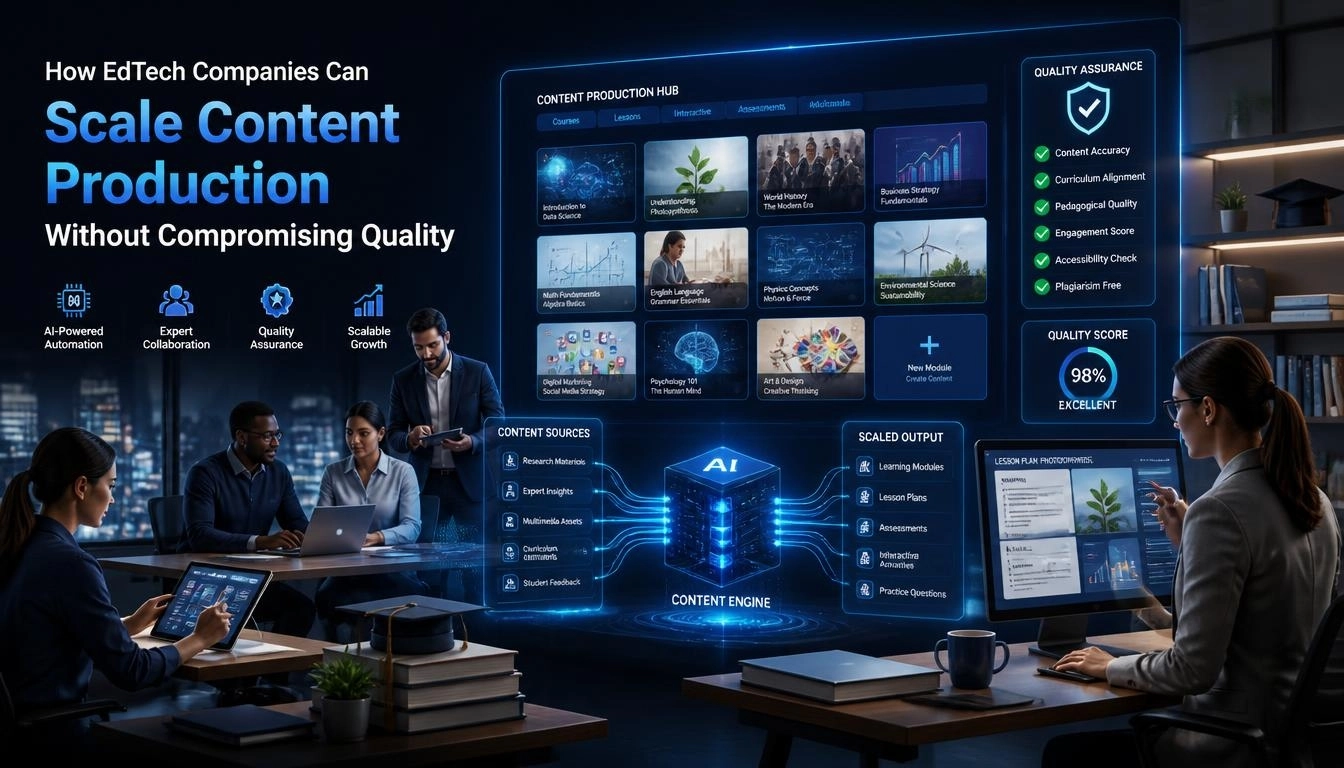
The answer lies in building scalable content development workflows, adopting appropriate technologies, standardizing production processes, and leveraging specialized educational content development partners.
In this guide, we explore practical strategies that help EdTech companies scale educational content production efficiently while maintaining quality and consistency.
Why Scaling Content Production Is Important for EdTech Companies
Educational content is the foundation of every digital learning experience. Whether a platform provides school-level education, professional training, test preparation, or higher education courses, its success depends heavily on the relevance and quality of its learning materials.
As an EdTech business grows, its content requirements become more complex.
For example, an online learning platform may initially offer mathematics and science courses for a few grade levels. As the business expands, it may need to introduce additional subjects, curricula, languages, learning formats, and assessment materials.
This creates several production challenges.
Key reasons EdTech companies need scalable content production include:
- Expanding course libraries: Businesses need to develop more courses, lessons, worksheets, and assessments to meet growing learner demand.
- Entering new markets: International expansion requires curriculum-aligned content that reflects different educational standards and learning requirements.
- Supporting multiple learning formats: Modern platforms need interactive lessons, videos, digital textbooks, quizzes, presentations, and assessments.
- Improving learner engagement: Updated and engaging educational resources help platforms deliver more effective learning experiences.
- Reducing development time: Efficient workflows allow companies to launch new courses and learning products faster.
- Maintaining competitiveness: A regularly updated content library helps EdTech platforms respond to changing educational requirements.
Scaling content production allows businesses to increase their educational offerings without proportionally increasing their internal operational workload.
1. Develop a Scalable Content Production Strategy
Before increasing production volume, EdTech companies need a clearly defined content development strategy.
Without proper planning, increasing content production can lead to duplicated work, inconsistent formatting, missed deadlines, and quality issues.
A scalable strategy begins with identifying what content needs to be developed, who will use it, and how it will be delivered.
Identify Content Requirements
Start by evaluating the existing content library and identifying gaps.
Consider the following questions:
- Which subjects or courses need additional learning materials?
- Which grade levels or educational programs require new content?
- Are existing courses aligned with current curriculum standards?
- Do learners need more assessments, practice exercises, or interactive resources?
- Which content formats are most suitable for the platform?
For example, an EdTech company offering K–12 mathematics courses may need additional video lessons, topic-wise worksheets, practice questions, and chapter assessments.
Identifying these requirements helps teams prioritize production based on business goals and learner needs.
Create a Content Development Roadmap
A content roadmap establishes clear production priorities and timelines.
It should include:
- Content categories and subjects
- Target learner groups
- Learning objectives
- Content formats
- Development responsibilities
- Review and approval stages
- Delivery deadlines
A structured roadmap helps teams manage large-scale content requirements while ensuring that production activities remain aligned with business objectives.
2. Standardize Content Development Workflows
One of the biggest obstacles to scaling educational content production is the absence of standardized processes.
When different writers, instructional designers, subject matter experts, and developers follow different approaches, the final learning materials can become inconsistent.
Standardization creates a repeatable production system that supports higher content volumes.
Build Standard Content Templates
Create reusable templates for different educational materials, including:
- Lesson plans
- Digital textbooks
- Worksheets
- Question banks
- Assessment papers
- Video scripts
- Presentation slides
- Interactive learning modules
Templates should define formatting guidelines, learning objectives, content structure, terminology, and assessment requirements.
Establish a Defined Production Workflow
A typical educational content development workflow can include the following stages:
Step 1: Requirement Analysis
Understand the target audience, curriculum requirements, learning objectives, and expected deliverables.
Step 2: Content Planning
Develop outlines, learning sequences, lesson structures, and assessment plans.
Step 3: Content Creation
Subject matter experts and content developers create educational materials based on approved specifications.
Step 4: Instructional Desig
Organize content into meaningful learning experiences using appropriate instructional strategies.
Step 5: Quality Assurance
Review factual accuracy, grammar, instructional alignment, formatting, and technical functionality.
Step 6: Final Delivery
Prepare approved content for integration into the learning management system (LMS), website, or educational application.
A standardized workflow reduces unnecessary revisions and makes it easier to manage multiple projects simultaneously.
3. Use Technology and Automation to Increase Production Efficiency
Technology plays an important role in modern educational content production.
EdTech companies can use digital tools and automation to reduce repetitive work, improve collaboration, and accelerate content development.
However, technology should support the content development process rather than replace educational expertise and quality control.
Use AI-Assisted Content Development
Artificial intelligence can support several stages of educational content production.
For example, AI-powered tools can help teams:
- Generate initial lesson outlines.
- Create draft explanations for educational topics.
- Suggest practice questions.
- Develop alternative examples.
- Summarize lengthy educational resources.
- Assist with content categorization.
- Identify potential grammar and consistency issues.
However, AI-generated educational content must be reviewed by qualified subject matter experts.
Incorrect explanations, outdated information, ambiguous questions, and curriculum misalignment can negatively affect learning outcomes.
Human review remains essential for validating educational accuracy and instructional quality.
Implement Content Management Systems
A centralized content management system helps teams organize and manage educational resources.
It can support:
- Content version control
- Collaboration between teams
- Asset management
- Approval workflows
- Content reuse
- Project tracking
- Publishing coordination
A well-organized content management system makes it easier to manage growing content libraries without losing track of updates or revisions.
4. Adopt a Modular Content Development Approach
Modular content development is one of the most effective ways to scale educational content production.
Instead of creating every course or learning resource from scratch, companies can divide educational materials into smaller, reusable components.
These components can be combined or adapted to create different learning experiences.
For example, a mathematics course may include:
- Concept explanations
- Worked examples
- Practice exercises
- Video lessons
- Knowledge checks
- Chapter assessments
These individual components can be reused across different courses, grade levels, or learning programs when the learning objectives and curriculum requirements align.
Benefits of Modular Content Development
Greater content reusability: Existing educational resources can be adapted for multiple courses and learning programs.
Faster development: Teams do not need to recreate every component for new projects.
Simplified updates: Individual content modules can be updated without rebuilding entire courses.
Better consistency: Standardized modules help maintain formatting and instructional quality.
Easier customization: Learning materials can be adapted for different audiences, subjects, and educational requirements.
Modular content development is particularly valuable for EdTech platforms operating across multiple subjects, curricula, and geographical markets.
5. Expand Content Production Through Educational Content Outsourcing
Building a large internal content development team can be expensive and time-consuming.
EdTech companies may need specialists in instructional design, curriculum development, subject matter expertise, assessment creation, graphic design, and multimedia production.
Recruiting and managing all these resources internally can increase operational complexity.
Educational content outsourcing provides an alternative.
By partnering with specialized educational content development providers, EdTech companies can access experienced professionals and expand production capacity according to project requirements.
What Can EdTech Companies Outsource?
Organizations can outsource several educational content development activities.
Curriculum Development
Develop structured curricula aligned with educational standards, learning objectives, and target learner requirements.
Instructional Design
Transform subject matter into structured, engaging, and instructionally effective learning experiences.
Educational Content Development
Create textbooks, digital lessons, worksheets, study materials, presentations, and learning resources.
Assessment Development
Develop quizzes, question banks, examinations, practice tests, and other evaluation materials.
E-learning Development
Convert instructional content into digital learning modules using suitable authoring tools and standards.
Educational Content Quality Assurance
Review educational materials for accuracy, consistency, instructional alignment, grammar, and usability.
Benefits of Outsourcing Educational Content Production
- Access to specialized educational expertise.
- Flexible production capacity.
- Reduced recruitment and training requirements.
- Better management of large content development projects.
- Ability to support multiple subjects and educational programs.
- More time to focus on platform development, customer acquisition, and business growth.
Outsourcing is particularly useful when content requirements fluctuate or when a business needs to launch multiple courses within a limited timeframe.
6. Build a Strong Quality Assurance Framework
Increasing content volume without an effective quality assurance process can damage the credibility of an EdTech platform.
Educational content must be accurate, understandable, relevant, and aligned with the intended learning outcomes.
A structured quality assurance framework ensures that increasing production volume does not reduce content standards.
Establish Content Quality Checklists
Every educational resource should pass defined quality checks before publication.
A comprehensive checklist should cover:
Subject Accuracy
- Are explanations factually correct?
- Are examples relevant to the topic?
- Are calculations and answers accurate?
- Are sources reliable where required?
Instructional Quality
- Are learning objectives clearly defined?
- Is the content organized logically?
- Is the difficulty level appropriate?
- Does the material support the intended learning outcomes?
Language and Presentation
- Is the language clear and understandable?
- Is grammar and punctuation correct?
- Is terminology consistent?
- Is formatting uniform?
Technical Quality
- Are images and diagrams displayed correctly?
- Do interactive elements function properly?
- Is the content compatible with the intended LMS?
- Does the content meet applicable accessibility requirements?
Introduce Multiple Review Stages
For large content projects, a single review stage may not be sufficient.
Consider implementing separate reviews for subject accuracy, instructional quality, editorial consistency, and technical functionality.
This approach helps identify problems before content reaches learners.
7. Develop Curriculum-Specific and Market-Specific Content
EdTech companies expanding internationally need educational materials that reflect the requirements of different markets.
A lesson designed for one curriculum may not be directly suitable for another.
For example, educational programs in the United States, United Kingdom, Australia, and other countries may differ in learning objectives, grade structures, terminology, assessment methods, and subject coverage.
Scaling content production across multiple markets requires curriculum-specific development and adaptation.
Understand Local Educational Standards
Before developing content for a new market, identify:
- Applicable curriculum frameworks.
- Grade-level expectations.
- Subject-specific learning outcomes.
- Assessment requirements.
- Regional terminology.
- Language and accessibility needs.
Localize Existing Learning Materials
Content localization involves more than translating educational resources.
It may require adapting examples, measurements, terminology, references, assessment formats, and instructional approaches to suit the target market.
This enables EdTech companies to expand their content libraries while maintaining relevance for different learner groups.
8. Measure Content Production Performance Using KPIs
Scaling content production requires measurable performance indicators.
Without tracking production efficiency and quality, companies may increase the number of deliverables without understanding whether their processes are improving.
EdTech companies should monitor both production-related and educational quality metrics.
KPI | What It Measures |
Content production volume | Number of lessons, courses, assessments, or resources completed |
Production turnaround time | Time required to complete content development |
First-pass approval rate | Percentage of content approved without major revisions |
Revision rate | Amount of content requiring corrections |
Cost per content unit | Average production cost per lesson, question, or module |
On-time delivery rate | Percentage of deliverables completed within deadlines |
Content reuse rate | Percentage of resources reused or adapted across projects |
Learner engagement | How learners interact with educational materials |
These metrics help organizations identify bottlenecks, improve workflows, and make informed decisions about production capacity.
9. Create a Flexible Content Development Team
A scalable content production model requires the right combination of expertise.
Depending on project requirements, an EdTech content development team may include:
- Subject matter experts
- Educational content writers
- Curriculum developers
- Instructional designers
- Assessment specialists
- Graphic designers
- E-learning developers
- Content editors
- Quality assurance professionals
Instead of relying entirely on a fixed internal team, companies can combine in-house specialists with external development partners.
This flexible model allows organizations to increase or decrease production capacity according to demand.
It also helps businesses access specialized expertise without maintaining every skill set internally.
10. Choose the Right Educational Content Development Partner
Selecting an experienced content development partner can significantly influence the success of a scaling strategy.
However, not every provider has the subject expertise, instructional design capabilities, quality assurance processes, or production infrastructure required for large educational projects.
Before selecting a partner, evaluate the following factors.
Subject Matter Expertise
Does the provider have experience developing educational content across your required subjects, grade levels, and educational programs?
Instructional Design Capabilities
Can the provider create structured learning experiences rather than simply producing written educational material?
Quality Assurance Processes
Does the organization follow documented review procedures to ensure accuracy, consistency, and instructional effectiveness?
Scalability
Can the provider manage increasing content volumes and multiple projects without compromising delivery timelines?
Technology Compatibility
Can the content be delivered in formats compatible with your LMS, learning platform, and required e-learning standards?
Communication and Project Management
Does the provider offer clear communication, progress tracking, defined responsibilities, and transparent delivery processes?
Choosing the right partner helps EdTech companies establish a more predictable and sustainable content production model.
Common Challenges in Scaling EdTech Content Production
Even with the right strategy, increasing content production can introduce operational challenges.
Understanding these challenges helps businesses prepare effective solutions.
Challenge | Recommended Solution |
Inconsistent content quality | Introduce standardized templates and quality checklists |
Limited subject matter expertise | Work with qualified subject specialists |
Increasing production costs | Adopt reusable content modules and flexible outsourcing |
Lengthy development cycles | Standardize workflows and automate repetitive tasks |
Curriculum differences | Develop market-specific content guidelines |
Frequent content revisions | Improve requirement analysis and review processes |
Team coordination issues | Use centralized project and content management systems |
AI-generated inaccuracies | Implement expert human review and validation |
The objective is not simply to increase the amount of content produced. It is to create a repeatable system that delivers consistent, high-quality educational resources at scale.
The Future of Scalable Educational Content Production
The future of EdTech content production will be shaped by artificial intelligence, adaptive learning, modular content architecture, automation, and personalized educational experiences.
As learning platforms expand, they will increasingly need content that can be updated, customized, reused, and delivered across multiple devices and learning environments.
Several developments are likely to influence the next generation of educational content production.
AI-assisted development: AI will support content research, drafting, question generation, and production workflows, with human experts responsible for validation.
Personalized learning resources: Educational platforms will increasingly develop content suited to different learner abilities, preferences, and progress levels.
Interactive learning experiences: Simulations, scenario-based activities, multimedia lessons, and interactive assessments will become important parts of digital education.
Learning analytics: Data from learner interactions will help organizations identify content gaps and improve educational resources.
Content interoperability: Reusable and standards-based learning materials will make it easier to distribute content across different platforms and systems.
EdTech companies that invest in scalable content infrastructure will be better positioned to respond to changing learner expectations and business requirements.
How Vaidik EduServices Helps EdTech Companies Scale Content Production
Scaling educational content production requires more than additional writers or faster development tools. It requires a combination of subject expertise, instructional design, standardized workflows, and reliable quality assurance.
Vaidik EduServices helps EdTech companies, educational publishers, schools, and digital learning providers develop and manage educational content at scale.
Our educational content development capabilities support organizations looking to expand their learning libraries, improve content quality, and streamline production workflows.
Our services include:
- Curriculum Development: Structured curriculum creation aligned with learning objectives and educational requirements.
- Instructional Design Services: Designing effective learning experiences for digital education and training programs.
- Educational Content Development: Creating lessons, digital textbooks, worksheets, study materials, and other educational resources.
- Assessment Development: Developing question banks, quizzes, examinations, and practice assessments.
- E-learning Development: Converting instructional content into engaging digital learning experiences.
- Educational Content Quality Assurance: Reviewing learning materials for accuracy, consistency, and instructional quality.
Whether you are launching new courses, expanding into international markets, or managing a growing educational content library, our team can support your content development requirements.
Looking to scale your EdTech content production?
Contact Vaidik EduServices to discuss your educational content development requirements and explore how we can support your next project.
Conclusion
Scaling content production is a critical requirement for EdTech companies looking to expand their educational offerings, enter new markets, and meet increasing learner expectations.
However, sustainable growth depends on more than producing a greater volume of educational materials. Companies need structured workflows, modular content development, appropriate technology, strong quality assurance, and access to specialized educational expertise.
By combining internal capabilities with experienced educational content development partners, EdTech organizations can build a flexible production model that supports long-term growth without compromising educational quality.
Frequently Asked Questions
EdTech companies can scale content production by standardizing development workflows, using reusable content modules, adopting AI-assisted tools, implementing quality assurance systems, and outsourcing specialized educational content development activities.
Scalable content development is an approach that allows educational organizations to increase the volume of learning materials without proportionally increasing production costs, development time, or operational complexity.
EdTech companies outsource content development to access subject matter experts, instructional designers, assessment specialists, and experienced production teams while reducing internal recruitment and operational requirements.
Organizations can outsource curriculum development, instructional design, digital textbooks, worksheets, lesson plans, question banks, assessments, e-learning modules, video scripts, and educational content quality assurance.
Modular content development involves creating smaller, reusable learning components that can be combined or adapted for different courses, subjects, and educational programs. It helps reduce duplication and accelerate content production.