
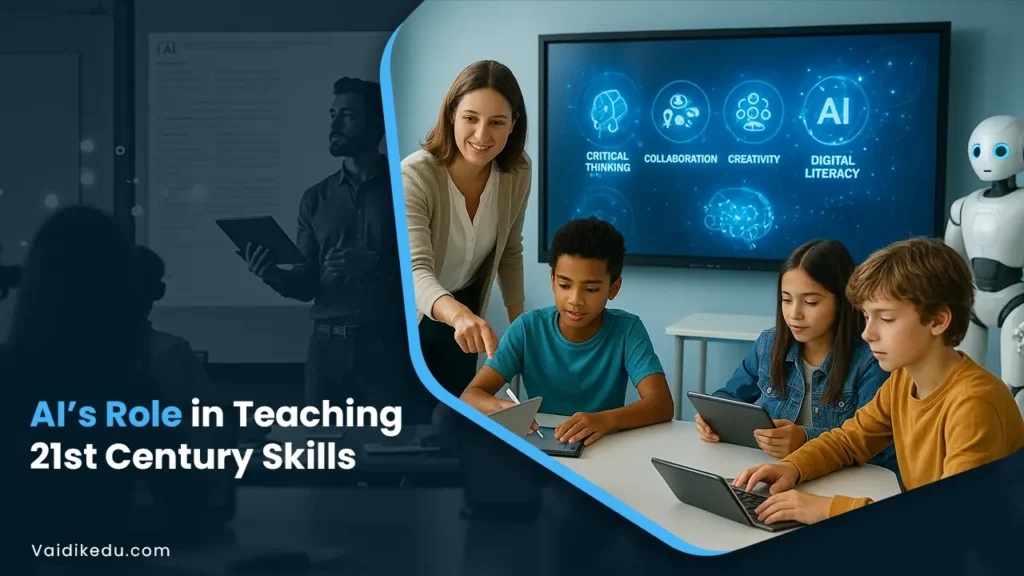
The beginning of the 21st Century has brought massive technological advancement in the development of Artificial Intelligence tools. This new phase of revolution is part of the 5th Industrial Revolution which hovers around the interaction between humans and machines.
Artificial Intelligence can play a vital role in the education/edtech industry as it can completely transform the traditional way of teaching and help in learning new skills.
There are various Artificial Intelligence Tools, that can help in the teaching of 21st-century skills that include:-
- Learning Skills – Self-learning, Decision-making Skills, critical thinking, Creativity, and Collaboration.
- Literacy Skills – Data Literacy, Technology Literacy, Media Literacy.
- Life Skills – Flexibility, Leadership Skills, Productivity, Social Skills.
How AI Supports the Development of 21st-Century Skills
Artificial intelligence is becoming more than a tool for generating answers or automating educational tasks. When used appropriately, AI can help educators create learning experiences that encourage students to analyze information, solve problems, collaborate, experiment with ideas, and develop digital literacy.
21st-century skills generally extend beyond subject knowledge. Students increasingly need competencies such as critical thinking, creativity, communication, collaboration, adaptability, information literacy, technology literacy, and responsible decision-making.
AI can support the development of these competencies through personalized practice, simulations, intelligent feedback, collaborative learning environments, data analysis, content creation, and scenario-based activities.
However, AI does not automatically develop these skills. Its educational value depends on how teachers design activities around the technology. Students should be encouraged to question AI-generated information, explain their reasoning, compare alternatives, verify evidence, and use AI as a learning tool rather than simply accepting generated answers.
Role OF AI Towards 21ST Century Skills
Learning Skills
(a) Self-Learning – One of the most important contributions of AI in teaching is to provide self-learning experiences. Every individual student has a different level of understanding, a different pace of learning, so Artificial Intelligence can be used to suit each individual aspect of learning for students.
For example- Artificial Intelligence can help students in solving a particular subject-related problem involving long calculations and deeper concepts with a certain level of accuracy. It can also create sample problems and analyze the responses given by the students’ thus providing valuable insight.
(b) Decision-making Skills – Artificial Intelligence tools are used by corporations or big business houses to make informative decisions and make future predictions related to their business.
For example – Artificial Intelligence can help in analyzing the quarterly results of the company and use that data to provide information on the segments that are lacking or falling behind thus affecting the overall growth of the company.
(c) Critical Thinking – Artificial Intelligence can help the student by providing simulations of problems thus helping them have deeper insight into real scenarios. This reason-based learning helps in the overall development of the student. AI Tools like Sim City provide problems to solve thus improving critical thinking.
How AI Can Develop Critical Thinking Rather Than Replace It
AI can support critical thinking when students are required to evaluate and improve its responses instead of simply copying them.
For example, an educator can ask students to use an AI system to generate an explanation of a historical event, scientific concept, or social issue and then complete activities such as:
Identify unsupported claims
Find factual inaccuracies
Compare the response with reliable sources
Identify missing perspectives
Explain whether the evidence supports the conclusion
Rewrite the answer using stronger reasoning
Compare two AI-generated viewpoints
Explain which response is more convincing and why
This transforms AI from an answer-generation tool into a resource for analysis and discussion.
Educators can also create scenario-based activities in which students must make decisions using incomplete or conflicting information. AI can generate different scenarios or perspectives, while students remain responsible for evaluating evidence and defending their conclusions.
The learning objective should therefore be the student’s reasoning process, not simply the quality of the AI-generated answer.
(d) Creativity – Today the world is more globalized than ever before. In this rapidly changing world, the creation of new and innovative ideas is the need of the time. Thus, Artificial Intelligence can be used to create uncertain scenarios and models that can be used to study and prepare for real-world complexities.
How AI Can Support Student Creativity
AI can be useful during different stages of the creative process, including brainstorming, exploration, prototyping, and revision.
Students might use AI to:
Generate alternative approaches to a problem
Brainstorm story or project ideas
Explore different design concepts
Create possible scenarios
Produce questions for further investigation
Compare multiple solutions
Receive feedback on early drafts
Experiment with different formats or perspectives
However, creativity should not be reduced to generating content automatically.
Educators can require students to explain why they selected a particular idea, how they modified an AI-generated suggestion, what original decisions they made, and how the final work differs from the initial AI output.
This keeps human judgment, imagination, and decision-making at the center of the creative process.
(e) Collaboration – AI tools can enable students to work together on projects and communicate effectively.
For example, several platforms like Google Workspace and Microsoft Teams utilize AI to foster collaboration by providing AI driven insights, real-time editing, and project management features. Such tools not only streamline group work but also help students develop important skills in cooperation, negotiation, and conflict resolution that are necessary for their career growth.
Using AI in Collaborative Learning Activities
AI can also support collaborative problem-solving when students work together to evaluate information, divide tasks, develop solutions, and communicate their reasoning.
For example, a group project could require students to:
Define a problem together.
Use AI to explore possible solutions.
Evaluate the strengths and weaknesses of each suggestion.
Research evidence independently.
Agree on a final approach.
Present and defend their decision.
In this type of activity, AI provides additional information or perspectives, but collaboration occurs through discussion, negotiation, evaluation, and collective decision-making.
Teachers can also use AI-supported activities to assign students different roles such as researcher, fact-checker, critic, presenter, or project coordinator. This can encourage students to participate more actively in group learning.
Literacy Skills
(a) Data Literacy – The AI tools can help students improve data extraction, which is useful for students doing research and development in various fields.
(b) Technology Literacy – Technology is a key aspect of human lives. It impacts every section of society. Therefore, it becomes more important for students to learn this skill.AI can help students in learning new programming and coding languages thus making students job-ready.
AI Literacy: A New 21st-Century Skill
As artificial intelligence becomes more widely used in education, work, media, and everyday decision-making, students increasingly need to understand how to interact with AI systems responsibly.
AI literacy does not necessarily mean that every student needs to become an AI engineer. Instead, students should learn how AI systems can be used, where they may fail, and how to evaluate AI-generated information critically.
Important AI literacy skills include:
Understanding basic AI capabilities and limitations
Writing clear instructions or prompts
Evaluating AI-generated answers
Identifying inaccurate or misleading information
Checking information against reliable sources
Recognizing potential bias
Understanding privacy considerations
Using AI ethically in academic work
Knowing when human judgment is necessary
For educators, this creates an important shift. Students should not simply learn how to use AI tools; they should learn how to question, evaluate, and responsibly apply the outputs those tools produce.
Teaching AI literacy alongside traditional digital literacy can help students become more responsible and informed users of emerging technologies.
AI tools can be used by students to learn cyber security and how to make use of the internet safe and to protect against any cyber crime and cybertheft.
(c) Media Literacy – There are several AI Tools that can be helpful for students to work on five pillars of media literacy which are to access, analyze, create, reflect, and act.
For example, there are several AI-driven platforms that are used to create presentations, infographics, and videos for online platforms.
AI, Information Literacy, and Fact-Checking
The growth of generative AI makes information literacy increasingly important.
AI systems can produce fluent and convincing responses even when information is incomplete, inaccurate, outdated, or unsupported. Students therefore need to learn that confident language does not automatically mean reliable information.
Educators can use AI-generated content as part of fact-checking activities.
Students can be asked to:
Verify claims using trustworthy sources
Identify whether sources actually support an argument
Compare AI-generated information with textbooks or academic resources
Distinguish facts from opinions
Look for missing context
Identify potentially misleading statements
Check dates, statistics, and quotations
Evaluate the credibility of online sources
These activities help students develop information literacy while also teaching responsible use of AI.
In an environment where students have access to large amounts of generated content, the ability to verify information may become just as important as the ability to find information.
Life Skills
(a) Flexibility – AI tools can be used in business to learn different scenarios to make people more adaptive and to adjust to new circumstances.
(b) Social Skills – It involves effective communication and interpersonal skills. In education, students can take help to prepare for their job interviews.
(c) Productivity – AI Tools like Grammarly can help individuals analyze their writing skills and suggest improvement therefore increasing their productivity.
(d) Leadership Skills – It involves communication skills, motivating team members, emotional intelligence, and problem-solving. AI tools like Speechify are used by individuals to practice their speaking skills, improve their vocabulary, and thus overall development of their leadership skills of which good communication is a prerequisite.
Practical Examples of Using AI to Teach 21st-Century Skills
The educational value of AI becomes clearer when specific tools and activities are connected to defined learning objectives.
Learning Activity | Skill Developed | Possible Use of AI |
Compare multiple solutions to a problem | Critical thinking | Generate alternative approaches |
Check an AI-generated explanation for errors | Information literacy | Create material for fact-checking |
Design a solution to a real-world problem | Creativity | Support brainstorming and prototyping |
Group research project | Collaboration | Organize ideas and explore perspectives |
Analyze a dataset | Data literacy | Assist with patterns and interpretation |
Debate different viewpoints | Communication and reasoning | Generate arguments for evaluation |
Revise a written assignment | Communication | Provide formative feedback |
Scenario-based decision activity | Decision-making | Generate changing situations |
Self-paced practice | Independent learning | Provide adaptive questions or explanations |
Career simulation | Adaptability | Create workplace scenarios |
The important principle is that AI should support the learning activity rather than become the learning objective itself.
For example, asking students to generate an essay with AI may require very little critical thinking. Asking students to evaluate an AI-generated essay for weak arguments, unsupported evidence, bias, and factual errors can require considerably more reasoning.
Teachers should therefore design AI activities around the skill they want students to practice.
The Role of Teachers in AI-Supported Skill Development
AI does not eliminate the need for teachers in the development of 21st-century skills. In many cases, educator guidance becomes even more important because students need help determining when AI outputs are reliable, useful, ethical, and appropriate.
Teachers can support AI-enabled learning by:
Defining clear learning objectives
Selecting appropriate AI activities
Teaching students how to verify information
Encouraging students to explain their reasoning
Monitoring academic integrity
Discussing bias and ethical AI use
Protecting student data and privacy
Evaluating learning outcomes
Ensuring students remain active participants in the learning process
Teachers can also decide when AI should not be used.
Some learning activities require students to practice foundational skills independently before using AI assistance. In other situations, discussion, experimentation, hands-on work, teacher feedback, and peer collaboration may be more appropriate.
The goal should therefore be purposeful AI integration rather than maximum AI usage.
Challenges And Concern
While the potential of AI in education is significant, it is essential to consider the challenges and ethical implications associated with its use. Issues related to data privacy, equity of access, and the risk of over-dependence on technology needs to be addressed.
1. Data Privacy – The AI tools have a collection of a large number of student data and that raises concerns about privacy and security. Educators and institutions must prioritize protecting student information and ensure responsible use of data.
2. Accessibility – Digital Literacy plays a vital role in access to digital tools. Those sections of society that do not have access to technology can fall behind in learning new skills. Thus creating a skill gap. Therefore it is crucial to provide support to ensure that everyone can benefit from AI-based learning.
3. Excessive Dependence on Technology – While AI can offer valuable support, it is important not to overlook the role of human educators. Teachers have different levels of compassion, creativity, and bring reasonable skills that cannot be replaced by any machine or artificial tools. Thus the role of AI is to act. The ideal approach is to use AI as a complementary tool that enhances, rather than replaces, traditional teaching methods.
4. Accuracy and AI-Generated Misinformation
AI-generated information is not always accurate. Students may receive incorrect explanations, fabricated information, or responses that lack important context.
Educators should therefore teach students to verify important claims and use authoritative sources when accuracy matters.
5. Bias
AI systems are developed using large datasets that may contain biases or uneven representation.
Students should understand that AI-generated outputs can reflect assumptions or limitations in the data and systems used to create them.
Bias evaluation can itself become a useful critical-thinking and media-literacy exercise.
6. Academic Integrity
Easy access to generative AI creates challenges around assignments, assessments, authorship, and plagiarism.
Educational institutions should establish clear guidance explaining when AI assistance is permitted, how AI use should be disclosed, and which tasks students are expected to complete independently.
7. Reduced Independent Problem-Solving
If students use AI immediately whenever they encounter difficulty, they may practice less independent reasoning.
Educators can address this by designing activities where students attempt problems first, document their reasoning, and use AI only at a defined stage of the learning process.
8. Teacher AI Literacy
Successful AI integration also depends on educators understanding the technology.
Teachers need practical knowledge about AI capabilities, limitations, privacy, bias, responsible classroom use, and appropriate instructional strategies.
Professional development can therefore play an important role in implementing AI-supported learning effectively.
A Framework for Integrating AI Into 21st-Century Skills Education
Schools and educators can follow a simple process when introducing AI-supported learning activities.
Step 1: Identify the Skill
Start with the learning outcome rather than the AI tool.
For example:
Goal: Improve critical thinking.
Not:
Goal: Use an AI chatbot.
Step 2: Select an Appropriate Activity
Choose an activity that requires students to practice the desired skill.
For critical thinking, students might evaluate multiple explanations or identify weaknesses in an argument.
Step 3: Determine AI’s Role
Decide whether AI will be used for:
Generating scenarios
Providing feedback
Creating practice questions
Supporting brainstorming
Producing information for evaluation
Personalizing practice
Step 4: Keep Students Responsible for Reasoning
Require students to explain decisions, verify information, provide evidence, or reflect on how they reached their conclusions.
Step 5: Establish AI-Use Guidelines
Students should understand:
When AI is allowed
What information should not be entered
Whether AI use must be disclosed
Which sources must be verified
Which parts of the task must be completed independently
Step 6: Assess the Skill, Not the Tool
Assessment should focus on whether students improved their critical thinking, creativity, collaboration, digital literacy, or other targeted competency.
The effectiveness of AI in education should ultimately be measured by learning outcomes rather than by how frequently the technology is used.
Conclusion
Artificial Intelligence has tremendous potential to revolutionize learning in education/ed tech by enhancing the teaching of 21st-century skills. Through adaptive assessments, collaborative tools, and data-driven insights, AI prepares students for the complexities of modern life and the future workforce.
By contributing in self-learning, critical thinking, and decision-making skills Artificial Intelligence equips students with the skills they need to thrive in a rapidly changing world.
However, to fully realize the potential benefits of AI, it is necessary to address the challenges and concerns associated with its use and make sure that every section of society has equitable access to these transformative tools.
By embracing AI thoughtfully and ethically, educators can create a learning environment that fosters innovation, creativity, and lifelong learning.
Frequently Asked Questions
It includes Learning Skills (Critical Thinking, Creative Thinking), Literacy skills (Data Literacy, Media Literacy), and Life Skills (Social Skills, Productivity).
Traditional skills emphasize focusing on individual effort, subject knowledge, and memorization of theories and concepts while 21st Century skill teaches to focus more on the practical aspect of knowledge, and teamwork over individual efforts, learning through in hand experience through simulation and lab work.
Yes, AI makes a significant contribution to teaching these skills in way of self-learning, outcome-based learning, feedback mechanisms, simulations, etc.