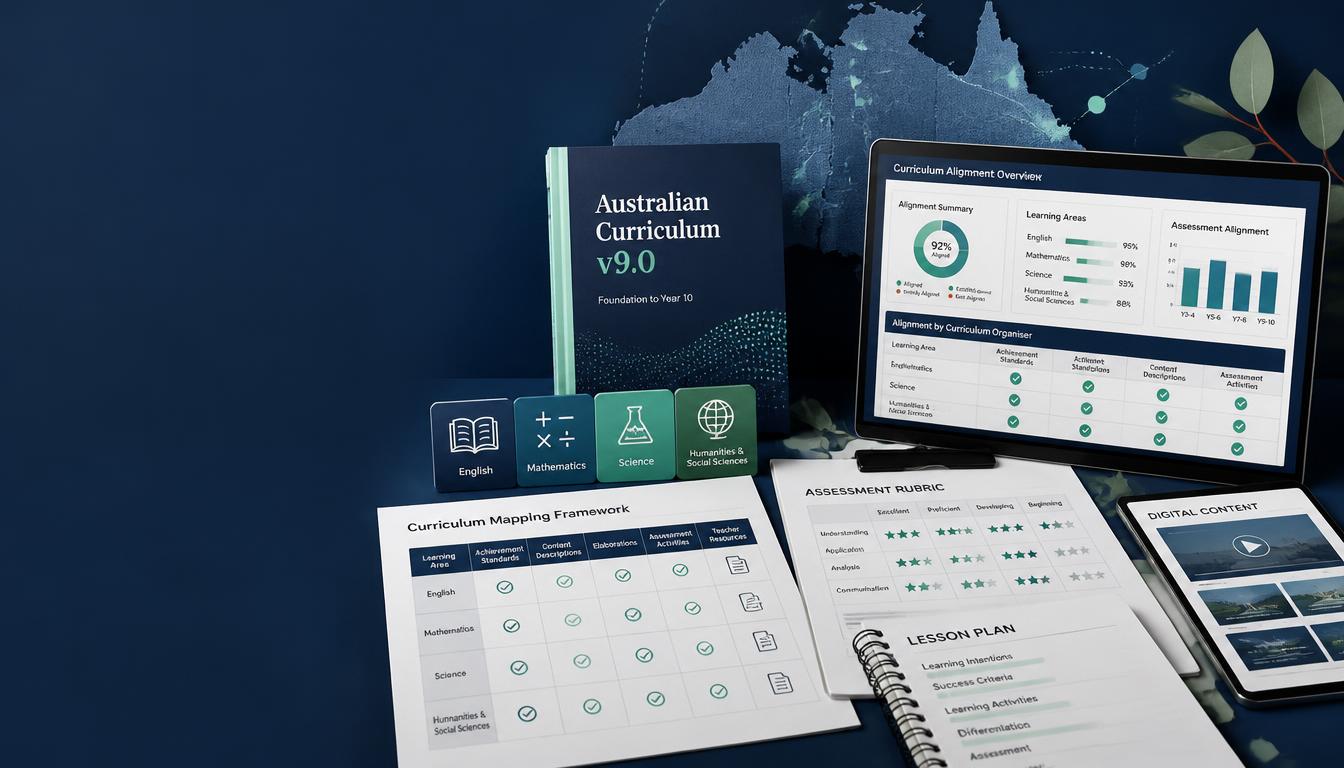


Developing educational content is not simply about writing lessons, creating worksheets or preparing examination questions. Every learning resource must support the intended learning outcomes, address the relevant curriculum requirements and provide meaningful evidence of student understanding.
This is where Australian Curriculum v9.0 mapping becomes essential.
The Australian Curriculum, Version 9.0, developed by the Australian Curriculum, Assessment and Reporting Authority (ACARA), refines the Foundation to Year 10 curriculum to clarify essential learning, improve the alignment between content descriptions and achievement standards, and make curriculum implementation more manageable.
For schools, publishers and education technology companies, these changes make structured curriculum mapping particularly valuable.
A well-designed mapping framework helps connect curriculum requirements with lesson plans, teaching resources, formative assessments, summative assessments and measurable learning outcomes.
Whether you are developing a complete curriculum, updating an existing question bank or creating digital learning resources for Australian schools, the objective remains the same: ensure that what students learn, what educators teach and what assessments measure are meaningfully aligned.
In this practical guide, we explain how to map Australian Curriculum v9.0 content descriptions, interpret achievement standards, design aligned assessments, identify curriculum gaps and build a reliable curriculum-to-assessment framework.
What is Australian Curriculum v9.0?
Australian Curriculum Version 9.0 is the national Foundation to Year 10 curriculum framework that describes the knowledge, understanding and skills students are expected to develop, alongside the expected quality of their learning.
It covers eight learning areas:
- English
- Mathematics
- Science
- Humanities and Social Sciences (HASS)
- Health and Physical Education
- Languages
- Technologies
- The Arts
The curriculum provides a common national reference point while allowing education authorities, schools and teachers to make implementation decisions according to jurisdictional requirements and local learning needs.
Version 9.0 strengthened the clarity of content descriptions and achievement standards, improved their alignment and refined connections to general capabilities and cross-curriculum priorities.
For organisations developing educational materials, understanding these elements is essential to producing accurate, curriculum-aligned content rather than resources that merely cover a broad subject.
What Are the Main Components of Australian Curriculum v9.0?
1. Content descriptions
Content descriptions specify the essential knowledge, understanding and skills students are expected to learn and teachers are expected to teach at a particular year or band level.
They form the foundation of curriculum mapping because they identify the learning that resources and instructional activities need to address.
2. Achievement standards
Achievement standards describe the expected quality of student learning at the end of a year level or band. They help teachers determine whether students have demonstrated the required understanding and skills.
When designing assessments, achievement standards help establish the level of performance students should demonstrate.
3. Year-level or band-level descriptions
These descriptions provide an overview of the learning students should experience at a particular year or band level. They help curriculum developers understand the broader purpose and progression of learning.
4. Content elaborations
Content elaborations provide examples and suggestions for teaching the content descriptions. They can help educators develop activities, explanations, investigations and contextualised learning resources.
Importantly, content elaborations are illustrative rather than mandatory lists of additional content.
5. General capabilities and cross-curriculum priorities
These dimensions help educators identify opportunities to develop broader capabilities and incorporate relevant priorities into learning experiences.
They should be considered where appropriate to the learning area and content description, rather than added mechanically to every resource.
Understanding these components helps establish a reliable foundation for Australian Curriculum content mapping.
What Is Curriculum Mapping, and How Does It Work?
Curriculum mapping is a structured process of connecting curriculum requirements with learning objectives, instructional content, teaching activities, assessments and evidence of student achievement.
In the Australian Curriculum v9.0 context, it involves identifying what must be taught, determining the expected level of learning, planning how students will develop that learning and selecting appropriate methods to evaluate their progress.
A practical curriculum mapping framework connects five key elements:
- Curriculum content descriptions
- Learning objectives and intended outcomes
- Teaching resources and learning activities
- Formative and summative assessments
- Achievement standards and evidence of learning
For example, a Mathematics unit may address a specific content description through worked examples, guided practice and independent problem-solving activities.
The corresponding assessment should then require students to demonstrate the relevant knowledge or skill at an appropriate level.
This relationship makes curriculum mapping useful for school curriculum planning, educational content development, assessment design, question bank development and digital learning resource production.
Curriculum Mapping vs Lesson Planning
Although related, curriculum mapping and lesson planning serve different purposes.
Curriculum mapping establishes coverage, progression, alignment and relationships across a subject, year level or program. Lesson planning translates those requirements into specific classroom experiences.
A curriculum map might identify the learning outcomes, content descriptions and assessment evidence required for a term. Individual lesson plans then determine how teachers introduce concepts, explain content, provide practice and evaluate understanding.
Both are necessary for effective curriculum implementation.
Step-by-Step Guide to Mapping Australian Curriculum v9.0 Content
An effective mapping process should be systematic, traceable and easy to update.
The following approach can support schools, publishers and education providers working with Australian Curriculum-aligned educational resources.
Step 1: Identify the Learning Area and Year Level
Start by defining the learning area, subject, year level or band and intended learner group.
For example, a project may involve developing Year 6 Mathematics resources, Year 8 Science assessments or Foundation English learning activities.
This step establishes the scope of the mapping exercise and helps prevent resources from being assigned to the wrong year level or curriculum context.
For learning areas organised into two-year bands, planning should account for the intended progression across the band rather than automatically treating every content description as a separate annual requirement.
Step 2: Review the Relevant Australian Curriculum v9.0 Content Descriptions
Use the official Australian Curriculum website to identify the relevant content descriptions for the selected learning area and year or band.
Record each applicable content description in a curriculum mapping spreadsheet or structured database.
A useful record includes:
- Learning area and subject
- Year level or band
- Strand and sub-strand, where applicable
- Official content description
- Content description code
- Intended learning outcome
- Planned instructional resources
- Related assessment items
Retain the official wording and code wherever applicable. Internal notes can explain how the description will be addressed, but they should not replace the authoritative curriculum reference.
Step 3: Break Content Descriptions into Assessable Learning Objectives
A content description may cover several related knowledge areas, skills or processes. Translating it into clear learning objectives makes it easier to plan lessons and assessments.
Consider a hypothetical Mathematics learning objective:
“Students will explain their reasoning when solving problems involving fractions.”
The mapping team should identify the relevant knowledge students need, the operation or process they must perform, and the evidence that would demonstrate successful learning.
Learning objectives should be specific enough to guide instruction and assessment without narrowing the curriculum requirement inappropriately.
Use observable verbs such as identify, describe, calculate, compare, interpret, explain, analyse, justify and evaluate where appropriate to the intended learning.
Step 4: Map Content Descriptions to Achievement Standards
This is one of the most important stages of Australian Curriculum assessment alignment.
Content descriptions identify what students are expected to learn, while achievement standards describe the expected quality of their learning.
A robust curriculum map links the selected content descriptions to the relevant parts of the achievement standard and identifies the evidence students need to demonstrate.
For example, if students are expected to interpret information and explain a mathematical strategy, a suitable assessment should evaluate both their interpretation and the quality of their explanation where those expectations are relevant.
Simply matching an assessment to a topic name is not sufficient. The knowledge, skills and cognitive demands must also align.
Step 5: Map Teaching Content and Learning Resources
Once learning objectives and standards have been identified, determine which resources will support their development.
These may include:
- Teacher guides and lesson plans
- Student textbooks and workbooks
- Worksheets and practice exercises
- Interactive learning modules
- Educational videos and presentations
- Digital simulations and investigations
- Differentiated learning activities
- Revision materials and question banks
Each resource should have a clear purpose within the curriculum map.
A lesson introducing a concept may build foundational understanding, while a later activity may require students to apply the concept independently. Mapping these resources together helps maintain continuity and progression.
Step 6: Map Assessments to Learning Objectives
Every assessment item should measure a clearly identified learning objective or combination of objectives.
Assessment mapping involves identifying which questions, tasks, projects or practical activities provide evidence of learning against the relevant curriculum expectations.
A single content description may be assessed through several question types, while an extended task may address multiple related objectives.
The important consideration is whether the assessment provides sufficient and appropriate evidence of the intended learning.
Step 7: Check Coverage, Progression and Duplication
After mapping content and assessments, review the complete framework for gaps and inconsistencies.
Ask the following questions:
- Have all applicable content descriptions been addressed?
- Are the intended learning outcomes clearly defined?
- Are achievement standards represented in the assessment plan?
- Are important concepts introduced in a logical sequence?
- Are the same skills being assessed repeatedly without a clear purpose?
- Are there learning objectives with no corresponding assessment evidence?
- Are assessments testing content students have had an opportunity to learn?
- Have cross-curriculum priorities and general capabilities been considered where relevant?
A structured review helps identify missing coverage, unnecessary duplication, inappropriate difficulty and gaps between teaching and assessment.
Step 8: Validate and Maintain the Curriculum Map
Curriculum mapping should be treated as a maintained resource rather than a one-time document.
Have subject specialists, curriculum leaders and assessment reviewers check the mapping for accuracy, coverage and consistency.
Document changes to curriculum references, learning resources, assessment items and internal mapping decisions. Where relevant, record the date of review and the version of the curriculum being used.
This is particularly important when updating existing resources or managing large educational content libraries across multiple subjects and year levels.
How to Align Assessments with Australian Curriculum v9.0
Curriculum-aligned assessment design begins by identifying what students should know, understand and be able to do.
The assessment must then provide suitable evidence of that learning.
The Australian Curriculum’s official guidance on aligning curriculum and assessment emphasises that assessment should evaluate student learning against achievement standards and inform teaching decisions.
An effective assessment alignment framework connects curriculum expectations with assessment purpose, task design, marking criteria and evidence of achievement.
Formative Assessment Mapping
Formative assessments help teachers understand student progress during the learning process.
Examples include:
- Short quizzes
- Exit tickets
- Guided practice questions
- Diagnostic exercises
- Classroom discussions
- Practical investigations
- Draft assignments and feedback activities
These assessments help identify misconceptions and determine whether students need additional explanations, practice or extension activities.
When mapped to specific learning objectives, formative assessments can support timely instructional decisions rather than simply generating scores.
Summative Assessment Mapping
Summative assessments evaluate learning at a defined point, such as the end of a unit, topic, semester or course.
Examples include:
- Topic tests
- End-of-unit examinations
- Extended written responses
- Research projects
- Practical investigations
- Performance-based tasks
- Cumulative assessments
Summative assessment mapping should ensure that the assessment covers the intended learning, reflects the appropriate cognitive demand and provides sufficient evidence for making judgments against the relevant achievement standards.
Diagnostic Assessment Mapping
Diagnostic assessments help identify existing knowledge, misconceptions and learning needs before or during a teaching sequence.
For example, a short pre-assessment may reveal whether students understand prerequisite fractions before beginning a more advanced Mathematics unit.
Mapping diagnostic assessments to prerequisite learning objectives helps teachers plan differentiated instruction and targeted intervention.
How to Match Assessment Questions to Learning Outcomes
A useful approach is to examine each question against four criteria.
Content alignment: Does the question address the intended curriculum content?
Cognitive alignment: Does it require the type and level of thinking intended by the learning objective?
Evidence quality: Can the student’s response demonstrate the knowledge or skill being assessed?
Marking consistency: Are the expected responses and assessment criteria sufficiently clear for reliable evaluation?
These checks are useful when developing curriculum-aligned question banks, worksheets, digital quizzes and formal assessments.
Practical Example: Australian Curriculum Content and Assessment Mapping
The following example illustrates how a curriculum team could organise a hypothetical Year 6 Mathematics mapping exercise.
It is an illustrative workflow, not a claim that the example reproduces a specific official content description or achievement standard.
Mapping element | Example |
Learning area | Mathematics |
Year level | Year 6 |
Learning focus | Fractions and mathematical reasoning |
Learning objective | Students explain and solve a relevant fraction problem |
Teaching resources | Worked examples, guided practice and independent exercises |
Formative assessment | Short practice quiz with an explanation prompt |
Summative assessment | Multi-step problem-solving task |
Evidence of learning | Correct method, accurate calculation and a clear explanation |
Review criteria | Content coverage, cognitive demand, marking consistency and achievement-standard alignment |
This structure provides traceability from the learning objective to the assessment evidence.
For an actual curriculum project, the team should insert the precise official Version 9.0 content description and relevant achievement standard, verify the intended scope and adjust the assessment to match those requirements.
What Should a Curriculum Mapping Spreadsheet Include?
A practical Australian Curriculum mapping spreadsheet may include the following columns:
- Learning area
- Year level or band
- Strand and sub-strand
- Official content description code
- Official content description
- Intended learning objective
- Related achievement standard
- Teaching resource or lesson reference
- Formative assessment reference
- Summative assessment reference
- Assessment format
- Cognitive demand
- Marking criteria or rubric
- Coverage status
- Reviewer comments
- Last review date
For larger projects, these records can be managed in a spreadsheet, curriculum management platform, learning management system or assessment item bank.
The most important requirement is that curriculum references, learning resources and assessment evidence remain connected and easy to verify.
Common Australian Curriculum v9.0 Mapping Mistakes to Avoid
Even a detailed curriculum map can be ineffective if it focuses on superficial coverage instead of meaningful alignment.
1. Mapping Only by Subject or Topic
A resource labelled “Year 7 Science” is not automatically aligned with every relevant Year 7 Science expectation.
How to avoid it: Map the resource to the precise content description, learning objective and applicable achievement standard.
2. Treating Content Descriptions as Assessment Questions
Content descriptions identify what students should learn, not the exact format or wording of assessment questions.
How to avoid it: Translate curriculum expectations into learning objectives and design suitable tasks that generate evidence of those objectives.
3. Ignoring Cognitive Demand
An assessment may cover the correct topic but require only simple recall when the intended learning requires explanation, application or analysis.
How to avoid it: Review the cognitive demands of the curriculum expectation and ensure the assessment provides appropriately challenging evidence.
4. Confusing Content Elaboration with Mandatory Content
Content elaborations offer examples and suggestions to support teaching. Treating every elaboration as a compulsory additional requirement can create unnecessary duplication.
How to avoid it: Use elaborations to inform teaching and resource design while keeping the official content description as the primary curriculum reference.
5. Overlooking Year-Level Progression
Resources may repeat the same activities across year levels without providing an appropriate increase in complexity, independence or depth.
How to avoid it: Review curriculum expectations across adjacent year levels or bands and plan progression intentionally.
6. Using One Assessment to Measure Everything
A single test may not provide sufficient evidence of every relevant skill, particularly when outcomes involve practical performance, extended reasoning, communication or investigation.
How to avoid it: Use an appropriate combination of assessment methods, selected according to the learning objectives.
7. Failing to Maintain Mapping Records
When content, question banks and teaching resources change, outdated mapping records can create inaccurate curriculum claims.
How to avoid it: Establish a review process, maintain version history and revalidate affected resources after significant updates.
How Curriculum Mapping Supports Educational Publishers and EdTech Companies
Curriculum mapping is valuable beyond classroom planning. It also supports organisations that develop and distribute educational products at scale.
For educational publishers, curriculum mapping helps structure textbook chapters, workbook exercises, teacher resources and assessment materials around intended curriculum coverage.
For EdTech companies, it can connect digital lessons, adaptive learning activities, question banks and progress dashboards to defined learning objectives.
For assessment providers, it helps organise question metadata, identify coverage gaps, review cognitive demand and maintain traceability between assessment items and curriculum requirements.
Curriculum Mapping for Digital Learning Resources
Digital learning resources should have clear curriculum references and learning purposes.
A mapping framework can connect each digital module with its intended outcomes, content descriptions, prerequisites, practice activities and assessment opportunities.
This is particularly useful when building reusable educational content libraries or adapting resources for different year levels, learning platforms and school requirements.
Explore Vaidik EduServices’ STEM curriculum resources to learn more about curriculum-focused educational content.
Curriculum Mapping for Question Banks and Assessment Libraries
Large assessment libraries require consistent metadata and reliable curriculum references.
A well-structured item bank may record the learning area, year level, content description code, learning objective, question format, cognitive demand, difficulty, correct answer, explanation and marking guidance for each item.
These attributes help assessment teams filter questions, build balanced assessments and identify content that needs review.
Read more about test preparation content and assessment support for related educational resource development needs.
Curriculum Mapping for Multiple Education Systems
Organisations operating internationally may develop educational resources for Australian, British and American curriculum environments.
However, similar topic names do not establish curriculum equivalence.
A resource designed for one curriculum should be checked against the target curriculum’s actual content, year-level expectations, terminology and assessment requirements before it is presented as aligned.
A structured mapping process helps teams identify overlap, differences and gaps without assuming that learning objectives are interchangeable across education systems.
Quality Assurance: How to Validate Curriculum and Assessment Alignment
Curriculum mapping requires quality assurance to ensure that its documented relationships reflect the actual learning materials and assessment tasks.
A useful validation process includes the following checks.
Curriculum accuracy: Verify official content descriptions, codes and achievement standards against the relevant Australian Curriculum version.
Coverage completeness: Check whether all applicable requirements have been addressed in the planned curriculum.
Instructional alignment: Confirm that learning resources provide appropriate opportunities for students to develop the intended knowledge and skills.
Assessment validity: Check whether each task measures the intended learning rather than unrelated knowledge or skills.
Assessment reliability: Review instructions, marking criteria, model responses and rubrics to support consistent judgments.
Accessibility and inclusion: Consider whether instructions, content formats and response methods create avoidable barriers for students.
Progression and coherence: Ensure that resources build appropriately on prerequisite learning and prepare students for subsequent expectations.
Traceability: Maintain clear links between curriculum references, resources, assessment items and review decisions.
These checks can be integrated into a formal content development and assessment review workflow.
Australian Curriculum v9.0 Mapping Checklist
Use this checklist when planning a new curriculum unit, developing a question bank or reviewing an existing resource library.
- Confirm the relevant Australian Curriculum version.
- Identify the learning area, subject and year level or band.
- Record the applicable official content descriptions and codes.
- Review the relevant achievement standards.
- Define measurable learning objectives.
- Map learning objectives to instructional content and activities.
- Map formative, diagnostic and summative assessments where appropriate.
- Check alignment between assessment tasks and intended cognitive demand.
- Review question coverage, marking criteria and evidence of learning.
- Identify gaps, duplication and progression issues.
- Consider relevant general capabilities and cross-curriculum priorities.
- Conduct a subject-matter and curriculum quality review.
- Record review dates, version information and required updates.
Completing this checklist can make curriculum development more systematic and improve the consistency of educational resources.
How Vaidik EduServices Can Support Curriculum and Assessment Development
Developing curriculum-aligned educational content at scale requires more than subject expertise. It requires a structured process for interpreting curriculum requirements, creating learning materials, developing assessment items and maintaining quality across a large content library.
Vaidik EduServices supports education businesses, publishers and learning providers with educational content and curriculum development solutions.
Depending on project requirements, support may include:
- Curriculum research and mapping
- Curriculum-aligned instructional content development
- Learning objectives and lesson resource development
- Assessment and question bank development
- Educational worksheets and practice materials
- Digital learning content and instructional design
- Curriculum review and content quality assurance
- Structured content development for educational platforms
For organisations implementing Australian Curriculum v9.0, the appropriate scope depends on the learning areas, year levels, existing content, assessment formats and quality requirements involved.
A practical engagement begins with defining the curriculum scope, identifying required deliverables, establishing a mapping framework and agreeing on validation criteria.
Learn more about Vaidik EduServices and its educational content development capabilities.
Building a More Reliable Curriculum Development Workflow
A repeatable workflow can help organisations reduce inconsistencies and make future updates more manageable.
The process typically involves:
- Scope definition: Identify subjects, year levels, curriculum requirements and intended users.
- Curriculum analysis: Review official content descriptions, achievement standards and relevant curriculum guidance.
- Mapping framework development: Connect curriculum references to learning objectives and planned resources.
- Content production: Develop lessons, instructional materials, questions and assessments.
- Quality assurance: Validate curriculum alignment, subject accuracy, assessment quality and accessibility.
- Documentation and maintenance: Record mappings, review decisions and updates.
This approach supports traceable content development and makes it easier to review or expand educational resources as project requirements evolve.
Conclusion: Make Curriculum Mapping the Foundation of Better Educational Content
Australian Curriculum v9.0 mapping provides a practical foundation for connecting curriculum expectations, instructional resources and assessment evidence.
When content descriptions, learning objectives, achievement standards and assessments are mapped systematically, schools and education providers can identify gaps, improve instructional coherence and develop more purposeful assessment materials.
The most effective approach is not to map resources by topic alone. It is to establish clear relationships between what students are expected to learn, how that learning is supported and what evidence demonstrates their progress.
For schools, publishers and EdTech organisations developing Australian Curriculum-aligned content, a structured mapping framework can support quality assurance, resource management and more consistent curriculum implementation.
Planning an Australian Curriculum v9.0 project? Contact Vaidik EduServices to discuss curriculum mapping, educational content development, question bank creation or assessment development requirements.
Frequently Asked Questions
Australian Curriculum v9.0 mapping is the process of connecting official curriculum content descriptions and achievement standards with learning objectives, teaching resources, assessments and evidence of student learning.
Identify the relevant content description, translate it into a clear learning objective, determine the expected evidence of learning and develop an assessment task that measures the intended knowledge or skill. Review the task against the relevant achievement standard.
Assessment alignment helps ensure that students are assessed on the learning they have been taught and that assessment results provide relevant evidence of progress against curriculum expectations.
Schools can compare their curriculum map with the applicable official content descriptions and achievement standards. They can then identify missing content, learning objectives without assessment evidence, duplicated activities and gaps in progression.
Yes. Mapping question bank items to curriculum references and learning objectives helps assessment teams organise questions, review coverage, identify gaps and create assessments that target intended learning.
The Australian Curriculum provides a national reference framework, but state and territory authorities and education sectors determine implementation approaches and timelines according to their policies and requirements. Schools should verify the relevant jurisdictional guidance before implementing curriculum changes.
Yes. Curriculum mapping can connect digital lessons, videos, interactive activities, quizzes and question banks to learning objectives and relevant curriculum references. This improves traceability and supports structured content management.