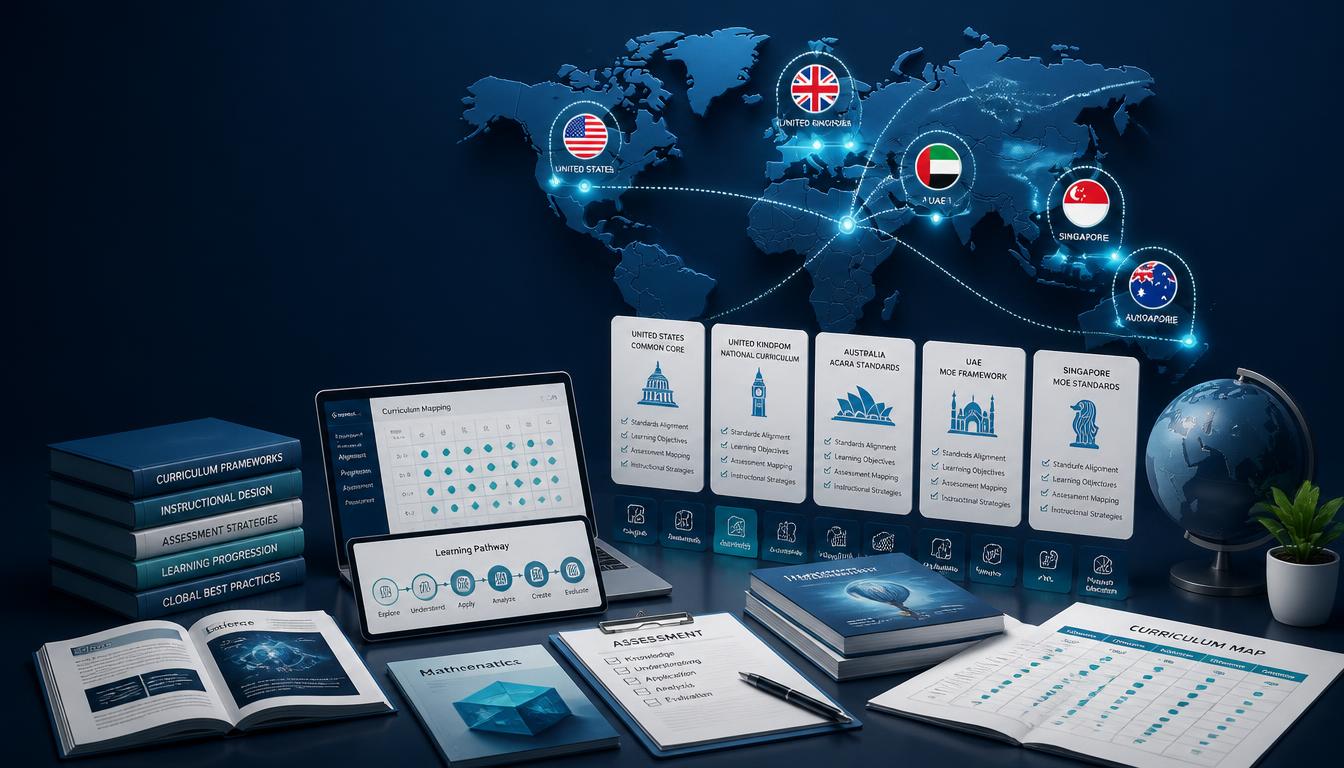


Educational publishers operating across international markets face a complex challenge: how can they create consistent, high-quality learning content while meeting the different curriculum standards, learning objectives, assessment requirements, and cultural expectations of each country?
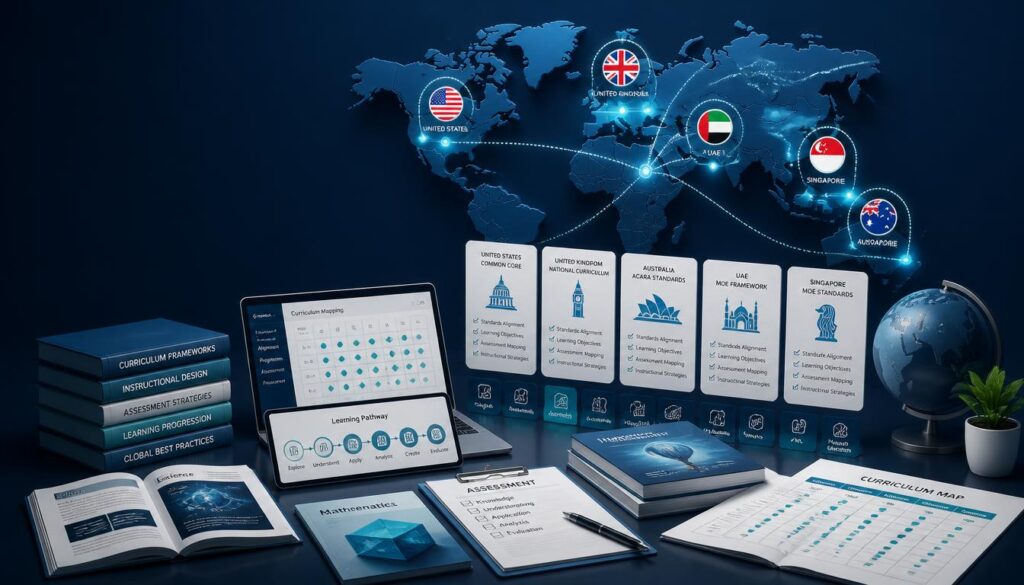
A mathematics workbook designed for the United States may follow Common Core State Standards, while a resource developed for England must align with the National Curriculum and GCSE examination requirements.
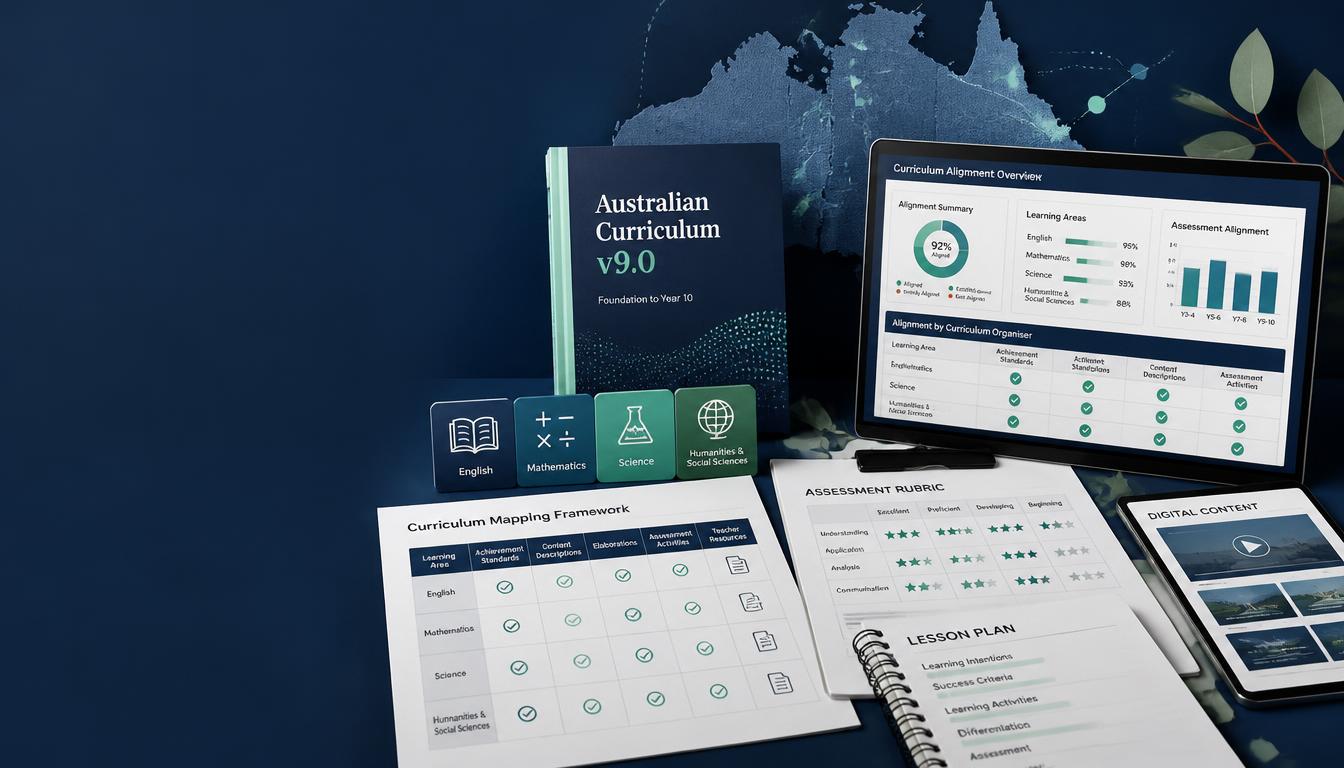
In Australia, publishers must consider the Australian Curriculum, including Version 9.0, alongside state-based syllabuses. In the UAE, learning materials may need to accommodate British, American, IB, and other international curricula.
This is why curriculum development for multiple countries requires more than translating existing textbooks or changing a few learning objectives. Publishers need a structured process for curriculum mapping, standards alignment, instructional design, assessment development, localisation, and quality assurance.
For educational publishers, EdTech companies, schools, and learning solution providers, a well-designed multi-country curriculum strategy helps reduce duplicated work, improve content consistency, and expand into international education markets more efficiently.
In this guide, we explore how educational publishers manage different curriculum standards across countries, the challenges they face, and the strategies they can use to build scalable, standards-aligned learning resources.
What Is Curriculum Development for Multiple Countries?
Curriculum development for multiple countries is the process of designing, adapting, aligning, and maintaining educational content for different national or regional education systems while preserving learning quality and consistency.
It involves analysing curriculum standards, identifying learning outcomes, mapping subject knowledge and skills, adapting instructional materials, and validating assessments against the requirements of each target market.
For educational publishers, this process can include:
- International curriculum development for K–12 education.
- Curriculum mapping and alignment across countries.
- Textbook and digital learning resource development.
- Learning objectives and competency mapping.
- Standards-aligned question bank development.
- Assessment and examination preparation content.
- Localisation of educational content for international markets.
- Curriculum adaptation for different grade levels and age groups.
- Digital curriculum development for international EdTech platforms.
The objective is not to create an entirely different product for every country. Instead, publishers aim to develop a reliable core content structure that can be adapted to the appropriate curriculum without compromising local standards.
Why Do Educational Publishers Need to Support Multiple Curriculum Standards?
International education markets are not governed by one universal curriculum. Countries and regions establish their own expectations for what students should learn, when they should learn it, and how their progress should be assessed.
For publishers serving multiple markets, these differences affect product planning, content creation, editorial workflows, assessment design, and product maintenance.
1. Different Countries Have Different Learning Standards
Each education system defines its own learning objectives, subject expectations, progression pathways, and assessment requirements.
For example:
- United States: Publishers may need to align resources with Common Core State Standards for Mathematics and English Language Arts, the Next Generation Science Standards (NGSS), or applicable state standards.
- United Kingdom: Publishers serving England may need to consider the National Curriculum, GCSE specifications, and A-level subject requirements. Scotland, Wales, and Northern Ireland have distinct curriculum frameworks.
- Australia: Content developers may work with the Australian Curriculum and state or territory syllabuses, including requirements relevant to NAPLAN and senior secondary qualifications.
- United Arab Emirates: Resources may need to support British, American, IB, and other international pathways, alongside applicable UAE education requirements.
- Singapore: Publishers may need to consider the Ministry of Education Singapore syllabus, including subject-specific learning objectives and examination expectations.
These differences mean that a single textbook or digital lesson cannot automatically be considered suitable for every market.
2. International Expansion Requires Local Relevance
Educational content must reflect more than the correct academic concepts. Examples, terminology, units of measurement, reading levels, cultural references, and assessment formats can also influence how well students understand a resource.
A publisher entering a new market may need to adapt:
- Mathematical word problems and everyday examples.
- Spelling, vocabulary, and academic terminology.
- Currency, measurement units, and geographical references.
- Science examples and local environmental contexts.
- Reading passages and culturally specific references.
- Examination-style questions and marking criteria.
- Grade labels and progression expectations.
Effective curriculum localisation helps publishers retain the educational value of their core content while making the material appropriate for the target audience.
3. Curriculum Alignment Supports Product Quality
Curriculum alignment helps ensure that lessons, activities, learning objectives, and assessments work together.
Without a structured alignment process, publishers risk creating content that covers the right topic but misses an important learning outcome, introduces a concept too early, or assesses a skill that students have not yet been taught.
A documented curriculum alignment process provides editorial teams with clear criteria for reviewing every resource before publication.
4. Multiple Markets Create Ongoing Maintenance Requirements
Curricula and examination specifications can change. Publishers therefore need processes for identifying updates, reviewing affected content, and maintaining accurate resources.
For example, a change to a science syllabus may require revisions to lesson objectives, explanatory content, practical activities, assessment questions, and answer rationales.
A scalable curriculum development strategy treats alignment as an ongoing responsibility rather than a one-time project.
How Do Publishers Manage Different Curriculum Standards Across Countries?
Successful international publishers typically combine curriculum research, standards mapping, modular content design, expert review, and ongoing quality assurance.
The following framework explains how this process can work in practice.
Step 1: Conduct Curriculum Research for Each Target Market
Before developing educational content, publishers need to establish which standards and requirements apply to their intended audience.
Curriculum research should identify:
- The relevant national, regional, or state curriculum.
- Grade-level expectations and subject-specific learning outcomes.
- Required knowledge, skills, and competencies.
- Examination boards and assessment frameworks, where applicable.
- Progression requirements between grades or stages.
- Terminology and localisation expectations.
- Official curriculum documentation and revision dates.
For example, a publisher developing a Year 8 mathematics programme for Australia should not assume that every state or territory uses an identical implementation framework.
The publisher should identify the applicable Australian Curriculum requirements and any relevant jurisdictional syllabus differences.
Similarly, a publisher developing GCSE resources for England must identify the relevant subject and examination-board specification rather than treating all GCSE courses as interchangeable.
Recommended practice: Maintain a curriculum research register containing the market, source document, applicable version, subject, grade range, review date, and responsible reviewer.
This register provides a traceable foundation for curriculum mapping and future updates.
Step 2: Build a Curriculum Standards Matrix
A curriculum standards matrix allows publishers to compare learning expectations across countries and identify similarities and differences.
Instead of reviewing standards separately for every lesson, teams can organise them into a structured comparison framework.
A useful curriculum mapping matrix may include:
- Country or education market.
- Curriculum framework or examination specification.
- Subject and grade.
- Standard or learning outcome reference.
- Knowledge and skills required.
- Depth of understanding expected.
- Suggested instructional content.
- Assessment method.
- Alignment status.
- Identified content gaps.
- Review and approval status.
For example, a publisher developing a primary mathematics programme might identify that fractions, measurement, and geometry appear in several target curricula. However, the expected level of mastery, terminology, and sequencing may differ.
The matrix makes these differences visible before content production begins.
Step 3: Identify Common Learning Outcomes Across Curricula
One of the most effective ways to manage multiple standards is to distinguish shared learning outcomes from market-specific requirements.
Publishers can group curriculum expectations into three categories.
Shared learning outcomes: Concepts or skills that align across several target curricula.
Partially aligned outcomes: Concepts that overlap but differ in depth, sequencing, terminology, or assessment expectations.
Market-specific outcomes: Requirements that apply to one curriculum, examination pathway, or jurisdiction.
Consider a hypothetical international mathematics programme covering fractions.
The shared content might explain equivalent fractions and fraction comparison. A country-specific version might then adjust the grade placement, vocabulary, worked examples, complexity of practice questions, or required assessment format.
This approach helps publishers avoid unnecessary duplication while ensuring that local requirements are not overlooked.
Importantly, shared content should only be reused after its alignment has been verified. Similar topic names do not guarantee equivalent learning expectations.
Step 4: Design a Modular Curriculum Architecture
A modular curriculum architecture separates reusable educational content from curriculum-specific components.
Rather than producing an entirely separate course for every country, publishers can build a core content library and connect it to market-specific learning pathways.
A modular structure may include:
Core learning modules
- Fundamental concepts and explanations.
- General learning activities.
- Reusable diagrams and multimedia assets.
- Core examples and instructional sequences.
Curriculum-specific modules
- Local learning objectives.
- Country-specific terminology and examples.
- Additional or advanced learning outcomes.
- Examination-specific question formats.
- Local assessment rubrics and marking criteria.
Market-specific metadata
- Curriculum framework.
- Grade or year mapping.
- Standard identifiers.
- Prerequisite relationships.
- Version and approval status.
This model supports efficient curriculum adaptation and makes it easier to update one component without rebuilding the entire learning product.
However, modularity should not be treated as a substitute for alignment review. Every final learning pathway must be checked against its intended standards.
Step 5: Map Grade Levels, Learning Progression, and Prerequisites
Grade equivalence is one of the most challenging parts of international curriculum development.
Year 6 in one country is not automatically equivalent to Grade 6 in another. Students may encounter concepts at different stages, and the expected depth of understanding can vary.
Publishers should therefore map learning outcomes rather than relying exclusively on grade labels.
A robust grade-mapping process considers:
- Prerequisite knowledge.
- Concept introduction and reinforcement.
- Expected complexity.
- Cognitive demand.
- Required practical or analytical skills.
- Assessment expectations.
- Progression to subsequent topics.
For example, a publisher may discover that a concept is introduced earlier in one curriculum but assessed in greater depth later in another. The correct response may be to adapt the sequence or create additional practice rather than simply relabel the same lesson.
A well-maintained progression map helps instructional designers create coherent learning experiences across different education systems.
Step 6: Adapt Instructional Design for Each Market
Curriculum standards describe learning expectations, but instructional design determines how those expectations are translated into effective educational experiences.
Publishers need to consider how content should be presented, practised, reinforced, and assessed for each intended learner group.
This may involve adapting:
- Lesson objectives and success criteria.
- Explanatory text and worked examples.
- Practice activities and guided exercises.
- Differentiated learning pathways.
- Multimedia and interactive learning resources.
- Formative assessment opportunities.
- Revision activities and extension tasks.
For digital learning platforms, this process may also involve designing reusable learning objects, interactive exercises, and structured content components that can be assembled into different curriculum pathways.
The key is to preserve instructional quality while adapting the learning experience to the requirements of each market.
For related services, publishers can explore instructional design services to understand how learning objectives, instructional strategies, and digital content can be structured into coherent learning experiences.
Step 7: Develop Curriculum-Aligned Assessments
Assessment development must be integrated into curriculum planning rather than treated as a final production task.
A lesson may explain a concept correctly but still fail to prepare learners for the type of reasoning, application, or problem-solving required by their target curriculum.
Publishers should map assessment items to specific learning outcomes and verify that the questions measure the intended knowledge or skill.
This process may include:
- Multiple-choice questions.
- Short-answer and extended-response questions.
- Problem-solving tasks.
- Practical or scenario-based assessments.
- Formative quizzes and knowledge checks.
- Examination-style practice questions.
- Mark schemes and answer rationales.
- Difficulty and cognitive-demand classifications.
For example, a mathematics question bank designed for several international markets may reuse a core concept while adapting the context, language, complexity, and marking approach for each curriculum.
Assessment teams should also check for ambiguity, inappropriate difficulty, misleading distractors, and alignment gaps.
Explore test preparation services for an example of how assessment-focused educational resources can support structured exam preparation.
Step 8: Localise Content Without Losing Academic Accuracy
Localisation goes beyond direct translation. It ensures that educational materials use suitable terminology, examples, conventions, and contextual references while maintaining the intended learning outcomes.
For international publishers, localisation may involve:
- British, American, Australian, or other English conventions.
- Local spellings and subject terminology.
- Country-appropriate names, currencies, and measurements.
- Culturally relevant reading passages and examples.
- Locally suitable diagrams and case studies.
- Curriculum-specific instructions and assessment language.
Localisation should not introduce stereotypes or unnecessary cultural assumptions. Content must remain inclusive, age-appropriate, and academically accurate.
Where educational resources are translated into additional languages, publishers should combine linguistic review with subject-matter and curriculum validation.
A translated resource should never be assumed to be curriculum-aligned simply because the original version was aligned.
Step 9: Implement Curriculum Quality Assurance
Quality assurance is essential when publishers manage multiple standards, content teams, and product versions.
A comprehensive curriculum QA process should examine both academic quality and compliance with the intended curriculum.
A practical review framework includes:
Curriculum alignment review: Verify that learning objectives and content address the relevant standards.
Subject-matter review: Check conceptual accuracy, explanations, terminology, and worked solutions.
Assessment review: Validate question alignment, answer keys, marking criteria, and difficulty.
Editorial review: Check clarity, readability, grammar, consistency, and age appropriateness.
Localisation review: Verify local conventions, contextual examples, and terminology.
Digital quality review: Check navigation, media functionality, accessibility, and rendering across devices.
Version-control review: Confirm that the approved resource corresponds to the correct curriculum version.
Publishers should document review outcomes, identified gaps, corrections, approvals, and unresolved issues.
A traceable quality assurance process reduces the likelihood of outdated or incorrectly mapped content reaching students and educators.
Step 10: Maintain Curriculum Versions and Update Content
Curriculum alignment is not a permanent status. It depends on the specific curriculum version, the intended grade or subject, and the scope of the learning resource.
Publishers should establish a curriculum update workflow that includes:
- Monitoring official curriculum and examination-board publications.
- Recording relevant changes in a curriculum change log.
- Identifying lessons, assessments, and digital assets affected by each change.
- Prioritising updates according to impact and publication schedules.
- Revising content and conducting appropriate reviews.
- Approving and publishing the updated resources.
- Archiving previous versions and retaining change records.
A content management system or learning content repository can help teams track standards, assets, ownership, review dates, and approval status.
For large content libraries, tagging every resource with its relevant standards and curriculum version makes it easier to identify affected materials when requirements change.
Curriculum Development Across Countries: Key Differences Publishers Must Understand
International publishers should avoid assuming that education systems differ only in terminology. The standards, assessment models, and curriculum structures may require substantive changes to the content.
The following table highlights important considerations for selected markets.
Market | Curriculum and standards considerations | Implications for publishers |
United States | Common Core State Standards, NGSS, and applicable state standards | Check state-level requirements, grade expectations, and assessment needs |
United Kingdom | National Curriculum for England, GCSE and A-level specifications, plus distinct frameworks elsewhere in the UK | Map content to the relevant jurisdiction, subject, and examination specification |
Australia | Australian Curriculum and state or territory syllabuses | Validate learning progression and jurisdiction-specific requirements |
United Arab Emirates | Different school curricula, including British, American, and IB pathways, alongside applicable local requirements | Identify the school’s curriculum and relevant UAE requirements before developing resources |
Singapore | MOE syllabuses and subject-specific learning expectations | Align content with the applicable subject syllabus and learning progression |
International schools | International programmes such as the IB and other recognised pathways | Confirm programme-specific requirements, assessment approaches, and school context |
This comparison is a starting point for curriculum research, not a substitute for reviewing official documentation. Standards and implementation requirements vary by subject, grade, jurisdiction, programme, and year.
How Publishers Manage US Curriculum Development
US curriculum development often requires publishers to distinguish between national frameworks, state standards, and local adoption requirements.
For mathematics and English Language Arts, Common Core State Standards may be relevant, depending on the state and programme. Science publishers may need to consider NGSS or applicable state science standards.
Publishers should map content to the actual standards used by the target customer rather than assuming that one alignment label covers every US market.
Useful keyword themes include US curriculum development, Common Core curriculum alignment, state standards mapping, K–12 curriculum development, and standards-aligned educational content.
How Publishers Manage UK Curriculum Development
UK curriculum development requires careful attention to the differences between education systems and examination pathways.
For England, publishers may need to consider the National Curriculum, Key Stages, GCSE specifications, and A-level requirements. Other UK jurisdictions have their own curriculum and qualification frameworks.
For GCSE and A-level resources, alignment should be verified against the relevant subject and examination-board specification.
This is particularly important for question banks, textbooks, revision resources, digital lessons, and assessment materials.
Relevant search themes include UK curriculum development services, GCSE curriculum alignment, A-level content development, exam-board alignment, and educational publishing services UK.
How Publishers Manage Australian Curriculum Development
Australian curriculum development involves the Australian Curriculum and, where relevant, state and territory syllabuses and senior secondary requirements.
Publishers need to identify the correct version of the curriculum and understand how content maps to the intended year level, achievement standards, and subject outcomes.
Resources designed for NAPLAN preparation or senior secondary subjects may require additional assessment-specific planning.
For example, a publisher creating a science resource should verify the relevant science outcomes, inquiry skills, terminology, and assessment expectations instead of relying only on topic matching.
Relevant keywords include Australian Curriculum development, Australian Curriculum Version 9.0 alignment, curriculum mapping Australia, Australian educational content development, and assessment development Australia.
How Publishers Manage UAE Curriculum Development
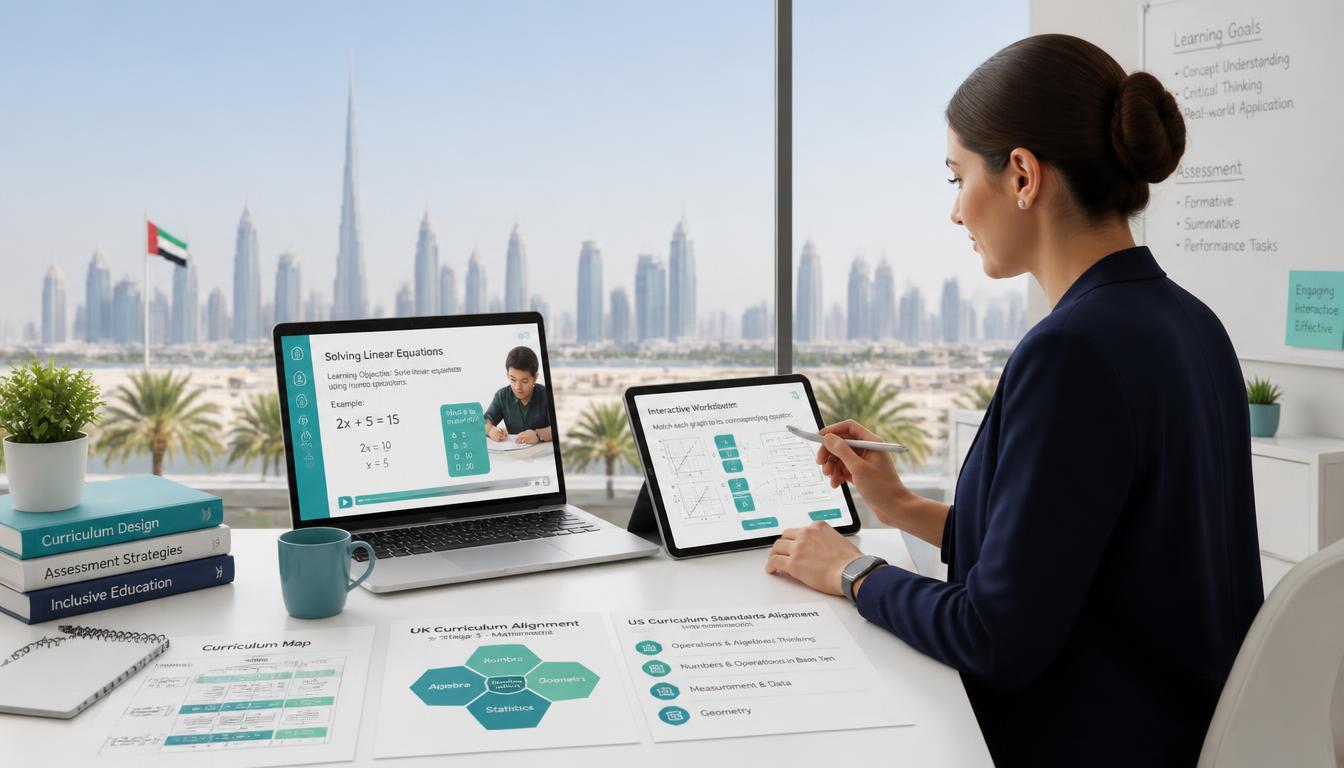
The UAE education market includes schools following different international curricula. Publishers may serve British curriculum schools, American curriculum schools, IB schools, and other educational pathways.
Before developing resources, teams should identify the intended curriculum, school requirements, grade structure, and any applicable local education expectations.
Publishers should also evaluate whether English-language content needs regional examples, localisation, or modifications to support the intended learner group.
Relevant keywords include UAE curriculum development, curriculum alignment services UAE, British curriculum content development UAE, American curriculum resources UAE, and educational content development UAE.
How Publishers Manage Singapore Curriculum Development
Singapore curriculum development requires attention to the applicable Ministry of Education syllabus and the expectations of the specific subject and educational stage.
Publishers developing mathematics, science, English, assessment, or examination preparation resources should validate learning outcomes and progression against the relevant syllabus.
Resources intended for international schools in Singapore may require a different alignment process from those intended for schools following the national curriculum.
Relevant keyword themes include Singapore curriculum development, Singapore syllabus alignment, educational content development Singapore, and curriculum mapping services Singapore.
Common Challenges in Multi-Country Curriculum Development
Even experienced publishers encounter operational and academic challenges when scaling content across international markets.
Challenge 1: Different Curriculum Terminology
The same concept may be described differently across education systems. Conversely, similar terms may refer to different expectations.
Solution: Maintain a controlled curriculum glossary that records local terminology, definitions, preferred usage, and relevant standards.
Challenge 2: Curriculum Gaps and Overlapping Content
Some learning outcomes overlap across markets, while others are missing from a shared content library.
Solution: Use a standards matrix and gap analysis to identify reusable content, additional learning requirements, and content that needs revision.
Challenge 3: Inconsistent Grade-Level Progression
A topic introduced in one year may be taught earlier or later in another curriculum.
Solution: Map prerequisites, learning progression, and depth of mastery rather than relying solely on grade equivalence.
Challenge 4: Duplicated Content Production
Creating completely separate resources for every country increases production costs and editorial workload.
Solution: Build modular content libraries with reusable core assets and clearly controlled local adaptations.
Challenge 5: Keeping Resources Updated
Curriculum changes can make previously aligned content incomplete or outdated.
Solution: Assign curriculum owners, maintain version records, monitor official sources, and establish scheduled reviews.
Challenge 6: Maintaining Assessment Consistency
Questions written for one curriculum may not measure the knowledge or skills expected by another.
Solution: Map every assessment item to a defined learning outcome and review its difficulty, format, terminology, and marking criteria.
Challenge 7: Coordinating Distributed Content Teams
Subject experts, instructional designers, editors, assessment writers, and localisation specialists may work across different locations.
Solution: Use standardised content templates, documented workflows, role-based approvals, shared terminology, and a central content management system.
Best Practices for Scalable International Curriculum Development
Publishers seeking sustainable international growth should build curriculum alignment into their content production model from the beginning.
Establish a Single Source of Curriculum Truth
Maintain a central repository of approved standards, learning outcomes, curriculum versions, and alignment decisions.
This reduces conflicting interpretations across teams and supports consistent updates.
Use a Reusable Content Model
Create reusable lesson structures, learning objects, question templates, metadata fields, and media assets.
Keep market-specific content separate where differences in curriculum, terminology, or assessment require individual treatment.
Involve Curriculum and Subject-Matter Experts
Curriculum specialists can interpret standards, while subject-matter experts validate academic accuracy. Instructional designers translate the requirements into effective learning experiences.
These responsibilities are complementary, and complex projects often benefit from collaboration among all three groups.
Integrate Assessment Design Early
Plan questions, rubrics, and assessment criteria alongside learning objectives and instructional content.
This helps teams identify alignment gaps before the content is finalised.
Track Alignment at Resource Level
Where practical, link individual lessons, activities, and assessment items to their relevant learning outcomes and standards.
This creates a more reliable basis for audits, updates, and product-level alignment claims.
Measure Content Quality and Operational Efficiency
Publishers can monitor indicators such as:
- Percentage of resources with documented standards mapping.
- Curriculum review completion rates.
- Number of unresolved alignment gaps.
- Assessment-item review and correction rates.
- Time required to update affected content.
- Reuse of approved content components.
- Editorial rework across different market versions.
These metrics help publishers identify process improvements without treating content reuse or production speed as substitutes for academic quality.
How Technology Supports Multi-Country Curriculum Development
Technology can make international curriculum development more manageable, particularly when publishers maintain large libraries of digital lessons, textbooks, questions, and multimedia assets.
Curriculum Mapping Software
Curriculum mapping tools help teams connect standards with learning objectives, lessons, resources, and assessments.
They can support gap analysis, progression mapping, and reporting across multiple curricula.
Learning Content Management Systems
A learning content management system can organise reusable learning objects, metadata, approvals, and versions.
For publishers, a structured repository makes it easier to find relevant content and manage country-specific adaptations.
AI-Assisted Curriculum Mapping
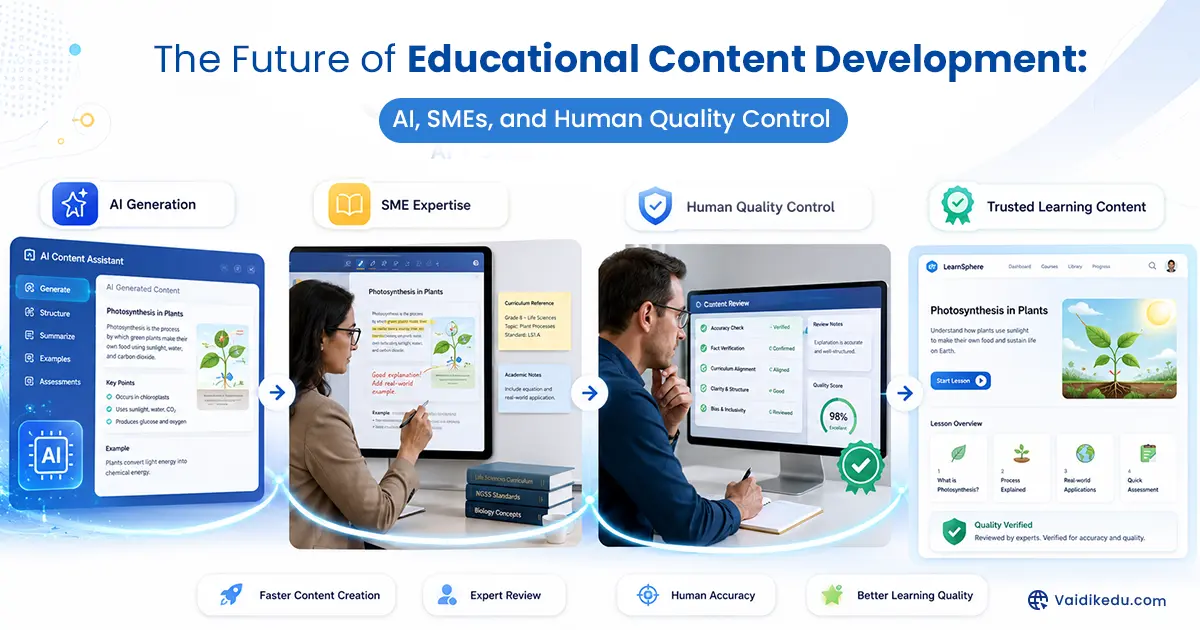
Artificial intelligence can assist with extracting learning outcomes from documents, suggesting possible relationships between standards, classifying educational resources, and identifying potential gaps.
However, AI-generated mappings should be treated as recommendations rather than verified alignment decisions.
Curriculum experts must validate interpretations, especially where standards contain nuanced requirements, subject-specific terminology, or assessment constraints.
Automated Assessment Analysis
Assessment analytics can help teams review question coverage, difficulty distribution, duplication, and relationships between assessment items and learning objectives.
Automation can reduce repetitive work, but final academic and curriculum validation should remain part of the quality assurance process.
Accessibility and Digital Publishing Tools
Digital learning resources should also be reviewed for accessibility, readability, navigation, and compatibility with the intended delivery platforms.
Where applicable, publishers can incorporate accessibility requirements into content templates and production checklists from the outset.
Technology is most effective when supported by clear standards, trained specialists, and documented review procedures.
How Outsourcing Supports International Curriculum Development
Educational publishers often need additional capacity when expanding into new markets, launching multiple products, or updating large content libraries.
An educational content development partner can support specific stages of the process or contribute to a broader curriculum production workflow.
Depending on project requirements, support may include:
- Curriculum research and standards mapping.
- Curriculum-aligned lesson and textbook development.
- Learning objectives and instructional design.
- Subject-specific educational content writing.
- Question bank and assessment development.
- Mark schemes, answer keys, and rationales.
- Digital learning resource development.
- Content localisation and editorial review.
- Curriculum alignment audits and quality assurance.
Outsourcing can help publishers scale production and access specialist expertise without building every capability internally. The best model depends on the complexity of the curriculum, available internal resources, required turnaround time, and the level of control the publisher needs to retain.
When selecting a partner, publishers should evaluate subject expertise, curriculum knowledge, documented quality assurance processes, confidentiality practices, content ownership arrangements, and experience with the intended delivery formats.
Vaidik EduServices supports educational organisations with curriculum-related content and learning resource development. Explore our curriculum alignment services to learn more about aligning educational content with defined curriculum requirements.
How Vaidik EduServices Can Support Multi-Country Curriculum Projects
Developing educational content for international markets requires a combination of curriculum understanding, subject expertise, structured production, and quality control.
Vaidik EduServices works with educational organisations on learning content and curriculum-related projects, with services relevant to publishers, EdTech providers, and other education-focused businesses.
Depending on project scope, a curriculum development workflow may include:
- Reviewing curriculum documentation and project requirements.
- Mapping learning outcomes to proposed content.
- Developing structured educational resources.
- Supporting instructional design and digital learning development.
- Creating curriculum-aligned assessment materials.
- Reviewing content for accuracy, consistency, and alignment.
- Organising content for future updates and reuse.
For publishers serving the USA, UK, Australia, UAE, Singapore, and other international markets, the scope of work should be defined according to the relevant curriculum, subject, grade range, and delivery format.
The objective is to help educational organisations create structured, reusable, and quality-reviewed learning resources while maintaining alignment with the requirements of their target markets.
Planning a multi-country curriculum project? Contact Vaidik EduServices to discuss your curriculum development, content production, or alignment requirements.
Conclusion: Build a Scalable Curriculum Strategy for Global Education Markets
Managing different curriculum standards is a strategic requirement for educational publishers expanding internationally. Success depends on understanding each target market, mapping learning outcomes accurately, designing reusable content structures, adapting resources appropriately, and maintaining a reliable quality assurance process.
A structured approach to curriculum development for multiple countries helps publishers reduce unnecessary duplication, manage curriculum updates, improve assessment alignment, and create learning resources that meet the needs of different education systems.
Rather than treating every country as a separate content production project, publishers can combine reusable core content with carefully validated local adaptations.
With the right curriculum mapping framework, specialist expertise, and content management processes, educational publishers can build more consistent and scalable learning products for the global education market.
Need support with curriculum mapping, curriculum-aligned content, or assessment development? Visit Vaidik EduServices to explore how we can support your next educational content project.
Frequently Asked Questions
Multi-country curriculum development is the process of designing, adapting, and validating educational content for different national, regional, or international curriculum frameworks. It includes standards mapping, learning outcome alignment, localisation, assessment development, and quality assurance.
Publishers typically research each target curriculum, create a standards mapping matrix, identify shared and market-specific learning outcomes, develop modular content, and validate the final resources against the relevant standards.
Curriculum mapping connects learning outcomes and standards with lessons, educational resources, and assessments. It helps publishers identify gaps, overlapping content, sequencing issues, and areas requiring additional development.
Curriculum development involves designing or revising the learning programme, including its objectives, content, instructional methods, and assessments. Curriculum alignment verifies that the programme and its resources meet the requirements of a specified curriculum or set of standards.
Outsourcing can provide additional subject expertise and production capacity for creating lessons, assessments, question banks, and digital learning resources. It can also help EdTech companies adapt content for new markets while maintaining documented curriculum alignment and review processes.