

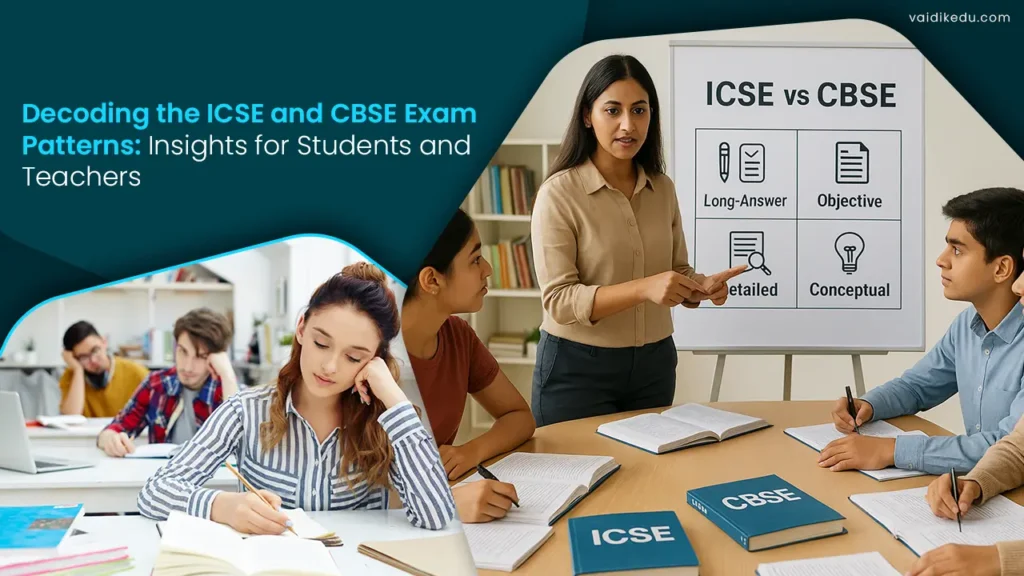
ICSE and CBSE are two of the most widely recognised school examination systems in India, but their academic structures and assessment approaches are not identical.
Understanding those differences can help students prepare more strategically and help teachers design instruction that reflects what learners are expected to demonstrate in examinations.
The distinction is not simply that CBSE is “concept-based” while ICSE is “descriptive“. Both boards increasingly emphasise conceptual understanding, application, competency and varied forms of assessment.
The more useful comparison is how each board structures subjects, external examinations, internal assessment, question design and the skills students need to demonstrate.
For students, understanding the exam pattern can influence how they revise, practise questions, manage time and approach answer writing.
For teachers, it can inform lesson planning, formative assessment, question design and academic support.
This guide explains the key differences between CBSE and ICSE examination patterns and offers practical preparation strategies for both students and educators.
Understanding the CBSE Exam Pattern
CBSE’s curriculum covers a broad range of subjects and is designed around learning outcomes, competencies and subject-specific requirements.
The board’s current curriculum places increasing emphasis on conceptual understanding and higher-order capacities rather than relying only on recall.
Its secondary-stage assessment framework includes case-based questions, simulations, essay-type questions, practical work, projects and other assessment methods alongside written examinations.
For Classes X and XII, CBSE also publishes official Sample Question Papers and Marking Schemes to help schools and students understand the design and expectations of board examinations.
For the 2025–26 academic session, CBSE stated that there was no change to the existing assessment scheme compared with 2024–25.
CBSE Assessment: What Students Need to Understand
CBSE papers can contain a combination of objective, short-answer, case-based and descriptive questions, although the exact structure varies by subject and year.
A successful CBSE preparation strategy therefore needs to go beyond memorising textbook material. Students should be prepared to:
- explain concepts accurately;
- apply concepts to unfamiliar situations;
- interpret information and data;
- solve problems systematically;
- answer case-based questions;
- write clear descriptive responses where required; and
- manage time across different question types.
CBSE has also strengthened competency-based assessment.
The Board reported that 50% competency-based questions were introduced in the 2025 examinations, making application and interpretation increasingly important parts of preparation.
The Role of NCERT in CBSE Preparation
For many CBSE subjects, especially Mathematics and Science, NCERT textbooks remain an important foundation for preparation. However, studying the textbook alone is not enough.
Students should use NCERT to build conceptual understanding and then practise:
- official CBSE Sample Question Papers;
- previous examination papers;
- competency-based questions;
- case-based questions;
- subject-specific practice sets; and
- timed mock examinations.
CBSE itself provides Sample Question Papers and Marking Schemes for Classes X and XII, making these resources particularly useful for understanding question design and answer expectations.
Understanding the ICSE Exam Pattern
The ICSE examination is administered by the Council for the Indian School Certificate Examinations (CISCE).
Its Class X structure combines external examinations with internal assessment, with the weighting depending on the subject.
Under the ICSE Year 2026 regulations, English, the second language; History/Civics/Geography; Mathematics; Science; and several other Group I and Group II subjects generally have an 80% external examination and 20% internal assessment.
Many Group III subjects, including areas such as Computer Applications, Art, Physical Education and Robotics & Artificial Intelligence, have a 50% external and 50% internal assessment structure.
This means students should not treat internal assessment as an optional addition to board preparation. Assignments, projects, practical work and coursework can form a meaningful part of the final result.
What Makes ICSE Preparation Different?
ICSE students often need to manage substantial subject content while developing the ability to communicate ideas clearly and accurately.
The examination approach can require students to demonstrate:
- subject knowledge;
- application and interpretation;
- structured written responses;
- accurate use of terminology;
- clear presentation;
- analytical thinking; and
- practical or project-based understanding where applicable.
CISCE regulations specifically note that clarity, neatness and accurate presentation are taken into account in assessing students’ work.
Therefore, ICSE preparation should not be reduced to memorising long answers. Students need to understand the material well enough to explain, analyse and apply it in the form required by the particular subject.
CBSE vs ICSE: What Are the Main Differences?
The most useful way to compare the two boards is to look at the skills and assessment demands students encounter rather than relying on broad stereotypes.
Curriculum and Subject Structure
CBSE follows a structured national curriculum covering academic, language, skill and other subject areas.
Its curriculum is periodically updated and increasingly incorporates competency-based learning and assessment.
ICSE provides a broad subject structure with compulsory and elective groups.
Its regulations include languages, humanities, mathematics, science, vocational subjects, computer applications, arts and other areas, with different external and internal assessment weightages.
Question Types
CBSE papers increasingly incorporate competency-based, application-orientated and case-based questions alongside objective and descriptive formats. The exact mix varies by subject.
ICSE examinations also require students to demonstrate subject understanding through written responses, while internal assessment and practical/project components play an important role in many subjects.
Internal Assessment
CBSE has subject-specific internal assessment requirements, practical work and other school-based assessment components.
Its curriculum also encourages formative assessment, projects, presentations and other methods of evaluating competencies.
ICSE has clearly defined internal assessment components across subjects, with the percentage varying according to the subject group.
Answer Writing
CBSE students need to become comfortable with multiple question formats and increasingly application-orientated questions.
ICSE students should pay particular attention to clarity, organisation, precision and the ability to develop an explanation or argument where required.
Neither board can be accurately described as requiring only short answers or only long answers.
Students should always prepare according to the current syllabus, specimen/sample papers and subject-specific regulations.
10 Effective Exam Preparation Strategies for CBSE and ICSE Students
Understanding the examination pattern is useful only when students turn that knowledge into a practical study strategy.
1. Start With the Current Syllabus
Students should begin preparation with the syllabus applicable to their examination year. This helps identify the prescribed topics, learning expectations and assessment components.
Avoid relying entirely on old notes or previous-year patterns because question formats and assessment requirements can change.
2. Study the Prescribed Textbooks Carefully
For CBSE students, NCERT textbooks are particularly important for building the foundation in subjects where they are prescribed.
ICSE students should also begin with their prescribed texts and school materials before expanding into reference resources.
Additional books should strengthen understanding rather than create an unnecessary study load.
3. Use Official Sample Papers
Sample papers are valuable because they show how knowledge is translated into examination questions.
CBSE publishes Sample Question Papers and Marking Schemes for Classes X and XII. Students should use them to identify question formats, mark allocation, expected depth and the type of reasoning required.
4. Practise Different Levels of Questions
Do not practise only questions that look familiar.
Include:
- direct concept questions;
- application-based problems;
- case-based questions;
- analytical questions;
- numerical problems;
- short-answer questions; and
- longer structured responses.
This helps students prepare for questions that test understanding rather than simple recall.
5. Develop a Time-Management Strategy
Students can know the syllabus thoroughly and still lose marks by spending too much time on individual questions.
During practice tests, track:
- how long each section takes;
- which questions consume excessive time;
- how much time remains for checking;
- whether answers are becoming rushed toward the end.
The goal is to develop a realistic pacing strategy before examination day.
6. Practise Answer Presentation
Good preparation should include learning how to communicate an answer effectively.
Students should practise:
- using appropriate headings where useful;
- showing steps in numerical problems;
- highlighting important terms when appropriate;
- presenting diagrams clearly;
- organising longer answers logically; and
- answering according to the marks allocated.
Presentation should support clarity rather than become decorative formatting.
7. Treat Internal Assessment Seriously
Students should not leave projects, practical records, assignments or coursework until the last minute.
Because internal assessment contributes differently across subjects and boards, students should check the exact requirements for their subjects and maintain consistent performance throughout the academic year.
8. Analyse Mistakes After Every Test
A mock test is useful only if students learn from it.
After each test, classify mistakes as:
- concept gap;
- careless error;
- calculation error;
- misreading the question;
- incomplete answer;
- weak explanation;
- poor time management; or
- lack of familiarity with the question format.
This makes revision much more targeted.
9. Build Revision Around Weak Areas
Students should not spend equal amounts of time on every chapter.
A better approach is to identify high-priority weaknesses and allocate additional practice to them while maintaining regular revision of stronger topics.
10. Practise Under Realistic Conditions
As examinations approach, students should complete full-length papers under timed conditions.
This develops more than subject knowledge. It helps students practise concentration, pacing, question selection, handwriting or typing speed where relevant, and the ability to remain composed during a long examination.
Preparation Strategies for CBSE Students
CBSE students should pay particular attention to conceptual understanding and application.
Instead of memorising a solution, ask:
- Why does this method work?
- Can I solve the problem if the numbers change?
- Can I explain the concept in my own words?
- Can I apply the concept to a real-world situation?
- Can I interpret information before answering?
This approach is increasingly relevant as CBSE continues to use competency-based and application-orientated assessment.
For Mathematics and Science, regular problem-solving is especially important. For languages and humanities, students should combine content knowledge with structured interpretation and written expression.
Preparation Strategies for ICSE Students
ICSE students should balance content coverage with answer-writing practice.
A useful approach is to:
- divide the syllabus into manageable units;
- revise concepts before memorising details;
- practise structured descriptive responses;
- strengthen subject-specific terminology;
- complete projects and internal work progressively;
- use diagrams, examples and evidence where appropriate;
- practise writing within the time available; and
- review completed answers for clarity and accuracy.
Students should also remember that the exact assessment weightage differs between subjects, so preparation should be based on the requirements of each subject rather than a general assumption about the ICSE board.
How Teachers Can Prepare Students for Different Exam Patterns
Teachers play an important role in helping students understand not just what to study but how they will be assessed.
1. Align Lessons With Learning Outcomes
Teaching should begin with the knowledge and competencies students are expected to develop.
A lesson should make it clear whether students are expected to remember information, explain a concept, apply a method, analyse a situation or create a response.
2. Use Formative Assessment Regularly
Short quizzes, questioning, problem-solving tasks, exit tickets, discussions and written exercises can reveal learning gaps before the final examination.
CBSE’s current curriculum specifically emphasises regular formative assessment and feedback at the secondary stage.
3. Introduce Exam-Style Questions During Teaching
Students should not encounter the board examination format for the first time during a pre-board test.
Teachers can gradually introduce:
- competency-based questions;
- case studies;
- application problems;
- structured responses;
- practical tasks; and
- timed practice.
4. Teach Students How to Interpret Questions
Many errors occur because students answer the topic they recognise rather than the question actually asked.
Teachers can train students to identify command words such as:
- explain;
- analyse;
- compare;
- justify;
- evaluate;
- calculate; and
- describe.
This is especially useful for longer and application-orientated questions.
5. Give Feedback That Students Can Act On
Instead of simply marking an answer incorrect, feedback should explain what needs to change.
For example, a teacher might identify whether the student needs to improve conceptual accuracy, evidence, calculation steps, structure, terminology or time management.
Common Challenges Students Face With CBSE and ICSE Preparation
Managing a Large Syllabus
Students can become overwhelmed when they look at the entire syllabus at once.
Breaking it into weekly targets, revision cycles and practice blocks makes preparation more manageable.
Balancing Schoolwork and Exam Preparation
Students often attempt to separate classroom learning and board preparation. A more effective approach is to make regular classroom learning part of examination preparation.
Relying Too Heavily on Memorisation
Memorisation can help with definitions, formulas, terminology and factual information, but it cannot replace understanding.
Both boards require students to demonstrate knowledge in ways that may involve explanation, application, analysis or practical work.
Ignoring Internal Assessment
Projects, practicals and coursework should be treated as part of the academic programme rather than as work to complete immediately before submission.
Using Too Many Resources
More books and more online material do not automatically mean better preparation.
Students should prioritise the official syllabus, prescribed resources, teacher guidance, official sample papers and carefully selected practice material.
Are CBSE and ICSE Better Suited to Different Students?
It is tempting to say that CBSE is best for students interested in competitive examinations and ICSE is best for students interested in languages or humanities. These statements are too simplistic.
A student’s experience depends on the school, teachers, subjects, learning preferences, academic goals and quality of support available.
CBSE’s structured curriculum and competency-based assessment can work well for students who value a nationally standardised framework and strong conceptual preparation.
ICSE’s broad subject structure and emphasis on different forms of internal assessment can suit students who are comfortable managing diverse subjects, detailed coursework and written expression.
The right question is not simply “Which board is easier?” but “Which academic environment and assessment structure fit the student’s needs and long-term goals?”
How Understanding the Exam Pattern Improves Learning
Exam-pattern awareness should not encourage students to study only for marks.Used properly, it helps students understand what they are expected to demonstrate.
For example:
- competency-based questions encourage application rather than simple recall;
- analytical questions encourage students to connect ideas;
- practical assessments connect knowledge with performance;
- projects can encourage sustained investigation;
- timed practice develops examination skills; and
- feedback helps students identify gaps before high-stakes assessments.
The examination pattern therefore becomes part of a broader learning strategy rather than merely a list of question types.
How Vaidik Eduservices Supports CBSE and ICSE Learning Solutions
For schools, EdTech companies and educational organisations, supporting CBSE and ICSE learners at scale requires more than generic academic content.
Vaidik Eduservices provides educational content development, curriculum development, assessment solutions, online tutoring and other academic services for education organisations.
Its curriculum alignment services specifically include CBSE and ICSE among the international frameworks it supports, with services such as content mapping, gap analysis, learning-objective alignment and curriculum review.
For organisations developing learning programmes or academic resources, Vaidik can support areas such as:
- CBSE and ICSE curriculum-aligned content;
- lesson plans and teacher resources;
- question banks and practice assessments;
- mock tests and assessment modules;
- digital learning content;
- curriculum design and mapping;
- online K–12 tutoring; and
- academic content review and quality assurance.
Its educational content development service includes curriculum design, lesson planning, question-bank development, e-learning content and other academic resources, supported by subject-matter expertise and instructional QA.
For institutions looking to extend academic support beyond the classroom, Vaidik also provides scalable online tutoring solutions that can be customised to an organisation’s subjects, grade levels and operational requirements.
Conclusion
Understanding the ICSE and CBSE examination patterns can help students replace vague exam preparation with a more deliberate strategy.
CBSE students should develop strong conceptual understanding, practise application-orientated questions and become familiar with competency-based assessment.
ICSE students should combine broad syllabus coverage with strong written communication, subject understanding and consistent attention to internal assessment.
For teachers, the key is to align classroom instruction, formative assessment and practice activities with the competencies students are expected to demonstrate.
Ultimately, success in either board is not about memorising an examination pattern. It comes from understanding the curriculum, practising the right skills, learning from feedback and adapting preparation to the requirements of each subject and examination year.
Frequently Asked Questions
CBSE as its syllabus is more compact and NCERT concepts take the place.
Yes, due to its vast syllabus and unique descriptive question types.
Yes, but shifting is not easy because their syllabi and teaching approaches are different.
Teachers can teach with projects in the curriculum and should ask the students to write answers elaborately and structured.
CBSE is preferred by many students due to its structured syllabus and competitive exams.