
Educational content development is entering a major transformation. Artificial intelligence (AI), generative AI, automation, and advanced digital learning technologies are changing how educational content is researched, written, reviewed, personalized, and delivered.
For years, educational content development depended heavily on curriculum specialists, instructional designers, teachers, writers, editors, and subject matter experts (SMEs).
Today, AI can support many of these activities by helping teams generate drafts, organize information, create practice questions, personalize learning materials, and accelerate repetitive production tasks.
However, faster content creation does not automatically mean better educational content.
Accuracy, curriculum alignment, instructional quality, age appropriateness, cultural relevance, assessment validity, and learner engagement still require human expertise.
UNESCO’s guidance on generative AI in education emphasizes human agency, pedagogical appropriateness, validation, and responsible use rather than treating AI as a replacement for educators and educational professionals.
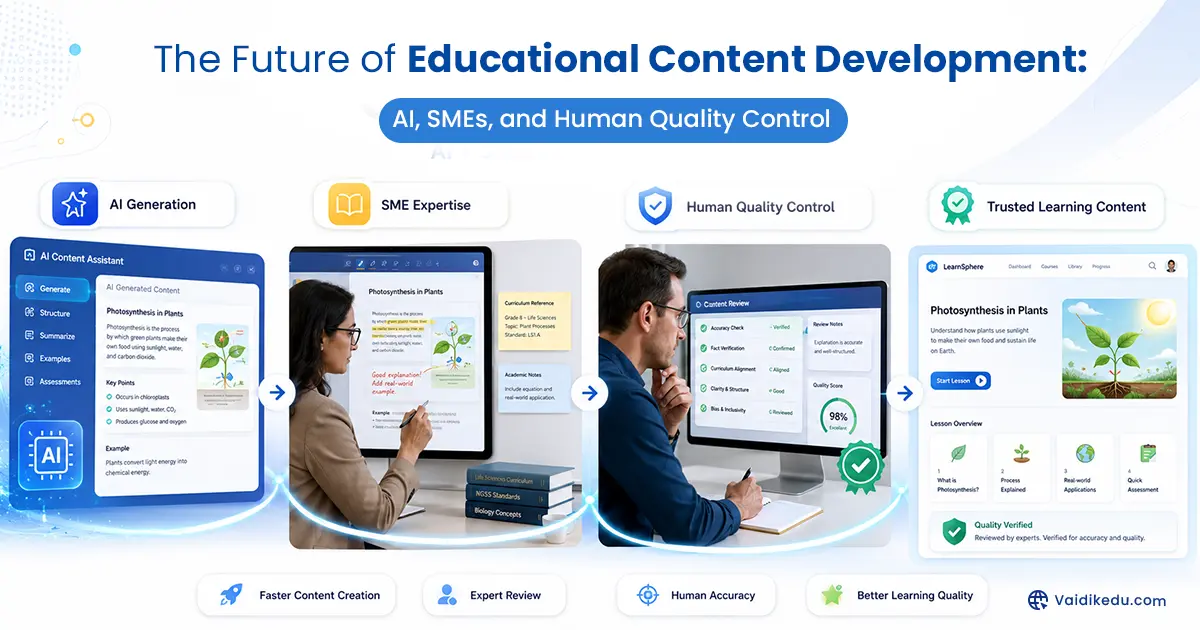
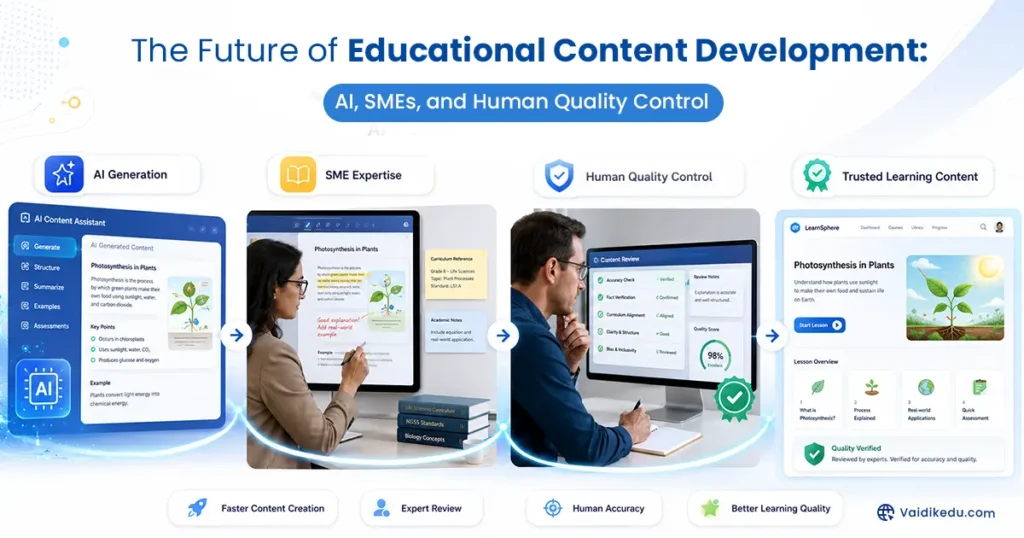
This is why the future of educational content development is unlikely to be completely AI-driven. Instead, the strongest model is likely to combine AI efficiency, SME expertise, instructional design, and human quality control.
In this article, we explore how this model is changing educational content development, what role AI and SMEs will play, and how education companies can build scalable content production systems without sacrificing quality.
What is Educational Content Development?
Educational content development is the process of researching, designing, creating, reviewing, and maintaining learning materials for students, teachers, institutions, and education businesses.
Educational content can include:
- Textbooks and digital textbooks
- Online course materials
- Lesson plans
- Worksheets
- Assessments and quizzes
- Question banks
- Video scripts
- E-learning modules
- Interactive learning activities
- Study guides
- Teacher resources
- Curriculum-aligned learning materials
- Educational articles and resources
- Learning management system (LMS) content
- Personalized learning materials
Modern educational content development goes beyond simply writing educational material. It involves understanding learning objectives, curriculum standards, student levels, instructional strategies, assessment requirements, and learner needs.
For EdTech companies, publishers, tutoring organizations, and educational institutions, this makes content development both a creative and highly specialized process.
Why Educational Content Development Is Changing
The demand for digital learning content has increased significantly as education becomes more technology-driven.
EdTech companies need content for websites, mobile applications, learning platforms, tutoring programs, online courses, assessments, and personalized learning systems.
At the same time, organizations face several challenges:
- Increasing content production costs
- Shorter content development timelines
- Demand for curriculum-specific materials
- Multiple grade levels and subjects
- Different educational standards across countries
- Growing demand for personalized learning
- Continuous content updates
- Need for assessment-quality questions
- Requirement for expert review
- Difficulty finding specialized educational writers and SMEs
AI can address some of these challenges, but it cannot independently guarantee educational accuracy or pedagogical quality.
The result is a new content development model where technology handles scale and humans provide expertise, judgment, and accountability.
How AI Is Transforming Educational Content Development
Artificial intelligence can support almost every stage of the educational content development workflow.
1. AI-Assisted Educational Research
AI can help content teams research topics, organize information, identify concepts, summarize source material, and create preliminary content outlines.
For example, an educational publisher developing a high-school biology chapter could use AI to generate an initial structure covering:
- Learning objectives
- Key concepts
- Definitions
- Examples
- Practice activities
- Review questions
- Assessment ideas
However, AI-generated research should not automatically be treated as authoritative.
Educational content teams still need experts to verify information, check sources, identify inaccuracies, and ensure that the material reflects the intended curriculum.
2. AI-Assisted Content Creation
Generative AI can accelerate the creation of first drafts for:
- Lesson explanations
- Reading passages
- Practice exercises
- Quiz questions
- Flashcards
- Educational articles
- Video scripts
- Learning activities
- Study guides
- Teacher instructions
This can significantly reduce the time required to move from a content brief to a working draft.
But the goal should not be “AI writes everything.”
A better approach is:
AI generates → SME validates → instructional designer improves → editor reviews → quality team approves
This keeps the benefits of automation while maintaining educational quality.
3. AI for Question and Assessment Development
Assessment content is one of the areas where AI can provide substantial productivity gains.
AI can help generate:
- Multiple-choice questions
- Short-answer questions
- True/false questions
- Scenario-based questions
- Practice tests
- Distractors
- Explanations
- Question variations
- Difficulty-level variations
For example, an AI system could generate multiple versions of a mathematics problem while maintaining the same underlying skill.
However, assessment content requires particularly strong human review.
A question can be grammatically correct but still have:
- An incorrect answer
- Multiple possible answers
- A weak distractor
- Ambiguous wording
- An inappropriate difficulty level
- A mismatch with the curriculum
- An incorrect cognitive level
Therefore, AI-assisted assessment development still requires expert human validation.
4. AI for Content Personalization
Personalized learning is another important application.
AI can help adapt educational content according to:
- Student ability
- Grade level
- Learning objectives
- Previous performance
- Reading level
- Preferred learning format
- Areas of difficulty
- Assessment results
For example, the same concept could be presented through a basic explanation for one learner and a more advanced application-based explanation for another.
This creates opportunities for scalable personalized learning that would be difficult to produce entirely manually.
5. AI for Content Localization
Global education companies often need to adapt content for different countries, curricula, languages, and learner populations.
AI can assist with:
- Translation
- Content adaptation
- Reading-level adjustments
- Terminology changes
- Localization
- Content variation
- Regional examples
However, translation is not the same as educational localization.
A human reviewer may need to determine whether an example, cultural reference, measurement system, educational term, or assessment format is appropriate for the target market.
The Growing Role of Subject Matter Experts (SMEs)
While AI is becoming more capable, subject matter experts remain critical to high-quality educational content development.
A Subject Matter Expert (SME) is a professional with deep knowledge of a particular academic or professional subject.
Examples include:
- Mathematics experts
- Science educators
- Physics specialists
- Chemistry experts
- Biology teachers
- English language specialists
- History experts
- Computer science professionals
- Curriculum specialists
- Assessment experts
SMEs provide something AI cannot reliably provide on its own: domain-specific judgment and accountability.
What Do SMEs Do in AI-Assisted Content Development?
SMEs can:
- Validate factual accuracy
- Check curriculum alignment
- Identify misconceptions
- Verify calculations
- Review examples
- Evaluate question quality
- Confirm terminology
- Assess difficulty levels
- Improve explanations
- Identify missing concepts
- Review AI-generated content
- Approve final educational materials
The role of SMEs is therefore changing from simply creating content to becoming expert validators and quality controllers within an AI-assisted production workflow.
AI + SMEs: A Better Educational Content Development Model
The future is not necessarily about choosing between AI and human experts.
It is about combining them.
A modern educational content workflow can look like this:
Content Brief → AI-Assisted Research → AI Draft → SME Review → Instructional Design Review → Editing → Quality Assurance → Final
Approval
Each stage has a different purpose.
AI
AI provides speed, scalability, content variations, automation, and production assistance.
SMEs
SMEs provide subject expertise, accuracy, curriculum knowledge, and academic judgment.
Instructional Designers
Instructional designers ensure that content supports meaningful learning objectives and appropriate learning experiences.
Editors
Editors improve clarity, structure, consistency, grammar, and readability.
Human Quality Control
Quality control teams verify that the final material meets predefined academic, instructional, technical, and editorial standards.
This hybrid model can produce content faster without treating AI output as automatically correct.
Why Human Quality Control Still Matters
One of the biggest misconceptions about AI-generated educational content is that a technically fluent response is necessarily a high-quality learning resource.
AI-generated content can contain:
- Factual inaccuracies
- Outdated information
- Hallucinated references
- Incorrect calculations
- Biased explanations
- Cultural assumptions
- Inconsistent terminology
- Curriculum mismatches
- Incorrect difficulty levels
- Ambiguous assessment questions
UNESCO specifically highlights the need to validate GenAI systems and outputs, protect human agency, and maintain human accountability for decisions involving AI-generated educational content.
This makes human quality control an essential component of modern educational content production.
What Does Human Quality Control Include?
A comprehensive educational content quality assurance process can include several levels.
1. Factual Accuracy
Does the content contain correct information?
SMEs should verify important facts, concepts, calculations, formulas, dates, definitions, and examples.
2. Curriculum Alignment
Does the content correspond with the intended curriculum or academic standard?
For example, content designed for a U.S. school may need to align with relevant state or national standards, while international content may need to align with GCSE, IGCSE, IB, A Level, AP, or other curricula.
3. Pedagogical Quality
Does the content actually support learning?
Reviewers should consider:
- Learning objectives
- Student level
- Cognitive demand
- Explanation quality
- Examples
- Practice opportunities
- Feedback
- Progression of concepts
4. Language and Readability
Educational material must be understandable for its intended learners.
Quality control should check:
- Grammar
- Sentence structure
- Terminology
- Reading level
- Clarity
- Consistency
- Tone
5. Assessment Quality
Questions should be checked for:
- Accuracy
- Difficulty
- Relevance
- Answer validity
- Distractor quality
- Cognitive level
- Curriculum alignment
6. Bias and Inclusivity
Educational content should be reviewed for inappropriate assumptions, stereotypes, exclusionary language, and cultural bias.
UNESCO’s AI guidance emphasizes inclusion, equity, linguistic and cultural diversity, and protection of human agency in the use of GenAI for education.
The Future Educational Content Development Workflow
The traditional workflow was often:
Research → Write → Edit → Review → Publish
The AI-assisted workflow is becoming more sophisticated:
Define Learning Objective
↓
Create Content Brief
↓
AI-Assisted Research
↓
AI-Assisted Drafting
↓
SME Validation
↓
Instructional Design Review
↓
Editorial Review
↓
Assessment Validation
↓
Human Quality Assurance
↓
Final Approval
↓
Publishing
↓
Performance Monitoring
↓
Content Updates
This workflow creates multiple quality checkpoints instead of relying entirely on the AI generation stage.
AI Will Change the Role of Educational Content Developers
AI is unlikely to eliminate the need for educational content professionals.
Instead, their roles are likely to evolve.
From Writers to Content Strategists
Instead of spending most of their time producing first drafts, content professionals can focus more on:
- Content architecture
- Learning objectives
- Content strategy
- Learner needs
- Quality standards
- Content optimization
From SMEs as Writers to SMEs as Validators
Subject matter experts can increasingly focus on:
- Accuracy
- Curriculum alignment
- Expert review
- Misconception detection
- Assessment validation
From Editors to Quality Controllers
Editors can increasingly focus on:
- Consistency
- Clarity
- Brand standards
- Accuracy checks
- AI output review
- Content governance
From Instructional Designers to Learning Experience Architects
Instructional designers will continue to play a critical role in determining how content supports actual learning outcomes.
UNESCO’s AI competency framework for teachers identifies human-centered thinking, AI ethics, AI foundations, AI pedagogy, and professional learning as important areas of competency in AI-enabled education.
Benefits of AI-Assisted Educational Content Development
When implemented correctly, AI-assisted content development can provide several benefits.
Faster Content Production
AI can accelerate repetitive drafting and content transformation tasks.
Greater Scalability
Organizations can produce more content across subjects, grades, and curricula.
Lower Production Costs
Automation can reduce the amount of manual effort required for repetitive activities.
More Content Variations
AI can create multiple versions of explanations, examples, exercises, and questions.
Personalized Learning Opportunities
Content can be adapted for different learner profiles.
Faster Content Updates
Organizations can more efficiently revise and refresh existing educational materials.
Improved Content Operations
AI can help organizations structure and standardize large-scale content production workflows.
However, these benefits are strongest when AI operates within a clearly defined human quality-control system.
Challenges of AI in Educational Content Development
AI-assisted content development also creates new challenges.
Accuracy and Hallucinations
AI systems can produce information that sounds convincing but is incorrect.
Copyright and Content Ownership
Organizations need clear policies around source material, training data, generated content, and intellectual property.
Data Privacy
Education organizations may process sensitive learner and institutional information. AI workflows should therefore consider
privacy, security, consent, and appropriate data handling.
Bias
AI-generated content can reflect biases present in its training data or the way systems are designed.
Lack of Context
AI may not fully understand the instructional context, learner background, curriculum requirements, or institutional objectives.
Over-Automation
Organizations that automate too much of the workflow may reduce opportunities for expert judgment.
This is why responsible AI adoption in education requires more than simply purchasing an AI tool.
How Educational Publishers and EdTech Companies Can Prepare
Organizations that develop educational content at scale should begin building an AI-ready content development framework.
Step 1: Identify Where AI Adds Value
Not every task needs automation.
Identify repetitive activities that AI can support while keeping high-risk decisions under human control.
Step 2: Create SME Review Processes
Define which types of content require SME approval.
For example:
- New curriculum content
- Assessment questions
- Complex scientific concepts
- Mathematical calculations
- Medical or technical content
- High-stakes examination materials
Step 3: Establish AI Content Guidelines
Create internal policies covering:
- Approved AI tools
- Data privacy
- Prompting practices
- Source verification
- AI disclosure
- Copyright
- Human review
- Quality standards
Step 4: Build Quality Checklists
Create standardized review criteria for:
- Accuracy
- Curriculum alignment
- Pedagogy
- Language
- Accessibility
- Assessment quality
- Bias
- Formatting
Step 5: Measure Content Quality
Track metrics such as:
- Review rejection rate
- Error rate
- SME correction rate
- Production time
- Cost per content item
- Learner engagement
- Assessment performance
- Content update time
Step 6: Continuously Improve the Workflow
AI systems and educational requirements will continue to change.
Organizations should regularly evaluate whether their AI-assisted content workflow is improving both efficiency and educational outcomes.
The Future: AI-Assisted, Expert-Validated Educational Content
The future of educational content development will likely be neither completely manual nor completely automated.
Instead, it will be AI-assisted and human-validated.
AI will increasingly handle:
- Draft generation
- Content transformation
- Personalization
- Variations
- Classification
- Metadata
- Repetitive production tasks
- Content organization
Humans will remain responsible for:
- Educational judgment
- Subject expertise
- Curriculum interpretation
- Pedagogical decisions
- Ethical considerations
- Quality assurance
- Final approval
This division of responsibilities creates a powerful combination.
AI provides scale.
SMEs provide expertise.
Instructional designers provide learning strategies.
Editors provide clarity.
Human quality control provides trust.
Why Human-in-the-Loop Content Development Will Matter
The concept of human-in-the-loop AI is particularly relevant to education.
Instead of allowing AI to independently create and publish educational materials, organizations can design workflows where humans remain involved at important decision points.
For example:
AI generates → Human reviews → AI revises → SME validates →
Human QA approves
This approach allows organizations to benefit from AI while maintaining accountability.
UNESCO recommends that educational use of GenAI remain human-controlled and pedagogically appropriate, with human accountability for decisions about accuracy, teaching strategies, and their impact on learners.
Educational Content Development Is Becoming a Strategic Capability
For EdTech companies, educational publishers, schools, universities, and tutoring organizations, content is no longer simply a production requirement.
It is a competitive advantage.
Organizations that can consistently produce:
- Accurate content
- Curriculum-aligned materials
- High-quality assessments
- Engaging learning experiences
- Personalized resources
- Multilingual content
- Regularly updated materials
can create stronger learning products and improve their ability to scale.
AI can make this process faster, but quality remains the differentiator.
The organizations that succeed will not necessarily be those using the most AI.
They will be those that build the best AI + expert + quality-control workflow.
Conclusion
The future of educational content development is moving toward a hybrid model where artificial intelligence and human expertise work together.
AI can accelerate research, drafting, personalization, assessment creation, localization, and content operations. Subject matter experts can provide the academic knowledge and judgment required to validate that content.
Instructional designers can ensure that materials support meaningful learning objectives, while editors and quality-control teams can ensure accuracy, consistency, accessibility, and usability.
The most effective approach is therefore not AI versus humans.
It is AI + SMEs + instructional expertise + human quality control.
For educational publishers and EdTech companies, this model provides a path toward producing educational content at greater speed and scale without compromising the trust and quality that learners, educators, parents, and institutions expect.
As AI continues to evolve, one principle will remain important: technology should enhance educational expertise, not replace the human judgment that makes learning content valuable.
The future of educational content development is not about choosing between artificial intelligence and human expertise.
It is about designing a system where both work together.
AI creates scale.
SMEs create accuracy.
Instructional designers create learning value.
Human quality control creates trust.
That combination can help educational organizations build faster, smarter, and more reliable learning content for a global audience.
Vaidik Edu Services can support organizations looking to scale educational content development through a combination of subject expertise, curriculum knowledge, instructional expertise, and structured quality assurance.
Frequently Asked Questions
AI is transforming educational content development by helping create drafts, personalize learning materials, automate repetitive tasks, generate assessments, and improve content production efficiency. However, human expertise remains essential for accuracy, relevance, and educational quality.
Subject Matter Experts (SMEs) provide specialized knowledge and ensure that educational content is accurate, curriculum-aligned, and appropriate for the target learners. SMEs also review AI-generated content and identify subject-specific errors or gaps.
Human quality control helps identify factual errors, misleading information, inappropriate language, bias, and inconsistencies that AI may produce. Human reviewers ensure that the final content meets academic, instructional, and quality standards.