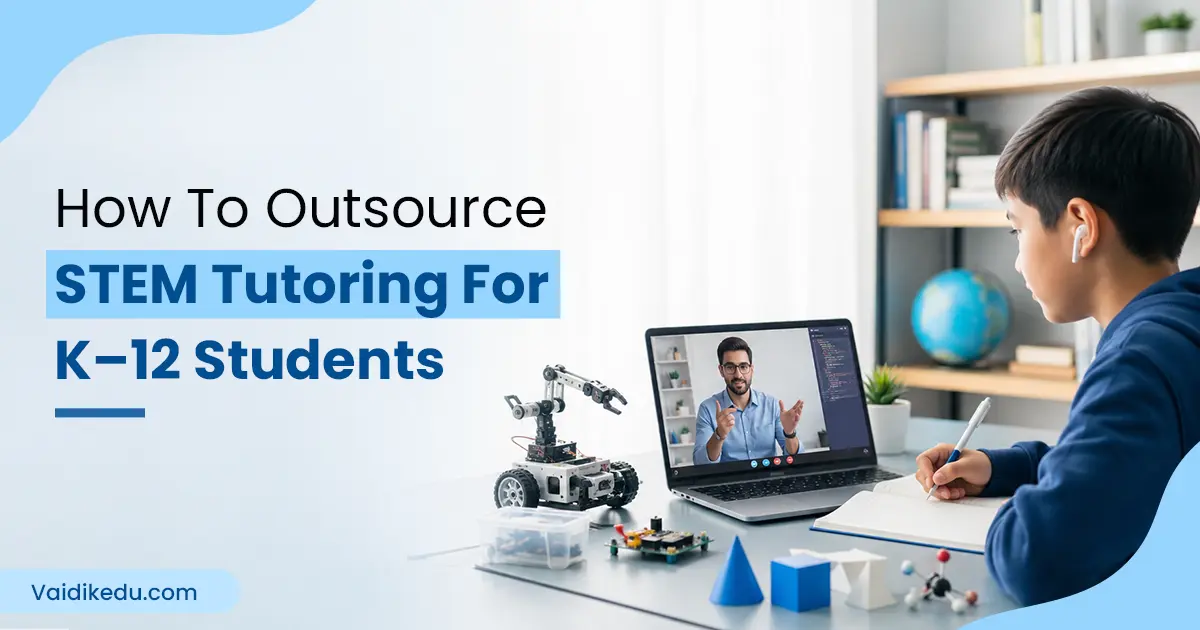


STEM education is no longer limited to teaching Science, Technology, Engineering and Mathematics as four separate subjects.
Students increasingly need opportunities to connect these disciplines, apply knowledge to authentic problems, work with digital tools and develop the ability to reason, experiment, design and solve unfamiliar problems.
This creates a challenge for schools, EdTech companies and educational organisations:
how can they build STEM curricula that remain academically rigorous while also preparing learners for changing technological, scientific and professional environments?
A strong STEM curriculum needs more than a list of topics.
It requires clear learning outcomes, meaningful progression, appropriate assessment, hands-on and inquiry-based experiences, interdisciplinary connections, teacher support and carefully selected technology.
This is where STEM curriculum development services can provide valuable support.
Curriculum specialists can work with subject-matter experts, educators and instructional designers to create structured learning programmes that connect academic knowledge with practical application.
What Is STEM Curriculum Development
STEM curriculum development is the process of designing structured learning experiences that integrate science, technology, engineering and mathematics around clearly defined educational outcomes.
A well-designed STEM curriculum can include:
- Subject knowledge and foundational concepts
- Scientific inquiry
- Mathematical reasoning
- Engineering design
- Computational thinking
- Problem-solving
- Project-based learning
- Experiments and practical activities
- Digital tools and simulations
- Collaboration and communication
- Formative and summative assessment
UNESCO describes STEM education as an interdisciplinary approach that integrates science, technology, engineering and mathematics to foster critical thinking, problem-solving and innovation.
The objective is therefore not simply to add more technology to a science or mathematics classroom.
It is to design learning experiences in which students can use knowledge from different disciplines to understand and address meaningful problems.
Why Does STEM Curriculum Need to Evolve
STEM disciplines are continually developing, while the skills students need to use them effectively are also changing.
For example, students increasingly encounter computational tools, data, simulations, digital models and AI-supported technologies in academic and professional environments.
The OECD’s current work on learning in the digital world highlights the importance of computational and scientific inquiry practices, including using digital tools to explore systems, represent ideas and solve problems.
This does not mean that foundational mathematics, science or engineering knowledge has become less important.
Instead, students need opportunities to connect foundational knowledge with application.
A modern STEM curriculum should therefore ask not only:
“What should students know?”
but also:
“What should students be able to do with what they know?”
10 Ways Curriculum Development Services Can Transform STEM Learning
Curriculum development services can help institutions move from fragmented subject teaching toward more structured, practical and future-focused STEM learning.
The following approaches can strengthen the design and implementation of STEM programmes.
1. Build Interdisciplinary STEM Learning
Real-world problems rarely fit neatly into one subject.
Designing a water filtration system, for example, may require students to understand scientific properties of water, calculate quantities, consider engineering constraints and use technology to model or test their solution.
Curriculum developers can identify meaningful connections between subjects and design units where students apply knowledge across disciplines.
However, interdisciplinary learning should not mean artificially combining subjects. The connections need to serve a meaningful learning purpose.
The OECD similarly notes that interdisciplinary connections can make mathematics more relevant by linking abstract concepts with applications across subjects and fields.
2. Connect STEM Concepts to Real-World Problems
Students often understand the value of learning more clearly when they can see how a concept applies beyond the classroom.
Curriculum developers can build authentic problems into STEM units, such as:
- Designing a sustainable building
- Developing a water conservation system
- Modelling population growth
- Creating a simple robotic solution
- Analysing renewable energy options
- Designing an assistive device
- Investigating environmental changes
- Developing a data-based solution to a community problem
These activities can help students connect theoretical knowledge with practical decision-making.
3. Integrate Project-Based Learning
Project-based learning can give STEM students opportunities to investigate questions, make decisions, test ideas and revise their solutions.
A well-designed STEM project should include more than simply creating a physical object.
Students may need to:
- Understand the problem
- Research relevant concepts
- Develop possible solutions
- Select an approach
- Build or model a solution
- Test it
- Analyse the results
- Make improvements
- Explain and reflect on their work
This process helps connect content knowledge with problem-solving and engineering or scientific practices.
UNESCO has highlighted examples of integrated STEM projects in which students explore climate-related challenges through activities such as ecosystem construction and renewable-energy design.
4. Strengthen Problem-Solving and Critical Thinking
STEM education should give students opportunities to work through problems where the answer is not immediately obvious.
Curriculum developers can deliberately build progression into problem-solving activities.
For younger learners, this might involve identifying patterns, making predictions or testing simple designs.
For older students, it could involve analysing data, evaluating competing solutions, designing experiments or using mathematical models.
The OECD’s future-focused mathematics work emphasises the importance of data literacy, computational thinking and problem-solving while also highlighting the need to avoid curriculum overload.
The goal is not to add endless new topics. It is to create better opportunities to apply existing knowledge.
5. Use Digital Tools With a Clear Learning Purpose
Technology can make some STEM concepts easier to explore, model and visualise.
Depending on the learning objective, a curriculum might incorporate:
- Coding environments
- Data-analysis tools
- Digital simulations
- Virtual laboratories
- Interactive models
- Robotics platforms
- Computer-aided design
- Digital sensors
- Educational software
- AI-supported tools
OECD research on digital technologies notes that programming environments, simulations and other digital tools can support engagement, conceptual understanding and interdisciplinary learning when used thoughtfully.
The important point is that technology should follow pedagogy.
A curriculum should not introduce a simulation simply because it looks impressive.
The tool should help students understand, investigate, practise or demonstrate something that would otherwise be difficult to achieve.
6. Develop Computational Thinking and Data Literacy
Modern STEM education increasingly intersects with data and computation.
Students may need to learn how to:
- Identify patterns in data
- Represent information
- Interpret graphs
- Build simple models
- Develop algorithms
- Use computational logic
- Evaluate digital outputs
- Understand limitations in models and datasets
These skills can be integrated into mathematics and science lessons rather than treated exclusively as computer-science topics.
The OECD’s PISA 2025 Learning in the Digital World framework specifically examines students’ ability to use computational tools for knowledge building and problem-solving.
7. Design for Different Learners
A STEM curriculum needs to account for differences in prior knowledge, pace, interests and learning needs.
Curriculum development services can support differentiated learning by providing:
- Multiple levels of challenge
- Scaffolding for complex tasks
- Extension activities
- Alternative representations
- Structured practice
- Choice in project outcomes
- Accessible digital resources
- Different pathways toward the same learning objective
This allows students to work toward common outcomes while receiving appropriate levels of support or challenge.
Inclusive curriculum design is particularly important when STEM programmes use technology, because access to devices, connectivity and digital skills can vary among learners.
UNESCO’s current digital-learning work emphasises inclusive, ethical and future-ready approaches rather than treating technology access as an automatic solution to educational challenges.
8. Align Assessment With STEM Learning Goals
A curriculum can encourage creativity and problem-solving while still assessing only memorised facts.
When that happens, the assessment system can undermine the curriculum itself.
STEM curriculum development should therefore align:
Learning objectives → Learning activities → Assessment
If students are expected to design, investigate and solve problems, assessment should provide opportunities to demonstrate those capabilities.
Depending on the programme, assessment can include:
- Concept quizzes
- Practical investigations
- Design challenges
- Project reports
- Presentations
- Portfolios
- Data-analysis tasks
- Problem-solving exercises
- Performance assessments
- Reflective activities
Vaidik Eduservices’s STEM curriculum services currently include quizzes, tests and project-based assessments, along with analytics-driven approaches to tracking learner progress.
9. Support Teachers With Curriculum Implementation
A well-designed curriculum is only effective when teachers have the resources and support needed to implement it.
Teachers may need:
- Detailed lesson plans
- Teaching guides
- Activity instructions
- Assessment rubrics
- Sample student work
- Digital-resource guidance
- Professional learning
- Troubleshooting support
- Progression frameworks
Curriculum development services can help create these supporting resources alongside the student-facing curriculum.
This is especially important when STEM programmes introduce new pedagogies or technologies.
OECD research emphasises that teachers need continuing professional learning to use digital resources effectively and adapt pedagogy to new learning environments.
10. Build Evaluation and Continuous Improvement Into the Curriculum
Curriculum development should not end when the materials are delivered.
Schools and education organisations need to understand whether the curriculum is achieving its intended outcomes.
Evaluation can examine:
- Student performance
- Engagement
- Completion rates
- Assessment results
- Teacher feedback
- Student feedback
- Difficult concepts
- Resource effectiveness
- Implementation challenges
This evidence can then inform curriculum revisions.
A continuous cycle of design → implement → evaluate → improve helps prevent STEM programmes from becoming outdated or disconnected from learner needs.
What Should a Modern STEM Curriculum Include?
A strong STEM curriculum should balance foundational knowledge with opportunities for application.
Depending on the age group and programme objectives, it can include:
Foundational Knowledge
Students need a strong understanding of scientific principles, mathematical concepts and technical knowledge before they can apply them effectively.
Inquiry and Investigation
Students should have opportunities to ask questions, develop hypotheses, gather evidence and draw conclusions.
Engineering Design
Engineering activities can introduce processes such as defining problems, developing solutions, testing designs and improving them.
Computational Thinking
Students can develop skills related to algorithms, patterns, data, modelling and computational problem-solving.
Practical Application
Experiments, prototypes, simulations and projects can connect concepts with action.
Collaboration and Communication
STEM professionals rarely work entirely in isolation. Students can therefore benefit from explaining ideas, discussing evidence, collaborating on projects and presenting solutions.
Reflection
Students should have opportunities to examine what worked, what did not work and how their thinking changed during the learning process.
Examples of Curriculum-Designed STEM Projects
Curriculum development services can transform broad STEM concepts into structured learning experiences.
Renewable Energy Project
Students investigate energy sources, calculate energy requirements, explore efficiency and design a renewable-energy solution for a hypothetical community.
Water Management Challenge
Students examine water usage, collect or interpret data, investigate filtration and design strategies for reducing water waste.
Smart Agriculture Project
Students combine biology, mathematics, technology and engineering to explore how sensors and data could support agricultural decision-making.
Sustainable Building Challenge
Students investigate materials, energy efficiency, geometry and environmental considerations before developing a model of a sustainable structure.
Assistive Technology Project
Students identify an everyday accessibility challenge and use engineering and technology concepts to design a possible solution.
The educational value comes not simply from producing the final product but from the research, reasoning, testing, revision and reflection involved throughout the project.
How Curriculum Development Services Help Make STEM Learning More Practical
One of the biggest challenges in STEM education is connecting abstract concepts with meaningful application.
Curriculum specialists can build this connection deliberately.
For example, instead of teaching statistics as a collection of formulas, students could analyse real datasets and use statistical reasoning to answer a defined question.
Instead of teaching geometry only through textbook exercises, students could use geometric principles to design a structure.
Instead of teaching coding solely through syntax exercises, students could use programming to model a scientific or mathematical problem.
This approach does not eliminate foundational instruction. It gives students a context in which to apply it.
The Role of Assessment in Transforming STEM Education
Assessment should measure more than whether students can remember information.
A broader STEM assessment framework can examine whether students can:
- Explain scientific concepts
- Apply mathematical reasoning
- Interpret data
- Design solutions
- Conduct investigations
- Evaluate evidence
- Revise an approach
- Communicate conclusions
This requires curriculum developers to consider assessment at the beginning of the design process rather than adding tests after the instructional materials have already been created.
Common Challenges in STEM Curriculum Development
Creating a modern STEM curriculum also comes with practical challenges.
Curriculum Overload
Adding coding, robotics, AI, sustainability and project work to an already crowded curriculum can overwhelm teachers and students.
Solution: prioritise essential learning outcomes and integrate new skills into existing subjects where meaningful connections exist.
Limited Resources
Some schools may not have laboratories, robotics kits or advanced technology.
Solution: design multiple implementation pathways using available materials, low-cost activities, digital simulations and optional enrichment resources.
Teacher Readiness
Teachers may be comfortable with STEM content but less experienced with interdisciplinary projects or new digital tools.
Solution: provide professional development, teacher guides, examples and implementation support.
Assessment Difficulties
Projects and open-ended tasks can be harder to assess consistently than traditional tests.
Solution: use clear rubrics linked directly to learning objectives and define what successful performance looks like.
Technology Becoming the Focus
There is a risk that technology becomes the centre of a STEM lesson instead of the learning objective.
Solution: start with the learning outcome and choose the technology only if it provides meaningful educational value.
How to Implement a New STEM Curriculum Successfully
Developing the curriculum is only the first step. Successful implementation requires coordination between curriculum designers, educators, administrators and learners.
A practical implementation process can include:
1. Conduct a Needs Assessment
Identify learner needs, existing curriculum strengths, gaps, available resources and institutional goals.
2. Define Learning Outcomes
Determine what students should know, understand and be able to do at each stage.
3. Map the Curriculum
Organise concepts, skills and experiences into a logical progression.
4. Select Instructional Approaches
Choose approaches such as inquiry learning, project-based learning, problem-based learning, direct instruction and collaborative learning according to the intended outcomes.
5. Develop Learning Materials
Create lesson plans, activities, digital resources, projects, assessments and teacher guides.
6. Pilot the Curriculum
Test selected units with teachers and learners before full implementation.
7. Gather Feedback
Use student performance, teacher observations and stakeholder feedback to identify improvements.
8. Revise and Scale
Refine the curriculum before expanding it across grades, schools or learning platforms.
How Vaidik Eduservices Supports STEM Curriculum Development
Vaidik Eduservices provides curriculum development and STEM curriculum design services for educational organisations, institutions and other learning providers.
Its curriculum-development approach includes needs assessment, curriculum design, content development, implementation support and quality review.
For STEM programmes specifically, Vaidik offers curriculum design and development, eLearning content, assessment and evaluation, and STEM programme consulting.
Its STEM curriculum solutions include interactive and hands-on learning approaches, digital resources, multimedia, simulations and project-based assessments.
Vaidik’s wider curriculum services can also support:
- Learning-outcome development
- Curriculum frameworks
- Lesson plans
- Instructional strategies
- Digital learning resources
- Assessment development
- Teacher resources
- Standards alignment
- eLearning and LMS-ready solutions
- Curriculum implementation support
Its curriculum development process begins with understanding the client’s goals, learners, subject requirements and learning outcomes before bringing together subject-matter experts, instructional designers and editors to develop and review the curriculum.
For organisations seeking to modernise a STEM programme, this combination of curriculum expertise, instructional design, content development, assessment and technology-supported learning can provide a structured way to move from curriculum planning to implementation.
Conclusion
Effective STEM education is not created simply by adding more science, technology or digital tools to the timetable. It requires a carefully structured curriculum that connects knowledge with inquiry, application, problem-solving and meaningful assessment.
Curriculum development services can help institutions design these connections systematically.
They can support interdisciplinary learning, project-based experiences, digital integration, differentiated instruction, teacher preparation and continuous curriculum improvement.
The strongest STEM programmes also recognise that technology is a tool rather than the objective.
Students still need strong foundational knowledge, skilled teachers, meaningful questions and opportunities to reason, experiment, design and learn from failure.
For schools, EdTech companies and educational organisations, investing in thoughtful STEM curriculum development can therefore create a stronger foundation for learners to understand complex ideas and apply them to unfamiliar problems.
The goal is not simply to prepare students to use today’s technologies. It is to help them develop the knowledge, curiosity, problem-solving ability and adaptability needed to keep learning as STEM itself continues to evolve.
Frequently Asked Questions
The traditional curriculum for STEM education involves less practical knowledge and more rote memorization of facts. The students lack the necessary skills and hands-on experience to cater to the research and industrial needs of today.
Irrelevant and outdated curriculum does not teach students contemporary skills required for their all-round development. Due to a lack of practical knowledge and hands-on experience, they find it difficult to advance their careers in this technologically driven world.
Curriculum development services can redefine curriculum by collaborating with educators and field experts aligning it with the present and future needs. They can use interdisciplinary and project-based approaches to learning to modernize the STEM curriculum.
Curriculum development services can support teachers by providing training workshops, ongoing support, and access to resources that will help them adopt new teaching methodologies and incorporate the latest technology into their classrooms.