

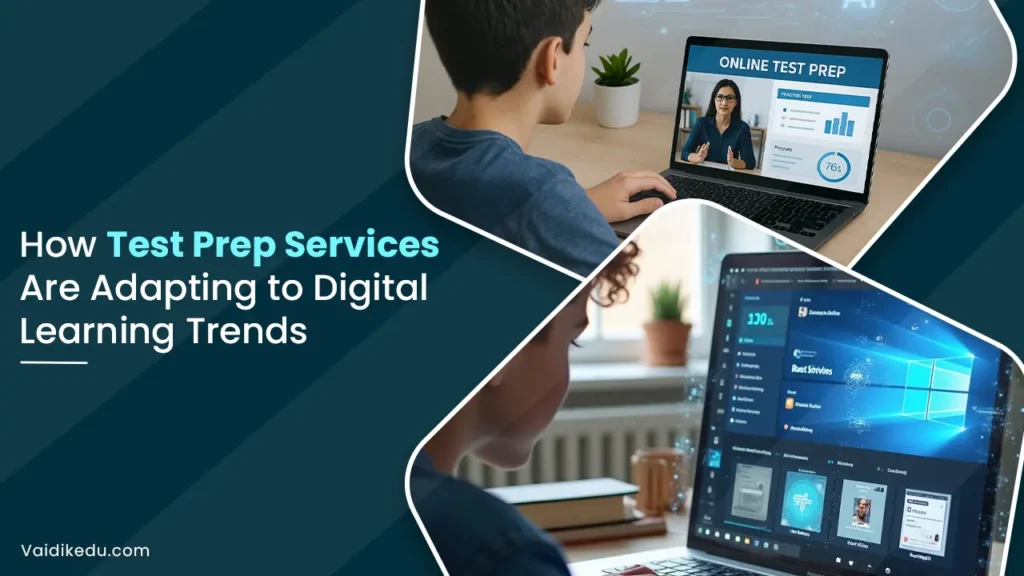
Digital technology has changed more than where students study for an exam. It is changing how test preparation providers deliver instruction, diagnose learning gaps, create practice materials, track progress, and connect students with tutors.
Students preparing for standardised tests and academic assessments can now access digital practice questions, full-length mock exams, video lessons, interactive exercises, performance dashboards, live tutoring, and personalised study recommendations from a single learning environment.
At the same time, test-prep providers face a new challenge:
simply putting traditional study materials online is no longer enough. Effective digital test preparation needs to combine curriculum and exam knowledge with sound instructional design, reliable assessment, useful data, accessibility, and appropriate technology.
Here are the major digital learning trends shaping modern test preparation services.
16 Key Digital Learning Trends Shaping Modern Test Preparation
Test preparation is moving beyond traditional textbooks, classroom lessons, and practice papers.
Digital tools are enabling providers to personalise learning, deliver realistic exam simulations, analyse student performance, support live instruction, and update content more efficiently. The following trends are shaping how modern test-prep services are designed and delivered:
1. Digital-First Test Preparation Platforms
Many test-prep services now provide a central digital environment where students can access lessons, practice questions, mock exams, explanations, progress reports, and other resources.
This allows students to move between different types of preparation without relying entirely on printed workbooks or fixed classroom schedules.
A digital test-prep platform may provide:
- Video lessons
- Practice question banks
- Timed quizzes
- Full-length mock exams
- Study guides
- Performance dashboards
- Progress tracking
- Digital flashcards
- Explanations and worked solutions
- Tutor communication
The exact features vary by provider, but the broader shift is from a collection of study materials toward an integrated preparation experience.
2. Personalised Learning Paths
Students rarely have identical strengths and weaknesses.
One student may need extensive support with algebra, while another may understand the mathematics but struggle with reading speed or test strategy.
A digital platform can use performance information to help identify these differences and recommend appropriate practice.
A personalised preparation pathway might involve:
- Diagnostic assessment
- Identification of strengths and gaps
- Targeted lessons
- Focused practice
- Additional assessment
- Progress review
- Adjustment of the study plan
Personalisation is most useful when recommendations are connected to meaningful learning objectives rather than simply generating more content.
3. Adaptive Practice and Assessment
Adaptive learning systems can change the sequence or difficulty of activities based on student responses.
For example, a platform may provide additional foundational questions when a student repeatedly struggles with a particular concept.
Once the student demonstrates greater proficiency, the system can introduce more challenging questions.
However, adaptive technology should not be confused with effective teaching by default.
The quality of the underlying questions, explanations, diagnostic logic, curriculum mapping, and learning design determines whether adaptation actually provides useful support.
4. Data-Driven Performance Tracking
Digital test preparation creates opportunities to collect more detailed information about student performance than a simple score on a practice test.
Depending on the platform, providers may analyse:
- Accuracy by topic
- Question difficulty
- Time spent on questions
- Patterns of incorrect answers
- Progress across practice sessions
- Mock-test performance
- Areas of repeated difficulty
- Completion of assigned activities
This information can help tutors and students decide what to work on next.
For example, a student who consistently answers geometry questions incorrectly may need conceptual instruction rather than simply more random geometry questions.
The goal of analytics should therefore be better instructional decisions, not simply more data.
5. Digital Mock Exams That Replicate the Testing Experience
Practice tests are an important part of exam preparation, and digital delivery makes it possible to create increasingly realistic testing environments.
A digital mock exam can replicate elements such as:
- Exam timing
- Question formats
- Navigation
- Digital calculators or reference tools where applicable
- Section breaks
- On-screen instructions
- Time management demands
- Immediate or delayed scoring
This is particularly relevant as more major assessments offer digital testing options.
For example, the ACT provides online testing and requires students using that format to prepare compatible devices and use its testing software.
The College Board also continues to update its digital SAT/PSAT testing ecosystem, including new practice-test functionality and improvements to its Bluebook testing environment.
As the exam itself becomes digital, preparation needs to account for both academic knowledge and digital test-taking skills.
6. Mobile Learning and Short Practice Sessions
Mobile devices have made it possible for students to practise outside traditional study periods.
A student might complete a short vocabulary activity during a commute, review flashcards between classes, or answer a small set of mathematics questions during a study break.
Mobile learning can support:
- Flashcards
- Vocabulary practice
- Short quizzes
- Formula review
- Timed questions
- Progress checks
- Revision reminders
However, mobile learning should complement deeper study rather than replace it.
Short activities are useful for review and retrieval practice, while complex concepts may require longer lessons, worked examples, or interaction with a tutor.
7. Video and Interactive Learning Content
Digital test-prep services increasingly use multimedia to explain concepts and demonstrate problem-solving strategies.
Examples include:
- Short instructional videos
- Worked-problem demonstrations
- Animated explanations
- Interactive diagrams
- Step-by-step solutions
- Scenario-based activities
- Digital whiteboards
Video can be particularly useful when a tutor needs to demonstrate a multi-step process.
However, simply converting a traditional lecture into a video does not guarantee better learning.
Effective digital content should be structured around the learning objective and give students opportunities to actively practise what they have learned.
8. Live Online Tutoring Alongside Self-Paced Learning
Technology has not eliminated the need for human tutors.
Self-paced platforms can provide practice and resources, but students may still need an expert to explain a difficult concept, diagnose a misconception, provide feedback, or help them develop an effective study strategy.
Digital test-prep providers can therefore combine:
- Self-paced lessons
- Automated practice
- Digital assessments
- Live one-to-one tutoring
- Small-group classes
- Instructor feedback
This blended approach allows technology to handle some repetitive practice and tracking tasks while tutors focus on explanation, reasoning, feedback, and individual support.
9. AI-Assisted Test Preparation
Artificial intelligence is becoming an increasingly important part of digital education, including test preparation.
Potential applications include:
- Generating additional practice questions
- Providing explanations
- Identifying recurring error patterns
- Recommending practice activities
- Supporting conversational tutoring
- Helping tutors analyse student performance
- Tagging and organising educational resources
- Supporting content development workflows
However, AI should be used carefully.
The OECD’s 2026 Digital Education Outlook notes that generative AI can support learning when it is used with clear pedagogical intent, but simply outsourcing cognitive tasks to general-purpose AI does not necessarily produce learning gains.
The report emphasises the importance of using AI to augment teaching while preserving human judgement and student cognitive effort.
For test preparation, this means an AI system should not simply give students answers.
It can be more useful when it encourages reasoning, identifies misconceptions, asks guiding questions, and provides appropriately designed practice.
10. More Targeted Feedback
Digital assessment can make feedback faster and more specific.
Instead of reporting only:
“You scored 65%.”
A well-designed system can show:
- Which topics require attention
- Which question types caused difficulty
- Which answers were incorrect
- Why an answer was incorrect
- Which concepts should be reviewed
- What practice should come next
For more complex work, human feedback remains important because automated systems may not reliably understand every aspect of a student’s reasoning.
The strongest digital test-prep models therefore combine automated feedback where appropriate with expert human intervention.
11. More Sophisticated Question Banks
Question banks are becoming central components of digital test preparation.
A high-quality question bank should contain more than a large number of questions.
Items need to be appropriately written, reviewed, categorised, and aligned with the relevant curriculum or exam framework.
Questions can be tagged according to:
- Subject
- Topic
- Skill
- Difficulty
- Question type
- Cognitive level
- Exam objective
- Common misconception
This allows platforms to build targeted practice sets rather than giving every student the same collection of questions.
For high-stakes testing, quality assurance and assessment expertise are particularly important because poorly written questions can provide misleading information about student ability.
12. Social Learning and Peer Support
Digital test preparation can also create opportunities for learners to interact with one another.
Depending on the course, this may involve:
- Discussion forums
- Online study groups
- Collaborative problem-solving
- Peer review
- Group tutoring
- Instructor-led communities
Peer interaction can provide motivation and expose students to different approaches to solving problems.
However, community features need moderation and clear guidelines, particularly when students are exchanging answers or discussing examination content.
The purpose should be to support learning rather than encourage unverified advice or answer-sharing.
13. Gamification and Motivation Features
Some digital test-prep platforms use points, badges, streaks, progress bars, challenges, or leaderboards to encourage continued participation.
These features can make practice feel more interactive, but gamification is not inherently educational.
A leaderboard, for example, may motivate some students while discouraging others.
Similarly, a streak can encourage consistency but may prioritise completing activities over understanding the material.
Gamification should therefore be used selectively and connected to meaningful learning behaviours.
14. Accessibility and Inclusive Digital Test Preparation
As test preparation moves online, accessibility becomes an important part of service design.
Digital resources should be usable by students with different accessibility needs, subject to the requirements of the specific examination and platform.
Depending on the learning environment, this may include:
- Captions
- Transcripts
- Keyboard-accessible controls
- Screen-reader-compatible resources
- Clear navigation
- Accessible digital documents
- Appropriate colour contrast
- Adjustable text presentation
- Alternative formats where appropriate
UNESCO has emphasised that digital learning should be inclusive, ethical, and future-ready rather than allowing technology to increase existing inequalities.
For test-prep providers, accessibility should be considered during content and platform development rather than added as a final feature.
15. Cloud-Based and On-Demand Learning
Cloud-based platforms allow students to access learning resources without being tied to a particular classroom or physical location.
This can make test preparation more flexible for students balancing:
- School
- University
- Employment
- Extracurricular activities
- Family responsibilities
- Other academic commitments
On-demand resources also allow students to revisit lessons when needed rather than relying on a single classroom explanation.
16. Continuous Content Updates
Digital test preparation also makes it easier for providers to update content when an examination framework, testing interface, syllabus, or preparation requirement changes.
This is particularly important for exams that are undergoing digital or structural changes.
For example, the Enhanced ACT has introduced a shorter testing experience, fewer questions, more time per question, and changes such as four answer choices in the mathematics section.
A test-prep provider that continues using outdated practice materials can give students an inaccurate picture of the current examination.
Digital content workflows therefore need mechanisms for:
- Monitoring exam changes
- Reviewing existing content
- Updating question banks
- Revising explanations
- Updating mock exams
- Checking digital functionality
- Communicating important changes to students and tutors
What Digital Test Prep Cannot Replace
Despite rapid technological development, effective test preparation is not simply a technology problem.
Students still need:
- Strong subject knowledge
- Deliberate practice
- Feedback
- Time-management strategies
- Exam familiarity
- Motivation and consistency
- Opportunities to reason through difficult problems
- Human guidance when they become stuck
Technology can make these processes more scalable and measurable, but it does not eliminate the need for sound teaching.
The most effective approach is often a combination of technology and human expertise.
How Test Prep Providers Can Build an Effective Digital Learning Experience
Adopting technology without an instructional strategy can result in a platform full of features but weak learning outcomes.
A stronger approach is to build the experience around the following process:
1. Identify the Exam Requirements
Understand the current exam structure, content areas, question types, timing, scoring, and digital requirements.
2. Diagnose the Learner
Use an initial assessment or other evidence to identify strengths, gaps, and learning priorities.
3. Map the Content
Connect lessons, practice questions, assessments, and resources to the relevant learning objectives and exam requirements.
4. Provide Targeted Practice
Use student performance to determine which concepts and question types require further attention.
5. Add Human Support
Provide tutors or instructors when students need explanation, feedback, motivation, or more complex academic guidance.
6. Monitor Progress
Use assessment and engagement data to determine whether students are progressing toward their goals.
7. Update the Programme
Review content and technology whenever exam requirements, evidence, or learner needs change.
This creates a continuous cycle:
Diagnose → Teach → Practise → Assess → Analyse → Adjust
How Vaidik Eduservices Supports Digital Test Preparation
Vaidik Eduservices provides test-preparation services for educational institutions, test-prep companies, and online learning platforms.
Its current test-prep offering covers standardised exams, academic assessments, professional certification exams, and K-12 testing, with services including practice tests, mock exams, question banks, and targeted learning materials.
Vaidik also describes technology-supported tutoring solutions that incorporate interactive whiteboards, analytics, and adaptive learning tools.
Its broader assessment capabilities include curriculum-mapped question development, psychometric review, difficulty calibration, and deployment-ready question banks for LMS, computer-based testing, and print environments.
For organisations building or scaling digital test-preparation programmes, this combination of test-prep expertise, assessment development, educational content, tutoring, and technology-supported delivery can help create a more integrated learning experience.
Conclusion
Digital learning is changing test preparation from a largely fixed process of lessons, books, and practice tests into a more connected learning experience.
Modern test-prep services can combine digital courses, adaptive practice, realistic mock exams, mobile learning, performance analytics, interactive content, live tutoring, question banks, and AI-assisted tools.
These technologies can make preparation more flexible and provide more information about how students are progressing.
But the technology itself is not the goal.
Effective digital test preparation depends on accurate content, high-quality assessment, thoughtful instructional design, meaningful feedback, accessibility, and human expertise.
As examinations continue to evolve, successful test-prep providers will need to update not only their technology but also their curriculum, practice materials, assessment strategies, and tutoring models.
The future of test preparation is therefore less about replacing traditional teaching with technology and more about combining the strengths of digital tools and expert educators to create targeted, evidence-informed, and adaptable learning experiences.
Frequently Asked Questions
Test prep services are leveraging online platforms, mobile apps, and virtual classrooms to provide flexible, on-demand learning. These platforms allow students to access study materials, practice tests, and video lessons anytime, ensuring convenience and accessibility.
AI-powered tools and data analytics help personalize learning by analyzing student performance and identifying strengths and weaknesses. This enables adaptive test prep programs that recommend customized study plans, practice questions, and feedback to maximize exam readiness.
Yes, digital test prep services can be just as effective, if not more. They provide interactive content, instant feedback, and a wide range of resources. Additionally, students benefit from self-paced learning and access to expert tutors through live online sessions.
To maintain engagement, digital test prep platforms incorporate gamified learning, interactive quizzes, video explanations, and discussion forums. Many also provide progress tracking dashboards that motivate students to stay on top of their goals.
For institutions, digital test prep reduces operational costs and expands their reach to a global audience. For learners, it offers flexibility, affordability, personalized study paths, and easy access to resources—helping them prepare more efficiently for exams.