

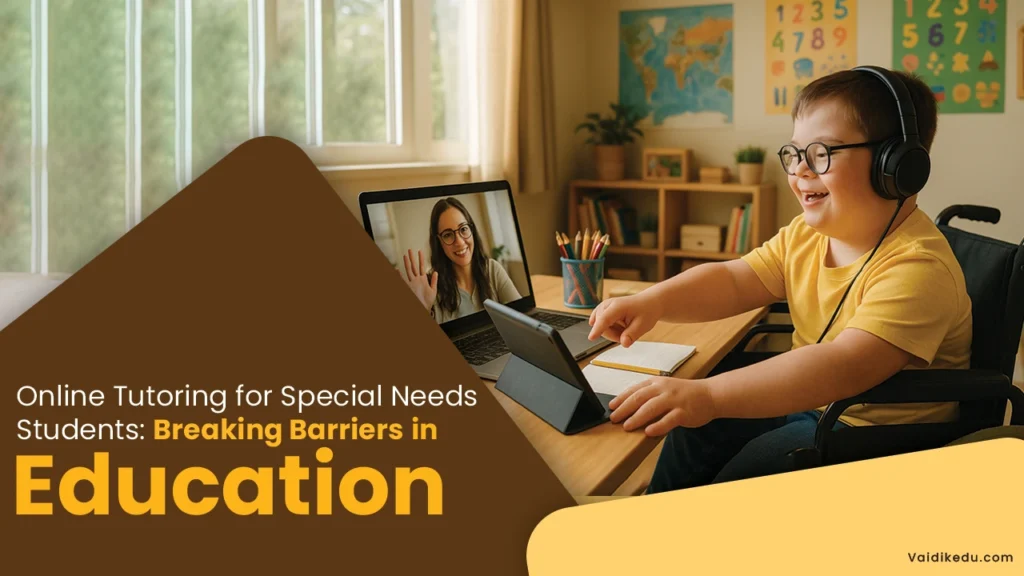
Access to effective education can look different for every learner. Students with disabilities or additional learning needs may benefit from adjustments to teaching methods, communication, learning materials, pacing, technology, or the learning environment.
Online tutoring can be one way to provide additional academic support.
A well-designed virtual tutoring programme can give students access to personalised instruction, flexible scheduling, accessible digital resources, and tutors with relevant subject expertise.
However, online tutoring is not automatically more inclusive simply because it takes place online.
Its effectiveness depends on how well the teaching approach, technology, accessibility features, and support systems fit the individual learner.
This guide explores how online tutoring can support students with special educational needs, what to consider when designing sessions, the role of assistive technology, common challenges, and how families and education providers can choose an appropriate tutoring service.
What Is Online Tutoring for Students With Special Educational Needs?
Online tutoring for students with special educational needs involves providing academic instruction and support through digital platforms while adapting the learning experience to the student’s individual requirements.
Depending on the learner, adaptations may involve:
- Adjusting the pace of instruction
- Breaking complex tasks into smaller steps
- Providing additional opportunities for practice
- Using visual, audio, or interactive resources
- Providing captions, transcripts, or accessible documents
- Reducing unnecessary distractions
- Allowing additional processing time
- Using assistive technology
- Offering different ways to demonstrate understanding
- Providing regular feedback and progress checks
The exact approach should be based on the student’s strengths, needs, learning goals, and existing educational support rather than assuming that all students with the same diagnosis require the same teaching strategy.
How Can Online Tutoring Support Students With Additional Learning Needs
Research and guidance on online learning for students with disabilities emphasise accessibility, personalisation, progress monitoring, and opportunities for interaction.
The U.S. Institute of Education Sciences, for example, recommends accessible online platforms, personalised instructional strategies, regular progress monitoring, and opportunities for students to interact with instructors and peers.
When these principles are incorporated into tutoring, online sessions may provide several useful forms of support.
1. Personalised Instruction
One-to-one tutoring allows the tutor to focus on the learner’s current level rather than teaching to the pace of an entire classroom.
A tutor can adjust explanations, examples, practice questions, and pacing based on how the student responds during the session.
2. Flexible Pacing
Some learners may need additional time to process instructions or practise a new concept. Others may move quickly through material they already understand.
Online tutoring can make it easier to adjust the pace within a session and revisit difficult concepts when necessary.
3. A More Controlled Learning Environment
Some students may find particular classroom environments distracting or overwhelming.
Learning remotely may allow families and educators to create a more suitable physical environment.
However, this is not true for every student. Some learners may find the home environment more distracting, while others may prefer face-to-face instruction.
The important consideration is the individual student’s response to the learning environment.
4. Access to Specialised Academic Support
Online tutoring can expand the pool of tutors available to students, particularly when suitable subject expertise is difficult to find locally.
This can be valuable for students who need support in a particular subject, curriculum, examination, or learning area.
5. Accessible Digital Resources
Digital learning materials can provide multiple ways to access information.
Depending on the platform and learner requirements, resources may include:
- Digital text
- Audio
- Captions
- Transcripts
- Visual explanations
- Interactive exercises
- Screen-reader-compatible materials
- Digital annotation
- Adjustable presentation formats
Accessibility should be built into the learning experience rather than treated as an optional feature.
Supporting Different Learning Needs
Students with disabilities and learning differences have highly varied needs. A diagnosis should not be treated as a complete description of how a student learns.
Instead, tutors should identify the student’s individual strengths, barriers, preferences, and learning goals.
Autism Spectrum Disorder
Some autistic students may benefit from predictable lesson structures, clear instructions, visual supports, and consistent routines.
Others may have different preferences and require different forms of support. A tutor can establish a predictable session structure while still allowing flexibility when the student’s needs change.
For example, a session might follow:
Review → Learning objective → New concept → Guided practice → Independent practice → Recap
Clear transitions and advance information about changes may also help some learners.
ADHD
Students with ADHD may benefit from lessons that provide clear goals, manageable tasks, active participation, and regular opportunities to check understanding.
Tutors may divide a larger task into smaller stages and use varied activities to maintain engagement.
This does not mean every student with ADHD requires very short lessons.
Session length and activity structure should be determined according to the learner’s age, goals, attention patterns, and preferences.
Dyslexia and Other Reading Difficulties
Students with dyslexia may benefit from explicit instruction, appropriately structured reading and writing practice, and tools that reduce unnecessary barriers to accessing text.
Depending on the student’s needs and available technology, support may include:
- Text-to-speech
- Speech-to-text
- Audiobooks
- Accessible digital text
- Spelling and writing support
- Visual organisation of information
- Additional opportunities to practise reading skills
Technology should complement appropriate teaching rather than replace explicit instruction.
Sensory and Attention Needs
Some learners may be sensitive to visual, auditory, or other environmental stimuli.
An online session can sometimes be adapted by reducing unnecessary visual clutter, controlling audio, simplifying the interface, and maintaining a predictable structure.
Again, individual preferences matter. A digital environment that feels comfortable for one student may be distracting for another.
Physical or Motor Disabilities
Online learning can also provide useful flexibility for some students with physical disabilities, depending on the accessibility of the hardware, software, and learning materials
Keyboard accessibility, voice input, screen-reader compatibility, appropriate device support, and alternative methods of interaction may be important considerations.
Accessibility Should Be Part of the Tutoring Design
Online tutoring is only inclusive when students can actually access and use the digital learning environment.
The Web Content Accessibility Guidelines (WCAG) provide an international framework for making web content more accessible.
WCAG 2.2 organises accessibility requirements around four principles: content should be perceivable, operable, understandable, and robust.
For online tutoring, accessibility considerations may include:
- Captions for video content
- Transcripts where appropriate
- Alternative text for meaningful images
- Keyboard-accessible controls
- Clear headings and instructions
- Sufficient colour contrast
- Accessible digital documents
- Screen-reader compatibility
- Predictable navigation
- Accessible assessment activities
Accessibility also needs to be tested in the actual learning environment. Simply stating that a platform is accessible does not guarantee that every resource, activity, or third-party tool will work for every learner.
Technology and Tools That Can Support Online Tutoring
Technology can expand the ways tutors teach and students interact with learning materials, but tools should always be selected according to the student’s needs and learning objectives.
Video Conferencing and Virtual Classrooms
Video platforms can enable live interaction between tutors and students.
Useful features may include:
- Screen sharing
- Digital whiteboards
- Chat
- Document sharing
- Breakout activities
- Recording where appropriate and permitted
The platform should be usable with the student’s accessibility tools and should not introduce unnecessary barriers.
Assistive Technology
Assistive technologies can help learners access, process, communicate, or produce information.
Depending on individual requirements, these may include:
- Screen readers
- Text-to-speech
- Speech-to-text
- Magnification tools
- Alternative keyboards
- Captioning
- Accessible digital books
- Other adaptive technologies
The tutor should understand how the student’s chosen technology works and design activities around it rather than treating it as a separate component.
Interactive Learning Resources
Interactive exercises can give students opportunities to practise concepts and receive feedback.
Examples include:
- Digital quizzes
- Simulations
- Interactive diagrams
- Virtual manipulatives
- Educational games
- Collaborative whiteboards
The purpose should be clear: an interactive feature should make it easier to practise or understand something, not simply add visual activity.
Digital Progress Tracking
Digital tutoring platforms can help record information about student participation, assessment performance, learning goals, and progress.
Progress data can help tutors identify areas that require additional attention and communicate relevant information to parents or educational teams where appropriate.
The Role of Parents, Teachers, and Other Professionals
Online tutoring should generally be viewed as a supplement to a student’s broader educational support rather than a replacement for school-based services or specialist intervention.
Depending on the learner, effective support may involve coordination between:
- Parents or carers
- Classroom teachers
- Special education professionals
- Tutors
- Speech and language professionals
- Occupational therapists
- Other relevant specialists
Tutors should work within their professional role. Academic tutoring can provide subject-specific instruction, but it should not be presented as a substitute for clinical, therapeutic, diagnostic, or specialist services.
Where appropriate and with suitable consent, communication between the people supporting a student can help maintain consistency in goals and strategies.
How to Choose an Online Tutoring Service for a Student With Additional Needs
Choosing a tutor should involve more than checking subject qualifications.
1. Look for Relevant Experience
Ask whether tutors have experience supporting students with the relevant learning needs and age group.
Experience should include not only subject knowledge but also the ability to adapt explanations, pacing, communication, and learning activities.
2. Ask How Individualisation Works
Find out how the service identifies a student’s needs before instruction begins.
A useful tutoring process should establish the learner’s current level, goals, challenges, and preferred approaches before creating a teaching plan.
3. Check Accessibility
Ask whether the platform and learning materials support the student’s required accessibility features.
If the learner uses assistive technology, confirm compatibility before committing to a programme.
4. Understand the Progress-Tracking Process
Ask how progress is measured and communicated.
Useful measures might include curriculum objectives, assessment results, skill development, completed work, and tutor observations.
5. Consider Communication With Families and Schools
For some students, consistent communication between the tutor and the people responsible for their education can be valuable.
Clarify what information is shared, how frequently progress is reported, and what consent is required.
6. Review Privacy and Safeguarding Practices
Online tutoring involves minors and digital communication, so families should understand how the service handles student information, recordings, communication, and account access.
Parents should also understand who can join sessions and how tutors are screened and supervised.
7. Consider a Trial Session
A trial session can help determine whether the student is comfortable with the tutor, technology, communication style, and lesson structure.
The student’s own feedback should be part of the decision.
Challenges of Online Tutoring for Students With Special Educational Needs Online tutoring can remove some barriers while introducing others.
Technical Problems
Poor connectivity, unsuitable devices, software problems, or inaccessible interfaces can interrupt learning.
What can help: Test the technology before sessions, maintain a backup communication method where appropriate, and ensure the platform works with required accessibility tools.
Screen Fatigue
Long periods of digital learning can be tiring for some students.
What can help: Use appropriate session lengths, vary activities, include breaks, and avoid unnecessary screen-based tasks.
Difficulty With Hands-On Activities
Some subjects require physical materials, laboratory equipment, practical demonstrations, or other hands-on experiences that are difficult to reproduce online.
What can help: Use demonstrations, simulations, and household materials where safe and appropriate, or combine online tutoring with in-person practical learning when necessary.
Distractions at Home
Learning from home does not automatically mean fewer distractions.
What can help: Create a consistent learning space, reduce unnecessary interruptions, use predictable routines, and adapt the session structure to the student’s environment.
Limited Social Interaction
One-to-one tutoring provides individual attention but may not provide the same peer interaction as a classroom.
What can help: Where appropriate, combine individual tutoring with classroom participation, small-group activities, or structured peer learning.
Tutor-Student Fit
A highly qualified tutor may still not be the right match for a particular learner.
Communication style, patience, subject approach, pacing, and the student’s comfort with the tutor can all influence the experience.
How to Make Online Tutoring More Effective
A thoughtful tutoring structure can make virtual sessions easier to follow.
A typical session might include:
- Review: Briefly revisit previous learning.
- Goal setting: Explain what the student will work on during the session.
- Instruction: Introduce or explain the new concept.
- Guided practice: Work through examples together.
- Independent practice: Give the student an opportunity to apply the concept.
- Feedback: Address misconceptions and reinforce successful strategies.
- Recap: Summarise what was learned.
- Next steps: Identify what the student should practise or learn next.
This structure can then be adapted according to the learner’s age, needs, subject, and level of independence.
The Future of Online Tutoring and Special Education
Artificial intelligence, adaptive learning, speech technologies, accessibility tools, and other digital developments may create new possibilities for personalised learning.
However, technology should not be treated as a substitute for skilled educators.
AI tools may help with tasks such as generating practice questions, adapting explanations, analysing learning data, or supporting accessibility.
Their use still requires human oversight to check accuracy, appropriateness, privacy, bias, and alignment with the student’s learning objectives.
Similarly, emerging technologies such as virtual and augmented reality may provide useful simulations for certain subjects, but their value depends on whether they solve a genuine instructional need.
The future of inclusive online tutoring is therefore likely to depend not simply on using more advanced technology but on combining technology with thoughtful pedagogy, accessibility, human support, and individualised instruction.
How Vaidik Eduservices Supports Online Tutoring
Vaidik Eduservices provides online tutoring services designed for educational institutions, EdTech companies, and learning platforms.
Its tutoring model includes identifying learner needs, setting learning outcomes, interactive instruction, real-time doubt resolution, adapting instruction to learner pace, and reviewing next steps.
Vaidik also describes tutor screening, subject assessments, live teaching assessments, training, mock sessions, session monitoring, rubric-based evaluation, and performance reporting as part of its tutoring operations.
For organisations developing scalable academic support programmes, these processes can provide a structured foundation for delivering personalised online instruction while maintaining consistency and quality.
Conclusion
Online tutoring can provide an additional pathway to academic support for students with disabilities and other learning needs.
Its potential benefits include individualised instruction, flexible pacing, access to specialised tutors, and the ability to use digital resources and accessibility tools. But technology alone does not create inclusive education.
Effective online tutoring requires a good fit between the learner, tutor, teaching approach, digital environment, and support system.
Accessibility needs to be considered from the beginning, progress should be monitored regularly, and families and educational professionals should understand the role and limits of tutoring.
When these elements are brought together thoughtfully, online tutoring can help remove some barriers to learning while giving students greater opportunities to participate, practise, and progress.
Frequently Asked Questions
Online tutors adapt their teaching methods, assistive technology, and lesson plans to meet the unique needs of each student.
Key tools include video conferencing platforms, speech-to-text software, audiobooks, and gamified learning applications.
Yes, because online tutoring provides distraction-free settings and brief, concentrated sessions catered to their attention spans, it can be quite beneficial for kids with ADHD.
Parents should prioritize platforms with experienced tutors, customizable plans, assistive technologies, and positive reviews from other families.