


Educational institutions are under increasing pressure to deliver learning content that is accurate, curriculum-aligned, accessible, engaging and suitable for different learning environments.
At the same time, developing high-quality educational content requires more than subject knowledge.
It can involve instructional design, curriculum mapping, subject-matter expertise, assessment development, multimedia production, editing, accessibility checks and technical delivery.
For institutions with limited internal capacity, managing all of these requirements can put considerable pressure on teachers, academic teams and administrators.
This is where outsourcing educational content development can provide a practical solution.
Working with an experienced education content partner allows institutions to supplement their internal expertise, increase production capacity and develop specialised resources without having to build every capability internally.
Outsourcing does not mean giving up academic control. With the right partner and a clearly defined review process, institutions can retain ownership of learning objectives, curriculum decisions and quality standards while external specialists support the development and production work.
What Is Educational Content Development Outsourcing?
Educational content development outsourcing involves engaging an external specialist or organisation to create, revise, digitise or manage learning materials on behalf of an institution.
The scope can range from a single project, such as developing a question bank, to ongoing support for an entire digital learning programme.
Depending on the institution’s requirements, outsourced content development may include:
- Curriculum and course development
- Lesson plans
- Textbooks and study materials
- eLearning modules
- Video scripts and storyboards
- Interactive learning resources
- Question banks
- Mock tests and assessments
- Teacher guides and workbooks
- Microlearning content
- Digital learning resources
- Content editing and enhancement
- Curriculum mapping and alignment
A professional content-development process should connect the content to the target learners, learning objectives, curriculum requirements and assessment strategy rather than simply converting existing text into a digital format.
Why Are Institutions Outsourcing Educational Content Development?
Developing educational content internally can require contributions from teachers, subject-matter experts, instructional designers, editors, graphic designers, multimedia specialists and technical teams.
That model can work well when an institution has sufficient staff, time and expertise.
However, it becomes more difficult when content requirements increase or when a project requires specialised capabilities that are not available internally.
Outsourcing can help institutions supplement their existing teams rather than replace them.
10 Benefits of Outsourcing Educational Content Development
The value of outsourcing goes beyond reducing the workload of internal teams.
When managed properly, an external content-development partner can provide specialist expertise, production capacity, quality processes and flexibility that are difficult to maintain entirely in-house.
1. Access to Specialist Expertise
High-quality educational content requires multiple areas of expertise.
A subject expert may understand the academic material but may not necessarily have the instructional design or multimedia skills needed to turn that knowledge into an effective learning experience.
An external education content partner can bring together:
- Subject-matter experts
- Instructional designers
- Educational writers
- Assessment specialists
- Editors
- Multimedia professionals
- eLearning developers
- Quality-assurance specialists
This multidisciplinary approach can be particularly valuable for complex digital learning projects.
2. Reduce Pressure on Internal Academic Teams
Teachers and academic staff already have responsibilities such as teaching, assessment, student support, curriculum planning and administration.
Adding large-scale content production to those responsibilities can create unnecessary pressure.
Outsourcing selected production tasks allows internal teams to concentrate on academic leadership and learner support while external specialists handle agreed content-development activities.
This does not mean removing educators from the process. Their expertise can remain important for reviewing content, confirming institutional requirements and providing subject-specific feedback.
3. Increase Content Production Capacity
Institutions may need to develop hundreds or thousands of learning assets when launching a new programme, digitising existing resources or expanding into new subjects.
Building an entirely new internal team for a temporary increase in demand may not be practical.
An outsourcing partner can provide additional production capacity for projects such as:
- Large question banks
- Multiple course modules
- Digital textbooks
- Lesson libraries
- Assessment collections
- eLearning programmes
- Teacher resources
This makes outsourcing particularly useful when content demand changes over time.
4. Improve Production Efficiency
Educational content development involves several stages, including research, instructional planning, writing, review, editing, design, quality assurance and delivery.
A specialist provider that has established workflows can coordinate these stages systematically.
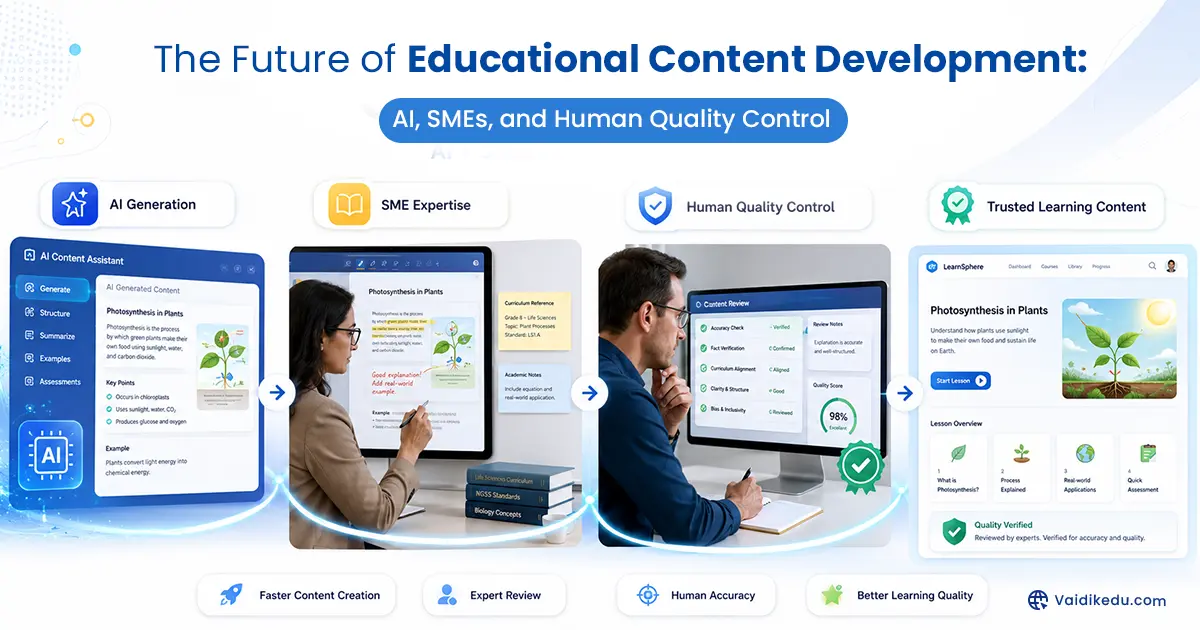
For example, a structured development process may begin with learning-needs analysis and instructional design, followed by subject-matter collaboration, content production, multimedia development, QA and final delivery.
Vaidik Eduservices describes a six-stage content development workflow covering discovery, instructional design, SME collaboration, multimedia and interaction design, instructional/editorial QA, and delivery and iteration.
A defined workflow can reduce unnecessary back-and-forth and make responsibilities clearer for everyone involved.
5. Support Curriculum and Standards Alignment
Educational content should reflect the curriculum or framework for which it is being developed.
This is especially important for institutions working across different grades, subjects, qualifications or geographic markets.
Content development partners can support activities such as:
- Curriculum mapping
- Learning-objective alignment
- Scope and sequence development
- Standards mapping
- Assessment alignment
- Gap analysis
- Progression planning
The goal is to ensure that content is not only factually accurate but also relevant to what learners are expected to know and do.
6. Maintain Greater Consistency Across Content
As an institution’s content library grows, maintaining consistency becomes increasingly important.
Different authors working independently may use different terminology, formats, instructional approaches or levels of detail.
A structured external content team can work from agreed:
- Style guides
- Content templates
- Curriculum maps
- Assessment frameworks
- Terminology standards
- Learning objectives
- Quality criteria
This can make large content libraries more coherent and easier to maintain.
7. Scale Digital Learning More Easily
Institutions expanding their online or blended learning programmes may suddenly need significantly more digital content.
Outsourcing can provide additional capacity without requiring the institution to permanently expand every internal function.
Digital content may include interactive modules, microlearning, video scripts, quizzes, simulations, digital workbooks and LMS-ready resources.
However, technology should be selected according to the learning objective.
Adding animation, gamification or advanced technology simply because it is available does not automatically improve learning.
8. Develop Customised Content
Outsourcing does not necessarily mean purchasing generic material.
A strong content-development partner can create resources around the institution’s:
- Curriculum
- Learner demographics
- Learning objectives
- Teaching model
- Assessment requirements
- Brand guidelines
- Delivery platform
- Academic standards
Customisation can be particularly important when an institution has its own curriculum, teaching methodology or programme structure.
Vaidik describes its educational content services as customisable for institutions, publishers, EdTech companies and other learning organisations, including curriculum development, textbooks, eLearning modules and assessment materials.
9. Make Content Updates Easier
Educational content does not remain static.
Curricula change, examination specifications are revised, technologies evolve and outdated examples may need to be replaced.
An institution with a large internal content library may find it difficult to audit and update everything at once.
An external partner can support:
- Content audits
- Curriculum updates
- Content modernisation
- Digital conversion
- Assessment revisions
- Accessibility improvements
- Replacement of outdated material
This can help institutions maintain the relevance and usability of their learning resources over time.
10. Allow Institutions to Focus on Their Core Mission
Perhaps the biggest strategic benefit is capacity.
Educational institutions exist primarily to educate and support learners.
Publishers focus on developing and distributing educational resources. EdTech companies focus on building learning products and services.
Content production is important to all of these organisations, but not every organisation needs to perform every production function internally.
Strategic outsourcing allows institutions to retain control over academic direction while using external expertise for specialised development work.
What Educational Content Can Institutions Outsource?
Outsourcing can cover individual content types or an entire content-development workflow.
Curriculum and Course Content
External teams can support curriculum architecture, course outlines, learning pathways, unit plans and lesson structures.
eLearning Content
This may include interactive modules, video-based learning, microlearning, scenarios, knowledge checks and LMS-ready resources.
Assessment Content
Institutions can outsource question writing, quizzes, tests, mock examinations, formative assessments and question-bank development.
Textbooks and Study Materials
Content partners can support textbook writing, editing, workbooks, solution manuals, teacher guides and supplementary learning resources.
Digital Learning Resources
These may include infographics, presentations, interactive exercises, video scripts, worksheets and other digital assets.
Vaidik’s current educational content services cover curriculum development, eLearning modules, textbook and study-material creation, lesson plans, question banks and assessment content.
Outsourcing Does Not Mean Losing Academic Control
One common concern about outsourcing is that an external team may not understand the institution’s academic standards or teaching philosophy.
This is why the outsourcing relationship needs a clear governance structure.
The institution should retain control over:
- Learning goals
- Curriculum decisions
- Academic standards
- Assessment requirements
- Institutional voice
- Final approval
- Learner requirements
The external partner can then manage agreed production responsibilities under those guidelines.
A collaborative review process is especially important. Vaidik’s broader service process includes consultation, planning and strategy, design and development, review and feedback, followed by delivery and support.
Challenges to Consider Before Outsourcing
Outsourcing has advantages, but it is not automatically successful.
Institutions should consider several potential challenges.
Academic Accuracy
Content must be reviewed by appropriately qualified subject experts.
Solution: establish SME review procedures and clear academic approval points.
Curriculum Alignment
Generic content may not match the institution’s curriculum.
Solution: provide the syllabus, standards, learning objectives and assessment requirements before development begins.
Communication
Large projects can become inefficient when instructions and feedback are unclear.
Solution: establish one primary communication channel, defined milestones and consolidated feedback.
Institutional Voice
External writers may produce technically correct content that does not sound like the institution.
Solution: provide style guides, examples, terminology preferences and brand guidelines.
Quality at Scale
Producing more content does not help if quality declines.
Solution: establish measurable QA criteria and review processes before scaling production.
Data, Confidentiality and Intellectual Property
Educational projects may involve proprietary curricula, assessment material, student information or other sensitive information.
Solution: define confidentiality, data handling, ownership and intellectual-property requirements contractually before work begins.
How to Choose the Right Educational Content Development Partner
Not every content provider will be suitable for every institution.
Before selecting a partner, evaluate:
Relevant Educational Expertise
Look for demonstrated experience in the subjects, learner groups and
education markets you serve.
Instructional Design Capability
The partner should understand how to structure content around learning objectives rather than simply produce well-written text.
Assessment Expertise
If the project involves tests or question banks, assess whether the provider understands item design, difficulty, cognitive levels and assessment alignment.
Quality Assurance
Ask how content is reviewed for factual accuracy, pedagogy, language, accessibility and technical compliance.
Scalability
Consider whether the provider can support both a pilot project and larger future requirements.
Technology and Delivery Capability
For digital projects, check whether the partner can deliver content in the formats and platforms your organisation uses.
Communication and Review Processes
A clearly defined workflow for feedback and revisions can significantly affect project efficiency.
How to Successfully Outsource Educational Content Development
The success of an outsourcing project depends as much on project planning as on the external team’s expertise.
Institutions can improve outcomes by following a structured process:
1. Define the Learning Objective
Start by identifying what learners should know or be able to do after completing the content.
2. Define the Learner
Specify the grade level, prior knowledge, language requirements, accessibility needs and learning environment.
3. Provide the Curriculum Framework
Share the syllabus, standards, scope and sequence or other relevant academic requirements.
4. Establish Content Specifications
Define the required format, length, level of interactivity, assessment requirements, platform and technical standards.
5. Agree on the Review Process
Decide who will review content, when feedback will be provided and who has final approval authority.
6. Start With a Pilot
A small pilot can reveal problems with tone, pedagogy, workflow, formatting or quality before the project is scaled.
7. Measure and Improve
After launch, use learner feedback, teacher observations, assessment results and content audits to identify opportunities for improvement.
How Much Does Educational Content Outsourcing Cost?
There is no universal price for educational content development.
The cost depends on factors such as:
- Content volume
- Subject complexity
- Level of instructional design
- SME involvement
- Assessment requirements
- Multimedia production
- Interactivity
- Accessibility requirements
- LMS integration
- Quality assurance
- Turnaround time
- Content localisation
- Ongoing maintenance
Institutions should therefore avoid comparing providers only on a per-page or per-word basis.
A lower initial price may not represent better value if the resulting content requires extensive correction or redevelopment.
The more useful comparison is the total cost, quality, expertise, turnaround and long-term usability of the deliverables.
When Should an Institution Consider Outsourcing?
Outsourcing can be particularly useful when an institution:
- Has a temporary increase in content demand
- Is launching new courses
- Is digitising existing educational resources
- Needs specialist instructional-design expertise
- Is developing a large assessment bank
- Is expanding into online or blended learning
- Needs content for multiple subjects or markets
- Has limited internal production capacity
- Needs to update an existing content library
- Wants to scale without immediately building a large permanent team
A hybrid approach can also be effective. Institutions can retain curriculum leadership and academic review internally while outsourcing specialised writing, instructional design, multimedia production, assessment development or technical work.
How Vaidik Eduservices Supports Educational Content Development
Vaidik Eduservices provides educational content development and education outsourcing solutions for EdTech companies, publishers, schools, universities and other learning organisations.
Its services cover curriculum development, educational content, assessment development, instructional design, eLearning and academic solutions.
Its educational content development services include curriculum development, eLearning modules, textbooks and study materials, lesson plans, question banks and assessment content.
The team works with educators, subject-matter experts and instructional designers to create customised learning resources.
For digital learning projects, Vaidik supports formats such as interactive eLearning, microlearning, video-based resources and LMS-ready content.
Its stated development workflow includes learning-needs analysis, instructional design, SME collaboration, multimedia development, QA and delivery/iteration.
This makes outsourcing a potential extension of an institution’s existing academic team rather than a replacement for its educational leadership.
Conclusion
Outsourcing educational content development can give institutions access to specialist expertise, additional production capacity and structured development processes without requiring them to build every capability internally.
The strongest outsourcing models are not based simply on handing content creation to a third party.
They involve collaboration between the institution and the external partner, with clear learning objectives, curriculum requirements, review procedures and quality standards.
When used strategically, outsourcing can help institutions develop curriculum-aligned content, expand digital learning resources, create assessments, update existing materials and respond to changing learner needs while allowing internal teams to remain focused on teaching, academic leadership and learner support.
In that sense, educational content outsourcing is not simply a way to produce more content.
It can be a strategic way to extend institutional capacity while maintaining academic ownership and quality.
Frequently Asked Questions
Outsourcing gives institutions access to specialized instructional designers, subject matter experts, and content developers who follow the latest pedagogical methods and technological tools. This ensures that learning materials are accurate, engaging, and aligned with modern educational standards.
Yes. Professional outsourcing partners work closely with institutions to understand their curriculum framework, learning objectives, and student needs. They customize the content to match the institution’s teaching style, assessment methods, and educational outcomes.
Outsourcing partners continuously update their practices with the latest trends in EdTech, AI-driven personalization, gamification, and accessibility standards. By outsourcing, institutions gain access to innovation and stay ahead in delivering next-generation learning experiences.