
Traditional classroom instruction remains an important part of education, but students also need opportunities to apply what they learn.
Knowing a scientific concept, mathematical formula or historical fact is valuable, but students also need to understand how to use that knowledge to investigate problems, make decisions, develop solutions and communicate their ideas.
This is where Project-Based Learning (PBL) can make a meaningful difference.
Project-based learning is an approach in which students learn by investigating an authentic, meaningful question, problem or challenge over an extended period.
Instead of simply completing an activity after a lesson, students use the project itself as a vehicle for developing academic knowledge and transferable skills.
Effective PBL typically involves inquiry, research, collaboration, revision and the creation of a product or presentation for an audience.
For K-12 students, this approach can connect classroom learning with real-world situations while developing skills such as critical thinking, creativity, communication, collaboration, problem-solving and self-management.
What is Project-Based Learning
Project-based learning is more than asking students to create a poster, build a model or give a presentation.
In a traditional assignment, students may learn a topic first and then complete a project to demonstrate what they have learned.
In PBL, the project is often at the centre of the learning experience.
Students investigate a challenging question or problem, acquire knowledge as they work, make decisions, revise their ideas and produce something that demonstrates their understanding.
For example, instead of simply teaching students about renewable energy and then asking them to make a poster, a teacher might present the challenge:
How could our school reduce its dependence on non-renewable energy?
Students could research different energy sources, analyse the school’s energy consumption, calculate potential costs, compare alternatives, design a solution and present their recommendations.
The academic content remains important, but students are now using that knowledge for a meaningful purpose.
How Is PBL Different From a Regular Project
One of the most important distinctions for teachers and schools is that not every classroom project is project-based learning.
A regular project might be completed after students have finished learning a unit. PBL integrates learning and project work more closely.
Students investigate a complex problem, make decisions, conduct research, receive feedback and refine their work throughout the process.
A genuine PBL experience generally includes:
- A meaningful question, problem or challenge
- Sustained inquiry
- Student decision-making and ownership
- Application of academic knowledge
- Research and investigation
- Collaboration and communication
- Revision and improvement
- A final product, solution or presentation
- Reflection on the learning process
This makes PBL a deeper instructional approach rather than simply an alternative format for homework.
Benefits of Project-Based Learning for K-12 Students
1. Encourages Active Learning
PBL moves students from simply receiving information to actively using it.
Instead of listening to an explanation about ecosystems, students might investigate the biodiversity of their local environment.
Rather than memorising information about structures in physics, they might design and test a bridge.
Students have to ask questions, gather information, experiment, make decisions and apply concepts.
This active involvement can make learning more meaningful and memorable.
Research reviews have found that well-designed PBL can support content retention, problem-solving, collaboration and positive attitudes toward learning.
2. Develops Critical Thinking
Real-world problems rarely have one obvious answer.
Students involved in PBL need to evaluate information, compare alternatives, identify limitations and justify their decisions.
For example, students investigating water conservation might discover several possible solutions.
They could compare rainwater collection, water-efficient fixtures and changes in consumption habits.
They would need to consider cost, effectiveness, environmental impact and feasibility before deciding which solution to recommend.
This process gives students opportunities to practise reasoning rather than simply recall information.
3. Strengthens Problem-Solving Skills
PBL gives students opportunities to work through problems that may not have immediate solutions.
A design may fail. An experiment may produce unexpected results. A proposed solution may not fit within the available budget.
Instead of treating these situations as failures, students can analyse what went wrong, modify their approach and try again.
This develops persistence and helps students understand that effective problem-solving often involves testing, reflection and revision.
4. Improves Collaboration
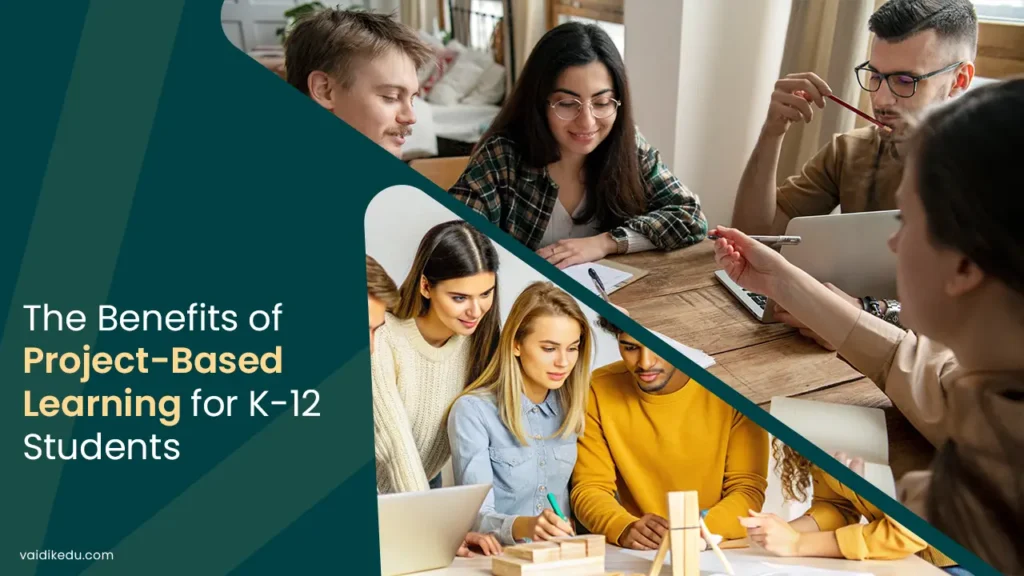
Many PBL activities involve students working in teams.
Students may need to divide responsibilities, share research, discuss competing ideas, resolve disagreements and reach decisions together.
For example, in a sustainable-school project, one student could analyse energy use, another could research renewable energy, another could calculate costs and another could prepare the final presentation.
Successful collaboration requires more than dividing tasks.
Students need to communicate, listen to others, provide feedback and take responsibility for their contribution.
These skills are valuable both inside and outside the classroom.
5. Encourages Creativity
PBL often allows students to explore more than one possible solution.
An engineering challenge, for example, may have several successful designs.
A multimedia history project could be presented as a documentary, podcast, website or interactive exhibition.
Because students are not always following one predetermined path, they have opportunities to experiment with ideas and develop original approaches.
Creativity becomes part of the learning process rather than something reserved for art classes.
6. Connects Classroom Learning With the Real World
One of the strongest features of PBL is its real-world relevance.
Students can investigate problems that exist beyond the classroom, such as:
- Climate change
- Waste management
- Sustainable transport
- Public health
- Water conservation
- Urban development
- Food production
- Community history
- Renewable energy
- Digital technology
When students understand why their learning matters, they may become more motivated to engage deeply with the subject.
PBLWorks identifies real-world relevance, deeper learning, collaboration, creativity, communication and connection with communities and careers among the major benefits associated with PBL.
7. Supports Cross-Disciplinary Learning
Real-world problems rarely fit neatly into a single subject.
A project about designing a sustainable garden could combine:
- Biology to understand plants and ecosystems
- Mathematics to calculate measurements and costs
- Science to study soil, water and energy
- English to write a proposal
- Technology to create a digital design
- Art to develop visual communication
This interdisciplinary approach helps students understand how different areas of knowledge complement one another.
8. Builds Communication Skills
Students need to communicate throughout a PBL activity.
They may write research reports, explain findings, discuss ideas with team members, create presentations or defend their recommendations.
A final presentation to classmates, teachers, parents or community members can give students an authentic reason to communicate their learning clearly.
This can improve both written and verbal communication while building confidence.
9. Develops Self-Management and Independence
Longer projects require students to organise their work.
They need to decide what has to be completed, manage deadlines, divide tasks and monitor their own progress.
Teachers can support this by providing project timelines, milestones, checklists and regular progress reviews.
Over time, students can become more independent learners who understand how to plan and manage complex tasks.
10. Improves Knowledge Application and Retention
Memorising information is different from being able to use it.
PBL requires students to repeatedly apply concepts in different situations.
A student studying mathematical measurement, for example, may understand the formulas in isolation.
But when designing a model building, they must actually use measurements, calculations and spatial reasoning.
Research on PBL suggests that when implemented effectively, students can develop deeper understanding and retain knowledge while also becoming better able to apply what they have learned to new situations.
Project-Based Learning Examples for Different K-12 Levels
PBL does not have to look the same for every age group.
Primary School
Younger students can participate in shorter, highly structured projects.
Examples include designing a simple structure that can hold a specific weight, growing plants and recording their development, investigating local weather patterns or designing packaging for a fictional product.
Teachers can provide more guidance while allowing students to make age-appropriate decisions.
Middle School
Middle school students can work on more complex investigations.
They might analyse local water quality, design a sustainable playground, investigate the impact of plastic waste or develop a simple coding solution to a practical problem.
Projects at this level can involve research, data collection, experimentation and presentations.
Secondary School
Older students can undertake longer and more independent projects.
They could develop a business proposal, analyse climate data, investigate a community issue, design an engineering prototype, create a documentary or develop a technology-based solution.
Secondary PBL can also connect with career exploration by introducing students to real professional problems and disciplines.
How to Implement Project-Based Learning in the Classroom
Effective PBL requires planning. Teachers do not need to redesign their entire curriculum at once.
Step 1: Start With a Curriculum Objective
Begin by identifying what students need to learn.
For example, if the curriculum objective involves understanding ecosystems, the project should require students to use that knowledge.
The project should not become an entertaining activity disconnected from academic learning.
Step 2: Develop a Meaningful Driving Question
Create a question that encourages students to investigate.
Instead of asking:
What is renewable energy?
A stronger project question might be:
How could our school increase its use of renewable energy?
The second question creates a reason for students to research, analyse and apply information.
Step 3: Plan the Investigation
Identify the information, skills and resources students will need.
Students may conduct research, collect data, interview people, perform experiments or analyse existing information.
Step 4: Break the Project Into Milestones
Large projects can become overwhelming without structure.
Teachers can divide the project into stages such as:
Question → Research → Planning → Development → Testing → Revision → Presentation → Reflection
This allows students to make progress while giving teachers opportunities to monitor learning.
Step 5: Provide Feedback Throughout the Project
Feedback should not be limited to the final presentation.
Teachers can review research, question assumptions, provide guidance and help students identify areas for improvement during the project.
Peer feedback can also help students evaluate their work from different perspectives.
Step 6: Present the Final Product
Students should have an opportunity to communicate their findings or solutions.
Depending on the project, this might involve a presentation, prototype, report, website, exhibition, video, model or demonstration.
An authentic audience can make the work feel more meaningful.
Step 7: Encourage Reflection
Reflection is an important part of PBL.
Students can consider:
- What did I learn?
- What was difficult?
- What did I contribute?
- What mistakes did I make?
- How did my ideas change?
- What would I do differently next time?
Reflection helps students become more aware of how they learn.
The Role of the Teacher in Project-Based Learning
PBL does not mean that teachers stop teaching.
Instead, the teacher’s role changes from being primarily a provider of information to also becoming a facilitator, guide and learning designer.
Teachers introduce important concepts, establish expectations, provide resources, ask questions, monitor progress and give feedback.
They may also provide direct instruction when students need specific knowledge to continue their investigation.
This balance is important. Student ownership does not mean students should be left without guidance.
How Should PBL Be Assessed
Assessment can be one of the more challenging aspects of PBL because teachers need to evaluate both academic learning and the process students used to reach their final outcome.
Assessment can include:
- Research quality
- Subject knowledge
- Problem-solving
- Critical thinking
- Collaboration
- Communication
- Creativity
- Application of concepts
- Final product
- Individual contribution
- Reflection
Teachers can use rubrics to establish clear expectations before students begin the project.
It is also useful to combine individual and group assessment. A group may produce one final product, but students should still have opportunities to demonstrate their individual understanding.
PBL should not completely replace traditional assessments. Tests, quizzes and other forms of assessment can still be useful for checking foundational knowledge.
The goal is to use different forms of assessment to create a more complete picture of student learning.
Using Technology in Project-Based Learning
Technology can expand what students are able to investigate and create.
Depending on the project, students might use:
- Digital research tools
- Spreadsheets
- Data visualisation
- Coding platforms
- Digital whiteboards
- 3D modelling software
- Presentation tools
- Video editing
- Online collaboration platforms
- Simulations
Technology should have a clear purpose.
The objective should not be to use a digital tool simply because it is available. Instead, technology should help students research, analyse, collaborate, create, communicate or solve a problem more effectively.
The Role of AI in Project-Based Learning
Artificial intelligence can also become part of PBL when used responsibly.
Students might use AI to brainstorm potential solutions, generate questions for investigation, analyse information or receive feedback on early ideas.
However, students should remain responsible for evaluating AI-generated information.
For example, a teacher could ask students to analyse an AI-generated explanation, identify inaccurate claims, verify information using reliable sources and revise the explanation.
This turns AI into an object of critical analysis rather than simply an answer-generation tool.
Schools should also establish clear rules around academic integrity, privacy, appropriate AI use and disclosure.
Supporting Different Learners Through PBL
PBL can provide students with different ways to demonstrate understanding.
One student may excel at research, another at designing, another at data analysis and another at presenting.
Teachers can provide different roles while maintaining common learning objectives.
Projects can also be differentiated by adjusting:
- The complexity of the problem
- The amount of teacher guidance
- The resources provided
- The expected final product
- The level of independence
- The amount of research required
This can help make PBL accessible to students with different abilities and learning needs.
Common Challenges of Project-Based Learning
Although PBL has significant potential, implementation is not always easy.
Time Requirements
Projects can take longer than conventional lessons.
Teachers can address this by starting with smaller projects and linking them directly to existing curriculum objectives.
Teacher Preparation
Designing a meaningful project requires planning.
Professional development, collaborative planning and high-quality instructional resources can help teachers develop confidence.
Unequal Participation
Group projects can sometimes result in one student doing most of the work.
Teachers can reduce this risk by assigning clear responsibilities, using individual reflections and assessing individual contributions.
Assessment Difficulties
Projects can be difficult to assess consistently.
Clear rubrics, milestones and defined learning outcomes can make assessment more manageable.
Resource Limitations
Not every school has access to advanced laboratories, robotics equipment or expensive technology.
Fortunately, effective PBL does not necessarily require expensive resources. Many projects can use everyday materials, free digital tools and resources already available within the school.
Maintaining Academic Rigour
A project should not become an activity that is fun but academically shallow.
Teachers should continuously connect project activities to curriculum outcomes and subject-specific knowledge.
How Vaidik Supports Project-Based Learning
For schools, EdTech companies and learning organisations looking to incorporate project-based learning into their educational programmes, Vaidik Eduservices provides academic and instructional support that can complement PBL initiatives.
Vaidik develops educational content, curriculum resources, assessments and instructional solutions designed around specific learning requirements.
Its services also include online tutoring for K-12 subjects and academic support.
Vaidik’s PBL-related support can help organisations strengthen the academic foundation behind project-based activities.
Its educational content can be designed around learning objectives so that projects remain connected to curriculum requirements rather than becoming isolated activities.
Vaidik specifically highlights its ability to create content aligned with PBL methodologies, helping students develop subject knowledge alongside critical thinking, collaboration and other transferable skills.
Curriculum-Aligned Learning Support
PBL works best when projects are connected to clear academic objectives.
Vaidik can support curriculum and instructional development by creating learning resources that align with the required subject matter and educational standards.
Subject-Specific Tutoring
Students may need additional support with the academic concepts required to complete a project.
Vaidik provides K-12 tutoring across subjects, including mathematics, science, English and social studies, allowing academic support to complement project-based activities.
PBL-Aligned Educational Content
Projects require more than a final assignment. Students may need background readings, research materials, practice questions, explanatory resources and assessment activities.
Vaidik’s educational content development capabilities can support these components and help organisations build structured learning experiences around their projects.
Assessment and Feedback
Assessment is an important part of a successful PBL. Vaidik provides assessment-development and academic solutions that can support organisations in creating structured ways to measure student understanding and progress.
Scalable Academic Support
Schools and EdTech platforms may need support for a small group of learners or a much larger student population.
Vaidik provides scalable online tutoring and educational solutions designed for educational institutions and learning platforms.
The aim is not to replace the teacher or classroom project.
Instead, Vaidik can provide the content, tutoring and academic support that helps educators and learning organisations deliver more structured and effective project-based learning experiences.
How Parents Can Support Project-Based Learning at Home
Parents can reinforce PBL by encouraging curiosity rather than immediately providing answers.
A child working on an environmental project, for example, could be encouraged to investigate household energy consumption, compare different solutions and explain why they recommend one approach.
Parents can ask questions such as:
- Why do you think this happened?
- What evidence supports your idea?
- What other solutions could work?
- What would happen if you changed this variable?
- What did you learn from your mistake?
- How could you improve your solution?
These questions encourage children to explain their reasoning and become more independent learners.
Does Project-Based Learning Replace Traditional Teaching?
No, PBL is most effective when it complements strong subject instruction.
Students still need foundational knowledge in mathematics, science, languages, social studies and other disciplines.
PBL provides opportunities to apply that knowledge in meaningful contexts.
The most effective approach is not necessarily to choose between traditional teaching and PBL.
Instead, schools can combine direct instruction, guided practice, independent learning and project-based experiences according to the learning objective.
Measuring the Success of Project-Based Learning
Schools should look beyond whether students completed a project.
Useful indicators include:
- Understanding of subject concepts
- Ability to apply knowledge
- Problem-solving
- Critical thinking
- Collaboration
- Communication
- Student engagement
- Independence
- Quality of final products
- Ability to reflect and improve
Student feedback and teacher observations can also provide valuable information about whether a project was appropriately challenging and whether students understood its purpose.
Research suggests that well-implemented PBL can support academic learning while also strengthening skills such as problem-solving, collaboration and communication.
A Simple PBL Framework for Schools
Schools that are new to project-based learning do not need to transform their entire curriculum immediately.
A practical starting point is:
1. Identify a curriculum objective.
Choose something students already need to learn.
2. Find a real-world connection.
Ask how the concept could be applied to a meaningful problem.
3. Create a driving question.
Develop an open-ended question that requires investigation.
4. Plan the learning sequence.
Identify the knowledge, skills and resources students will need.
5. Build milestones.
Divide the project into manageable stages.
6. Provide guidance and feedback.
Monitor progress and intervene when students need additional support.
7. Create a meaningful final product.
Give students an opportunity to communicate their solution or findings.
8. Assess and reflect.
Evaluate both academic learning and the project process.
9. Improve the next project.
Use student and teacher feedback to refine future PBL activities.
Conclusion
Project-based learning offers K-12 students an opportunity to move beyond simply memorising information and begin using knowledge to solve meaningful problems.
When thoughtfully designed, PBL can strengthen subject understanding while developing critical thinking, problem-solving, creativity, collaboration, communication and self-management.
Research also indicates that effective PBL can support knowledge retention, engagement and the ability to apply learning to new situations.
However, successful PBL requires more than assigning students a project.
Schools need clear curriculum objectives, meaningful questions, appropriate teacher guidance, structured milestones, effective assessment and opportunities for reflection.
Technology can expand what students can research and create, while AI can provide additional opportunities for brainstorming, analysis and critical evaluation when used responsibly.
For schools and learning organisations that need additional academic, instructional and tutoring support, Vaidik Eduservices can complement PBL through curriculum-aligned educational content, assessment development, K-12 tutoring and PBL-orientated learning resources.
Ultimately, the strength of project-based learning lies in its ability to answer an important question for students:
“Why do I need to learn this?”
When students can see how classroom knowledge can be used to investigate real problems, create solutions and make a difference, learning becomes more purposeful—and the skills they develop can continue to benefit them long after the project is complete.
Frequently Asked Questions
It is a teaching method. It is focused on hands-on projects. Students can work on real-world problems. It promotes active learning and collaboration. It also integrates knowledge from different subjects.
PBL helps students think critically and solve problems. It encourages creativity and teamwork. Students learn to communicate effectively. The task management will be more convenient. Real life and classrooms get linked here. It provides a whole new experience.
Yes, PBL is flexible and supports diverse learning styles. Visual learners can create charts or drawings. Kinesthetic learners can build or design models. Auditory learners can participate in discussions. They can also do the presentations.
PBL provides the necessary skills for students. This includes problem-solving and teamwork skills. It teaches adaptability and communication. These are essential for higher education and careers. It equips students to handle complex challenges in the modern world.