
Have you ever spent weeks (or even months) designing a training program, only to find out later that learners didn’t quite connect with it, or worse, the content was already outdated? You’re not alone. In a world where tools, technology and learner expectations are changing almost hourly, traditional instructional design methods seem a little slow, inflexible, and well antiquated!
Borrowed from the world of software development, this flexible, fast-paced approach helps instructional designers and educators build learning experiences that are responsive, collaborative, and continuously improving.
Instead of waiting until the end of a long development cycle to get feedback, Agile encourages you to test early, tweak often, and involve learners every step of the way.
This blog will examine Agile Instructional Design, how it works, and why many learning professionals are switching. Whether you prepare or facilitate learning experiences as an educator, a corporate trainer, or a content developer, knowing about Agile will help you create more effective, learner-centred experiences without the long wait.
What is Agile Instructional Design?
The term “Agile” originally came from software development, where developers needed a way to respond quickly to new requirements and user feedback. Instructional designers took note. Why wait until the end of a course build to see if learners engage with the content?
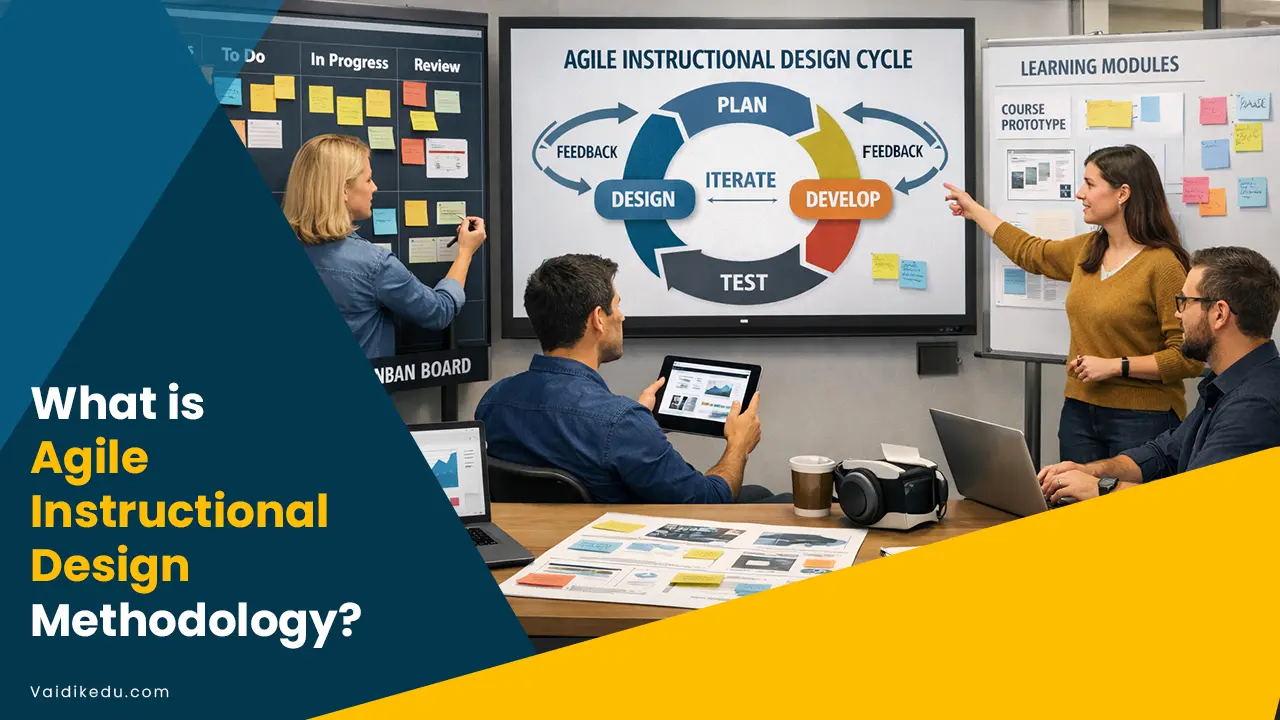
With Agile Instructional Design, the focus shifts from creating a perfect product on the first try to quickly creating something functional, testing it with real users, and refining it based on their feedback. You work in short, focused “sprints” small design, development, and testing cycles so you always progress and improve.
Agile vs. Traditional Instructional Design: What’s the Difference?
Let’s be honest there’s not one general plan that fits every learning experience design. But if you have ever been involved in a more traditional model like ADDIE, you likely know how linear (and sometimes slow) this way of designing can be. Agile Instructional Design takes an alternative route faster, more flexible, and more collaborative.
Here’s a breakdown of how these two approaches differ in real-life situations:
1. The Process Itself
Conventional design tends to be linearly planned, asking us to analyse, design, develop, implement, and evaluate. It is ordered but often leaves little room for surprises when using this model.
Agile design is iterative; it moves through many small cycles. You design a small piece, test it, get feedback, and then improve it. It is more about taking small steps, checking if you are on the right path, and then modifying.
2. Timeline & Speed
With traditional methods, course development can take weeks or even months. You plan everything up front, so changing course can be challenging once you’re deep into the process.
Agile allows you to start delivering value early. You create quick drafts, test them, and gradually build a complete learning experience. This means you can adapt faster when needs or goals shift mid-project.
3. Learner Involvement
In traditional models, learners typically don’t see the course until it’s finished.
Agile flips that. It brings learners into the process early often during the prototyping phase so their feedback shapes the course’s evolution. This makes learning more personalised and user-focused.
4. Flexibility
Traditional models are plan-driven. Once the plan is made, following it becomes the priority even if needs change.
Agile is outcome-driven. The goal is always to make the best possible experience for learners, even if it means reworking parts along the way. There’s room to adjust and improve without starting over.
5. Risk Management
Waiting until the end to determine if something works (like in ADDIE) can be risky. Agile reduces that risk by testing in smaller chunks. If something doesn’t land well, you catch it early before it becomes a bigger issue.
In short, traditional models involve creating a complete recipe book before testing a single dish. In contrast, Agile consists of experimenting with one recipe at a time, tasting as you go, and improving it each round.
The Process of Agile Instructional Design
Agile Instructional Design is not a prescriptive checklist, it’s a process of action, feedback, and iteration. Its origins stem from understanding what learners need.
This means that you will encounter the audience for the first time early on, whether that is via conversations, observations, or surveys focused on goals, obstacles, and preferences.
Unlike traditional models that often require lengthy documentation up front, Agile focuses on gathering just enough insight to begin designing without delay.
Once the basic needs are clear, the team usually made up of instructional designers, subject matter experts, and developers comes together to plan a short, focused development cycle called a sprint. Instead of aiming to build the entire course simultaneously, the team selects a small, manageable portion to work on first. It could be a single lesson, an activity, or a module prototype. The goal isn’t to make it perfect but to quickly get a functional version out.
During the sprint, the team creates a rough version of the content that learners can interact with. This is called rapid prototyping. At this stage, there’s no need for final graphics or polished narration; the focus is on whether the content is explicit, useful, and engaging.
Once the prototype is ready, it’s shared with a small group of real learners. They test it, give feedback, and offer suggestions based on their experience.
That feedback is the engine of Agile. It allows the team to understand what is succeeding and what needs adaptation. Based on the input, the content is enhanced and improved. After they have refined the first piece, the team moves into the next sprint and follows the same process: plan, build, test, and enhance.
Eventually, every piece of the course is put together and developed collaboratively with honest feedback from real learners.
This approach is so practical that you never wait until the end to determine if something works. You’re learning as you go, adapting to new needs, and ensuring the final product is useful. The process is flexible, responsive, and learner-centred just what modern education and training demand.
Popular Agile Models in Instructional Design
While the Agile mindset is flexible and can be applied in many ways, a few structured models have emerged to help instructional designers implement Agile more systematically. These models aren’t rigid frameworks; they’re more like guiding templates that help teams stay focused, collaborate better, and keep moving forward without getting stuck in the details.
One of the most well-known Agile-based models is the Successive Approximation Model, often shortened to SAM. SAM was explicitly created for instructional design and is built around improving content through quick drafts and regular revisions.
The process starts with a basic prototype and then moves through repeated design, review, and improvement cycles. It allows teams to test ideas early, avoid wasting time on fully polished versions too soon, and respond quickly to feedback. SAM’s simplicity makes it so effective, encouraging progress without overcomplicating things.
Another popular approach is LLAMA, which stands for ” like the agile management approach.” Developed by the Learning Guild team, LLAMA blends Agile principles with project management tools to help learning teams stay organised.
It emphasises flexibility, prioritisation, and open communication. LLAMA works well for small and large-scale instructional projects, especially when client or stakeholder needs change frequently.
Some teams also draw inspiration directly from Scrum, a widely used Agile framework in software development. While Scrum wasn’t built for education, many of its practices like short sprints, daily check-ins, and clear roles translate well to instructional design. For example, a team might hold regular stand-up meetings to stay aligned or use sprint boards to track which parts of the course are in development, under review, or ready for delivery.
Each of these models brings something slightly different to the table. Still, they all share one thing: they keep learning design moving forward in a responsive, collaborative way centred around real learner needs.
Your team, timeline, and how you want to approach the learning experience determine the model you select. Regardless of the model you use, the essence of Agile is to start small, test small, and welcome change.
Benefits of Agile Instructional Design
One of the biggest reasons Agile Instructional Design has gained so much attention is that it solves many common frustrations that educators and learning designers face.
Whether you’re working on a corporate training program, an online course, or a classroom module, the Agile approach offers real, practical advantages that traditional models often struggle to deliver.
As a point of fact, Agile is faster. Whereas it may take months to develop and polish a course, Agile allows you to create and release iterations of small, working pieces quickly.
As a result, your learners start receiving value much sooner, and your team avoids spending time perfecting something that will likely need to change. The early wins help build momentum and confidence.
Another major strength is its focus on the learner. Because feedback is built into every stage of development, you’re not guessing what your audience needs, you’re hearing it directly from them as the course takes shape. This makes the final product feel more relevant, user-friendly, and effective. Engagement naturally improves when learners feel listened to and their needs are reflected in the content.
Agile also encourages team collaboration. It brings together different voices designers, subject matter experts, developers, and even end-users so everyone has a role in shaping the learning experience. This breaks down the silos that can slow down traditional projects and leads to more creative, well-rounded outcomes.
One benefit that is usually overlooked is risk mitigation. Since you are testing and refining as you go, you have less chance of fully delivering a course only to discover that you missed the mark. If something isn’t working, you catch it early and fix it quickly. Agile is especially valuable in fast-changing industries where content and technology evolve rapidly.
Finally, Agile fosters a culture of continuous improvement. Don’t expect to do everything perfectly the first time. You should try things out and learn to adjust. That mindset itself is empowering, not only for designers but for a whole learning team.
Challenges in Applying Agile Instructional Design
One of the first hurdles many teams face is changing the organisational culture. Traditional instructional design methods are deeply ingrained in many workplaces, especially in education and corporate training.
People are used to detailed planning, final approvals, and clearly defined timelines. With its flexible and iterative nature, Agile can initially feel messy or uncertain.
Getting buy-in from stakeholders who prefer predictable outcomes and tightly controlled processes can be challenging.
Another issue is that Agile demands strong communication and collaboration. It’s not a solo sport. Things can quickly fall out of sync if teams like designers, subject matter experts, and developers aren’t used to working together across roles.
Agile relies on regular check-ins, quick decisions, and honest feedback. The process can easily stall or become frustrating. Without trust and open communication
There’s also the matter of managing continuous feedback. While it’s a strength of Agile, it can sometimes be overwhelming. Not every piece of feedback is helpful, and trying to implement every suggestion can lead to confusion or scope creep. Teams must learn to prioritise what matters and when to say, “Not right now.”
Agile also has a learning curve, especially for teams new to iterative work. It takes practice to break projects into manageable sprints, plan effectively, and deliver usable content without overthinking every detail.
And let’s not forget the pressure to produce quickly while Agile speeds up development, it still requires discipline to stay focused and avoid rushing just for speed.
Lastly, documentation can become a grey area. Since Agile doesn’t follow a rigid step-by-step flow, some organisations may struggle with tracking progress or reporting outcomes, mainly when used for formal documentation and milestone reports.
Despite these bumps in the road, most teams find that once they get used to the rhythm of Agile, the long-term benefits far outweigh the early discomfort. Like any change, it’s a process that can lead to much more adaptive, creative, and learner-centred results.
Conclusion
In a world where learning needs evolve faster than ever, sticking to rigid, one-size-fits-all instructional design models doesn’t cut it anymore. Agile Instructional Design offers a refreshing alternative that values progress over perfection, collaboration over isolation, and real-time feedback over guesswork.
It is not about throwing structure out the window but working more intelligently building in small, deliberate steps, listening to learners, and continuously adapting as needs and situations change.
Yes, it might feel uncomfortable initially, especially if you are accustomed to more traditional ways of doing things. Still, once you adopt an Agile approach, the design process can be more enjoyable, adaptable, and ultimately more efficient.
Whether you’re a course creator, a corporate trainer, or part of a learning and development team, embracing Agile can help you design experiences that aren’t just well-planned, they’re relevant, learner-centred, and built to evolve. And that might be precisely what’s needed in today’s fast-paced learning landscape.
Frequently Asked Questions
Not at all. While it’s commonly used in digital learning environments, Agile works just as well for in-person training, blended learning, and informal learning programs. The method is more about how you develop the content than where it’s delivered.
ADDIE is a linear model that analyses, designs, develops, implements, and evaluates. Conversely, Agile is cyclical and allows you to test and revise your content. Instead of launching one big final version, Agile helps you build, improve, and deliver in smaller, more adaptive steps.
Yes! Many educators are adopting Agile methods to design flexible, student-centred experiences. This method is beneficial when content needs to be updated frequently or student feedback significantly shapes the curriculum.