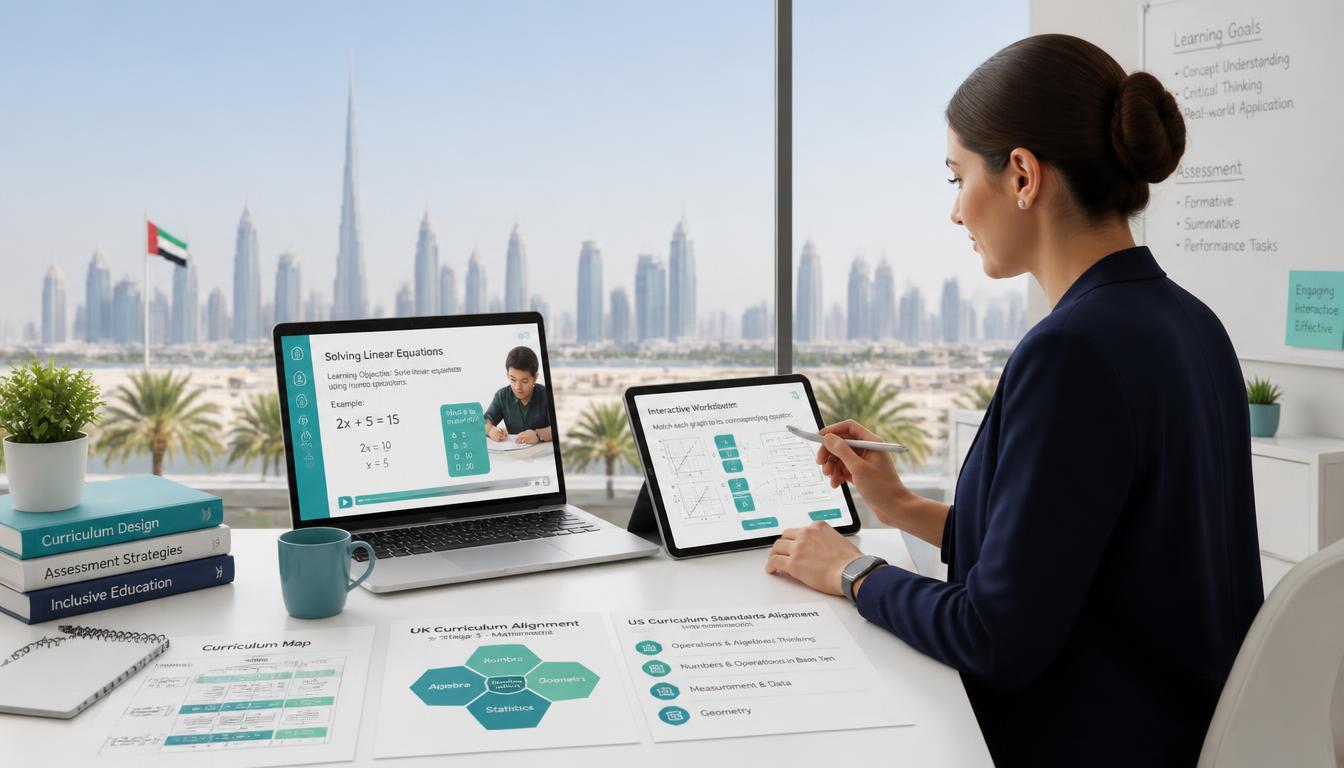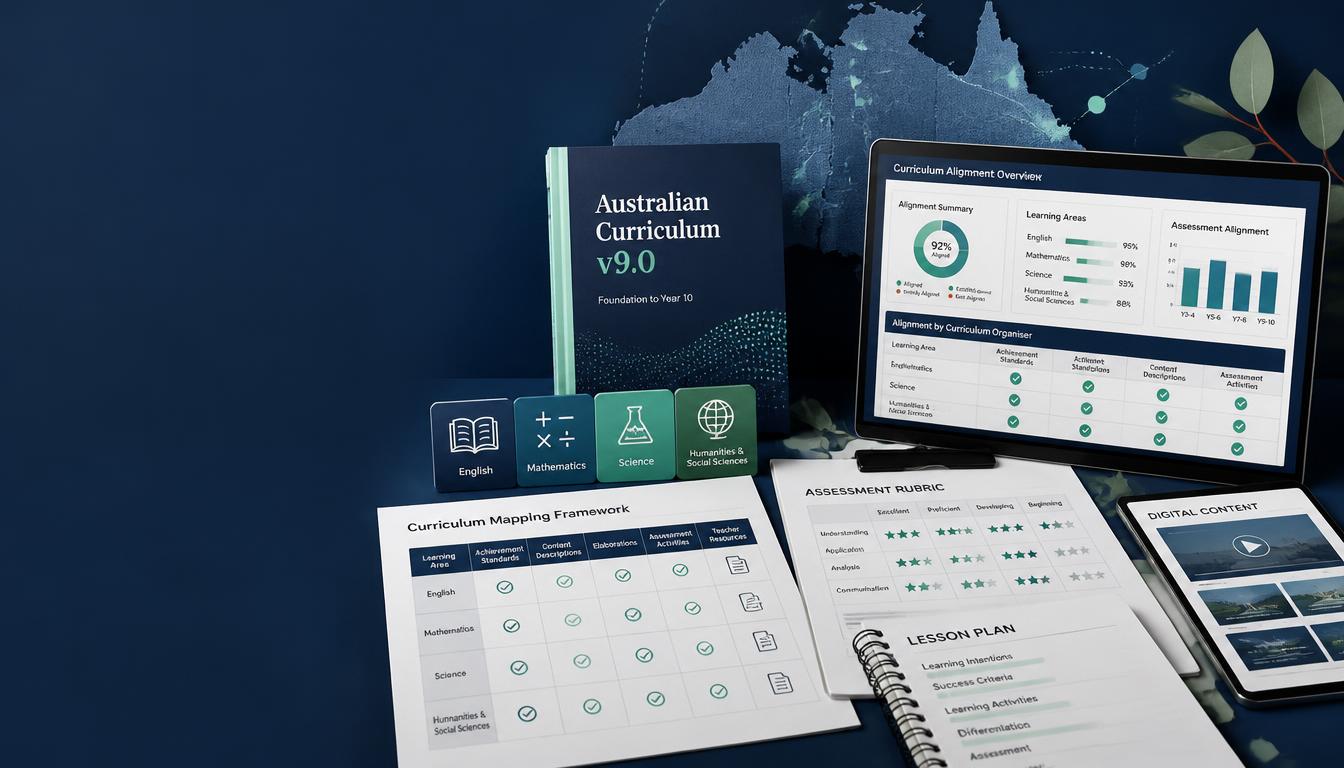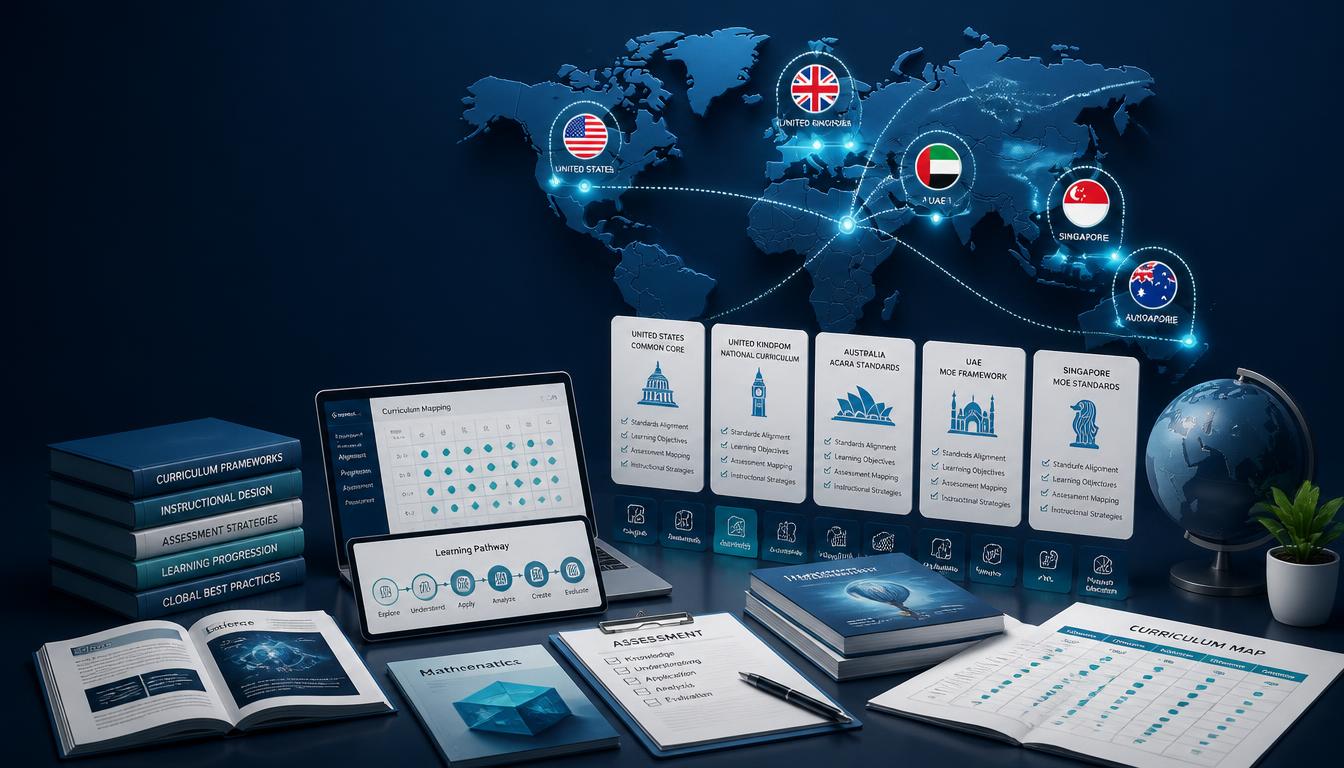


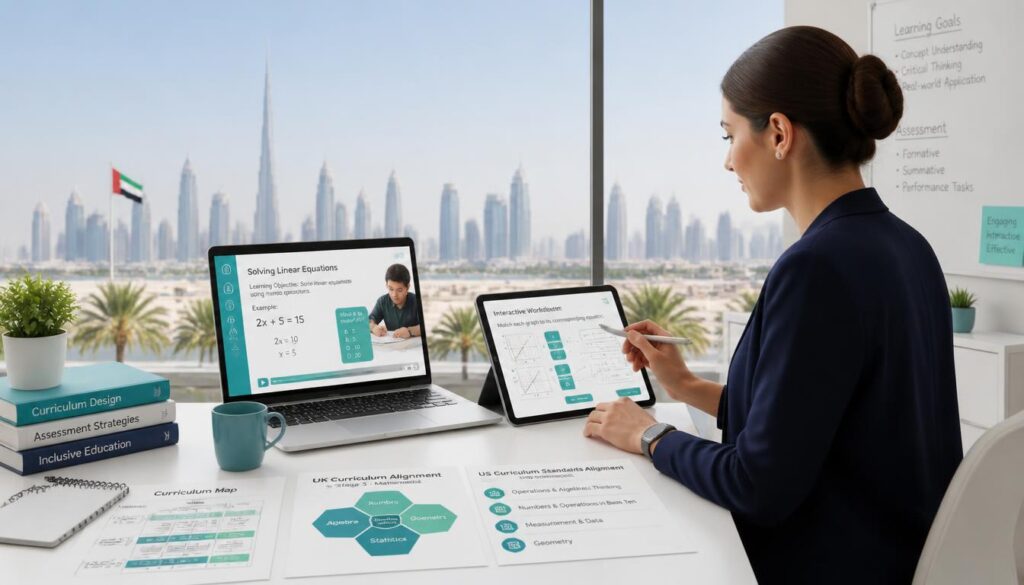
The education landscape in the United Arab Emirates is becoming increasingly technology-driven. Schools are investing in digital learning environments, interactive educational content, online assessments, multimedia lessons, and personalized learning experiences to meet the evolving needs of students and educators.
This demand is particularly relevant to international schools following the British and American curricula. Although both curriculum systems aim to develop students’ knowledge, critical thinking, and practical skills, they differ in their learning frameworks, assessment methods, subject structures, and progression pathways.
For school leaders, curriculum coordinators, publishers, and EdTech companies, the challenge is not simply converting textbooks into digital files. It is developing high-quality, curriculum-aligned digital learning resources that support teaching objectives, improve student engagement, and make learning outcomes measurable.
Professional digital learning content development helps schools create interactive lessons, digital worksheets, formative assessments, instructional videos, revision materials, and learning modules that reflect the requirements of their chosen curriculum.
For institutions seeking scalable educational content development services in the UAE, the right approach combines curriculum expertise, instructional design, educational technology, accessibility, and assessment alignment.
What Are Digital Learning Resources for Schools?
Digital learning resources are educational materials created or adapted for use through digital platforms, classroom technology, learning management systems (LMS), and online learning environments.
They can support classroom instruction, blended learning, remote education, independent study, revision, and assessment.
Common examples include:
- Interactive digital lessons and presentations
- Curriculum-aligned e-learning modules
- Digital textbooks and supplementary learning materials
- Educational videos, animations, and simulations
- Online quizzes, worksheets, and question banks
- Formative and summative assessments
- Digital revision guides and exam preparation resources
- Virtual labs and subject-specific learning activities
- Teacher guides, lesson plans, and instructional resources
- SCORM-compatible and xAPI-supported learning modules, where required
For British and American curriculum schools in the UAE, these resources should reflect the learning objectives, terminology, expected competencies, and assessment practices of the curriculum being delivered.
A well-designed digital resource does more than present information. It helps learners understand concepts, practise skills, receive feedback, and demonstrate progress.
Understanding British and American Curriculum Requirements in the UAE
One of the most important steps in developing digital educational content is understanding the curriculum framework for which it is being created.
British and American curriculum schools operate within different academic structures. Using the same digital lesson or assessment across both systems without appropriate adaptation can lead to gaps in curriculum coverage and learning progression.
1. Developing Digital Learning Resources for British Curriculum Schools
British curriculum schools in the UAE commonly offer programmes based on the English National Curriculum, with qualifications such as GCSEs and International GCSEs, followed by A Levels or other post-16 pathways.
Digital resources for these schools should support the relevant subject specifications, learning objectives, key stage expectations, and examination requirements.
Essential digital learning resources for British curriculum schools include:
- Key Stage 1 and Key Stage 2 interactive learning materials
- Key Stage 3 digital lessons and subject activities
- GCSE and IGCSE revision resources
- A Level subject-specific learning modules
- Exam-board-aligned question banks and practice assessments
- Digital science experiments and mathematics activities
- English language, reading comprehension, and writing resources
- Teacher support materials and lesson planning resources
Aligning Digital Content With GCSE, IGCSE, and A Level Specifications
For secondary education, curriculum alignment requires more than matching a topic title. Learning resources should reflect the relevant subject specification, assessment objectives, command words, expected depth of knowledge, and question formats.
For example, a GCSE science module may combine an explanation of a scientific principle with labelled diagrams, interactive activities, knowledge-check questions, and exam-style practice.
An A Level resource may require deeper conceptual explanations, data interpretation, extended responses, and opportunities to apply theoretical knowledge.
Schools and content developers should verify the relevant examination board and current specification before developing or updating these materials.
2. Developing Digital Learning Resources for American Curriculum Schools
American curriculum schools in the UAE typically use standards-based approaches influenced by state standards, school-selected frameworks, or recognised academic standards such as the Common Core State Standards and the Next Generation Science Standards, where applicable.
Unlike a single national curriculum, American curriculum implementation can vary between schools. Digital content must therefore be mapped to the standards and scope and sequence actually adopted by the institution.
Common digital learning resources for American curriculum schools include:
- Standards-aligned K–12 digital lessons
- Elementary mathematics and English language arts resources
- Middle school science and social studies modules
- High school mathematics, biology, chemistry, and physics content
- Reading comprehension and writing activities
- Project-based learning resources
- Digital formative assessments and standards-based quizzes
- Interactive science simulations and virtual labs
- SAT and other test preparation resources, where relevant
- Teacher guides, rubrics, and differentiated learning activities
Aligning Digital Content With Grade-Level Standards
American curriculum digital content should identify the intended grade level, learning standard, learning objective, and expected evidence of mastery.
For example, a middle school mathematics resource may introduce a concept, demonstrate a worked example, provide scaffolded practice, and finish with an assessment that measures the relevant skill.
A high school biology module may combine diagrams, scientific explanations, data-analysis exercises, vocabulary activities, and application-based questions.
This structured approach makes it easier for teachers to select resources, monitor learning progress, and identify areas where students need additional support.
3. Adapting Digital Resources for the UAE’s International School Environment
Curriculum alignment is essential, but schools also need content that fits their teaching environment and student population.
Digital learning resources developed for UAE schools should consider:
- Students from diverse linguistic and cultural backgrounds
- Appropriate, inclusive, and age-appropriate examples
- British or American English, depending on the school
- Accessibility for students with different learning needs
- Compatibility with the school’s learning management system
- Device availability and classroom technology
- Relevant local context without compromising curriculum accuracy
- School policies and applicable UAE education requirements
The objective is to maintain academic consistency while making learning materials accessible and relevant to the students who use them.
Why UAE Schools Need Professionally Developed Digital Learning Content
Schools may have access to digital textbooks, presentation tools, online worksheets, and learning platforms. However, collecting digital materials from multiple sources does not automatically create a coherent learning experience.
Professional digital learning content development helps address common challenges.
1. Maintaining Curriculum Alignment
Resources must support the intended curriculum rather than simply cover similar subject matter.
A structured curriculum mapping process helps ensure that lessons, activities, and assessments address the appropriate learning objectives and progression requirements.
2. Improving Student Engagement
Interactive elements can make difficult concepts easier to explore.
Examples include:
- Clickable diagrams for science
- Step-by-step mathematical demonstrations
- Drag-and-drop activities for vocabulary and classification
- Interactive timelines for history
- Simulations for scientific processes
- Scenario-based activities for problem-solving
Interactivity should support a learning objective rather than serve as decoration.
3. Supporting Differentiated Learning
Students do not all progress at the same pace or respond to the same teaching methods.
Digital learning content can incorporate scaffolded activities, additional practice, extension questions, visual explanations, and alternative representations of difficult concepts.
This enables teachers to adapt instruction while maintaining clear academic expectations.
4. Making Assessment More Meaningful
Digital assessments can provide immediate feedback, identify misconceptions, and help teachers understand student performance.
When assessment questions are mapped to learning objectives and curriculum standards, the results can support targeted revision and instructional planning.
5. Creating Consistent Learning Experiences Across Classes
A structured digital content library can help schools maintain consistency across classes, year groups, subjects, and campuses.
Shared templates, review procedures, curriculum maps, and version-control practices reduce the risk of inconsistent explanations or outdated learning materials.
6. Scaling Content Development Efficiently
School groups, educational publishers, and EdTech companies may need hundreds or thousands of learning assets across multiple subjects and grade levels.
A repeatable content development process helps teams expand their resource libraries while maintaining academic quality, accessibility, and consistency.
Types of Digital Learning Resources British and American Schools Should Develop
An effective digital learning strategy uses different resource formats for different educational purposes.
Interactive E-Learning Modules
Interactive e-learning modules combine explanations, visuals, knowledge checks, activities, and feedback within a structured learning experience.
They can support independent study, blended learning, revision, and teacher-led classroom instruction.
For schools using an LMS, modules can be developed in formats such as SCORM when supported by the platform. xAPI may be suitable where more flexible learning activity tracking is required.
Digital Worksheets and Practice Activities
Digital worksheets allow students to practise specific skills using online activities, fillable documents, interactive exercises, and automatically marked questions where appropriate.
Examples include mathematics problem-solving, English grammar exercises, reading comprehension, and science vocabulary activities.
Curriculum-Aligned Question Banks
A well-structured question bank provides questions mapped to the appropriate subject, grade, topic, learning objective, difficulty level, and assessment criteria.
For British curriculum schools, questions may need to reflect the relevant GCSE, IGCSE, or A Level specification and examination style.
For American curriculum schools, questions should align with the standards and learning objectives adopted by the school.
Question banks can support formative assessments, classroom quizzes, revision tests, mock examinations, and personalised practice.
Educational Videos and Animations
Video-based learning resources can explain complex concepts through demonstrations, narration, diagrams, animations, and real-world examples.
They are particularly useful for scientific processes, mathematical reasoning, language learning, and topics that benefit from visual explanation.
Effective educational videos should have clear learning objectives, accurate explanations, readable visuals, and appropriate pacing.
Virtual Labs and Simulations
Virtual laboratories and simulations allow students to explore concepts that may be difficult, expensive, or impractical to demonstrate in a physical classroom.
Potential applications include chemical reactions, physics experiments, biological processes, and mathematical modelling.
These resources should complement appropriate practical learning experiences rather than automatically replace them.
Digital Revision and Exam Preparation Resources
Secondary schools may benefit from structured revision libraries containing topic summaries, worked examples, practice questions, model answers where appropriate, and self-assessment activities.
Resources for GCSE, IGCSE, A Level, and American high school programmes should reflect the applicable curriculum and examination requirements.
Teacher Guides and Lesson Support Materials
Digital learning resources should also support educators.
Teacher-facing content can include lesson plans, presentation decks, answer keys, marking guidance, activity instructions, differentiation suggestions, and assessment rubrics.
These materials help teachers integrate digital resources into existing schemes of work.
The Process of Developing Curriculum-Aligned Digital Learning Resources
High-quality digital educational content requires a structured development process. The following workflow can be used by international schools, educational publishers, and EdTech companies.
Step 1: Conduct a Curriculum and Content Needs Analysis
Begin by identifying the curriculum, year group, subject, learning objectives, existing resources, and intended use of the content.
The analysis should establish whether the project supports classroom teaching, independent learning, examination preparation, assessment, or a combination of these purposes.
For British curriculum projects, identify the relevant key stage, subject specification, and examination board where applicable.
For American curriculum projects, confirm the school’s adopted standards, grade-level expectations, and scope and sequence.
Deliverable: A documented content brief and curriculum mapping framework.
Step 2: Define Learning Objectives and Outcomes
Each resource should have a clear educational purpose.
Learning objectives should describe what students are expected to know, understand, or demonstrate after completing the activity.
For example:
- Explain a scientific process using appropriate terminology.
- Solve a mathematical problem using a specified method.
- Analyse a text and support an interpretation with evidence.
- Apply a concept to an unfamiliar situation.
Clear learning outcomes make it easier to design relevant activities and assess whether the resource achieves its purpose.
Step 3: Develop the Instructional Design
Instructional design determines how content is organised, explained, practised, and assessed.
A typical digital lesson structure may include:
- A short introduction or prerequisite knowledge check
- Clear explanations of key concepts
- Examples, illustrations, or demonstrations
- Guided practice with hints or support
- Independent application activities
- Formative assessment and feedback
- A summary and suggested next steps
The exact structure should vary according to the age group, subject, complexity of the concept, and delivery environment.
Step 4: Create Curriculum-Aligned Educational Content
Subject matter experts and instructional designers work together to produce accurate explanations, activities, examples, and assessment materials.
The content should use consistent terminology, appropriate language, and the expected level of academic depth.
For international schools, the development team should also check British or American spelling, terminology, units of measurement, and curriculum-specific conventions.
Step 5: Design the Digital Learning Experience
The content is transformed into a suitable digital format using text, graphics, animations, video, interactive components, and assessment activities.
Design decisions should support comprehension, navigation, readability, and usability across supported devices.
A good digital learning interface makes it easy for students to understand instructions, complete activities, and identify their progress.
Step 6: Develop Assessments and Feedback
Assessment should be integrated into the learning experience rather than added as an unrelated final step.
Depending on the resource, this may include:
- Multiple-choice questions
- Short-answer questions
- Extended-response activities
- Matching and classification tasks
- Data interpretation
- Problem-solving exercises
- Self-assessment and reflection
- Automated feedback and worked solutions
Questions should be reviewed for accuracy, clarity, difficulty, and alignment with the intended learning objective.
Step 7: Conduct Academic and Technical Quality Assurance
Before publication, the resource should undergo subject review, instructional design review, editorial review, accessibility checks, and technical testing.
Quality assurance should verify that:
- Curriculum mappings are accurate.
- Explanations and answers are correct.
- Activities work as intended.
- Instructions are clear and age-appropriate.
- Images and media have appropriate permissions.
- Accessibility requirements have been considered.
- Links, navigation, and assessments function correctly.
- LMS tracking works where required.
- The content displays properly on supported devices.
Step 8: Deploy, Evaluate, and Improve
After deployment, schools can review teacher feedback, student performance, resource usage, and technical issues to identify opportunities for improvement.
Where appropriate, assessment results and LMS data can help reveal frequently misunderstood concepts and areas requiring additional practice.
Resources should be reviewed periodically to account for curriculum updates, specification changes, technical requirements, and feedback from educators.
Essential Quality Standards for Digital Learning Resources
Digital content quality depends on more than attractive visuals. It requires academic accuracy, pedagogical value, accessibility, usability, and reliable technical delivery.
Curriculum Mapping and Traceability
Each resource should be traceable to a defined learning objective, curriculum standard, or specification requirement.
This is particularly important when developing content at scale for multiple subjects, grade levels, or curriculum systems.
Accessibility and Inclusive Design
Digital learning content should be designed so that as many learners as possible can access and understand it.
Depending on the resource, good practices include:
- Captions and transcripts for relevant audio and video
- Alternative text for meaningful images
- Clear headings and logical navigation
- Adequate colour contrast
- Keyboard-accessible interactive elements
- Readable typography and appropriate spacing
- Instructions that do not rely on colour alone
- Compatibility testing with relevant assistive technologies
WCAG provides an established framework for evaluating web content accessibility. Applicable requirements should be confirmed for the school’s platform and project.
Assessment Reliability and Accuracy
Question banks and digital assessments should use clear wording, accurate answer keys, suitable distractors, and consistent marking criteria.
Assessment content should also be reviewed for ambiguity, unintended clues, and inappropriate difficulty.
Technical Compatibility
Schools should confirm compatibility with their LMS, browsers, devices, and reporting requirements.
SCORM and xAPI serve different technical purposes and should be selected according to the learning platform and data-tracking needs.
Content Security and Intellectual Property
Schools and content providers should establish clear rules for copyright, licensed media, access permissions, student information, and content ownership.
Digital content should use properly licensed assets and follow applicable privacy and data protection requirements.
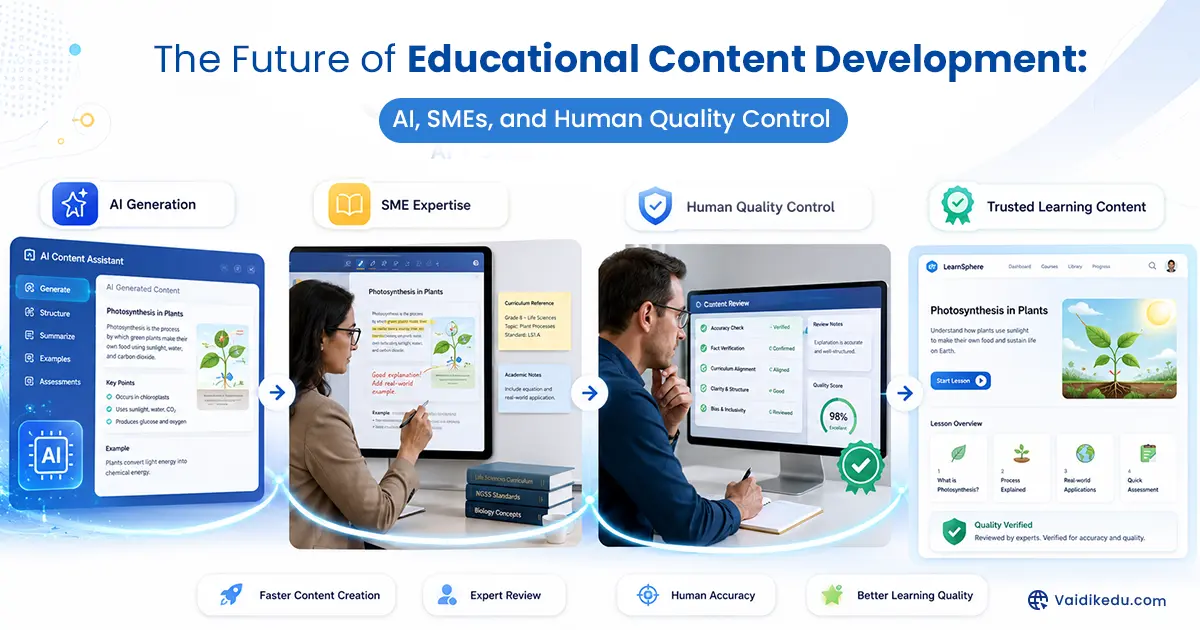
How AI Can Support Digital Learning Content Development
Artificial intelligence can support parts of the educational content production workflow, but its output requires appropriate academic oversight.
Potential applications include:
- Drafting initial learning objectives
- Organising content against supplied curriculum maps
- Generating first drafts of practice questions
- Suggesting differentiated activities
- Producing alternative explanations of difficult concepts
- Supporting metadata tagging and content categorisation
- Assisting with editorial checks and consistency reviews
AI-generated educational content should not be published without validation by qualified reviewers.
Subject experts should check factual accuracy, curriculum alignment, answer keys, cultural suitability, bias, age appropriateness, and the originality and permitted use of source materials.
Schools should also establish appropriate policies for student data, confidential content, and the use of AI tools.
The most reliable approach combines the efficiency of suitable digital tools with human expertise in curriculum, pedagogy, assessment, and quality assurance.
Common Challenges in Developing Digital Learning Resources for UAE Schools
Using the Same Content for British and American Curricula
A resource may cover a similar topic but still fail to meet the learning objectives or assessment requirements of the intended curriculum.
Solution: Develop separate curriculum mappings and adapt the content, terminology, depth, and assessment methods accordingly.
Prioritising Visual Design Over Learning Outcomes
Highly interactive content can still be ineffective if it lacks clear objectives or meaningful practice.
Solution: Define learning outcomes first, then select digital formats that support those outcomes.
Overlooking Accessibility
Small text, inaccessible interactions, missing captions, and poor navigation can prevent students from using resources effectively.
Solution: Integrate accessibility considerations into the design and testing process.
Creating Assessments Without Curriculum Mapping
Unmapped questions may test skills that have not been taught or fail to measure the intended outcomes.
Solution: Link each assessment item to a learning objective and appropriate curriculum reference.
Failing to Update Content
Curriculum specifications, examination requirements, software platforms, and school expectations can change.
Solution: Establish review schedules, content version control, and a process for approving updates.
Scaling Production Without Consistent Quality Control
Rapidly producing large quantities of content can lead to inconsistent terminology, duplicated material, and uneven academic quality.
Solution: Use standardised templates, subject-specific review criteria, documented workflows, and staged quality assurance.
How to Choose a Digital Learning Content Development Partner in the UAE
Schools, publishers, and EdTech businesses should assess potential content development partners against their academic, operational, and technical requirements.
1. Curriculum Expertise
Look for experience developing resources for the relevant British curriculum stages, GCSE and A Level specifications, or American curriculum standards.
Ask how curriculum alignment is documented and verified.
2. Instructional Design Capabilities
A capable partner should understand learning objectives, content sequencing, scaffolding, assessment design, and student engagement.
3. Multi-Format Content Development
Depending on the project, the partner may need to create interactive lessons, videos, digital worksheets, question banks, presentations, or LMS-ready modules.
4. Academic Review and Quality Assurance
Ask about subject matter expertise, editorial processes, answer validation, accessibility testing, and approval procedures.
5. Scalability and Project Management
For larger projects, assess whether the provider can manage multiple subjects, grade levels, content formats, and review cycles while maintaining consistency.
6. Technical Compatibility
Confirm support for the required LMS, content standards, reporting features, accessibility requirements, and delivery formats.
7. Clear Deliverables and Ownership
The project agreement should define content scope, milestones, review rounds, file formats, intellectual property rights, and ongoing maintenance responsibilities.
Selecting a digital learning content development partner should be based on demonstrated capabilities and the requirements of the project, rather than on content volume or visual design alone.
How Vaidik EduServices Can Support Digital Learning Content Development
Vaidik EduServices works in educational content and learning solutions, supporting organisations that need structured, curriculum-focused educational materials.
For schools, educational publishers, and EdTech companies serving British and American curriculum markets, a well-defined content development workflow can help align learning objectives, instructional design, assessment materials, and quality assurance.
Depending on the agreed project scope, digital learning content development may involve:
- Curriculum mapping and learning objective alignment
- Educational content and lesson development
- Interactive learning resource planning
- Question bank and assessment development
- Instructional design and digital learning storyboards
- Educational multimedia content
- Content review and quality assurance
- Support for appropriate LMS delivery formats
For organisations operating across the UAE, the UK, the USA, Australia, Singapore, and other international markets, curriculum-specific planning is important for maintaining accuracy across different educational frameworks.
Explore relevant services:
- Educational Content Development Services
- Instructional Design Services
- Assessment Development Services
- Question Development Services
- Curriculum Development Services
- STEM Curriculum Development
These resources can help organisations identify the type of support that best fits their digital learning project.
For a project-specific discussion, schools and education businesses can contact Vaidik EduServices through the contact Page to discuss their content requirements, curriculum framework, intended learners, and delivery environment.
The Future of Digital Learning Resources for International Schools in the UAE
Digital learning is likely to continue evolving through more flexible delivery formats, data-informed instruction, accessible content, and carefully governed AI-assisted production.
For British and American curriculum schools, the priority should remain the educational value of the resource.
Future-ready digital learning libraries can combine curriculum-aligned lessons, interactive practice, meaningful assessments, multimedia explanations, and teacher support materials within a consistent learning environment.
The most effective solutions will not necessarily be the most technologically complex. They will be the ones that help teachers deliver their curriculum, enable students to practise and understand important concepts, and provide meaningful evidence of learning.
Schools that establish strong curriculum mapping, instructional design, accessibility, and content governance practices can build digital learning resources that remain useful, adaptable, and easier to maintain over time.
Conclusion
Developing digital learning resources for British and American curriculum schools in the UAE requires a balance of curriculum expertise, instructional design, academic accuracy, accessibility, and technical compatibility.
Schools that build resources around clearly defined learning objectives can create more coherent learning experiences, support teachers, and make assessment more meaningful.
For educational publishers, EdTech companies, and school groups, a structured content development process also makes it easier to scale learning resources across subjects, grade levels, and international markets.
The key is to develop digital content that does more than move classroom materials onto a screen. It should support the curriculum, encourage active learning, and help educators understand what students have learned.
Frequently Asked Questions
Digital learning resources for British curriculum schools include interactive lessons, digital worksheets, educational videos, GCSE and IGCSE revision materials, A Level learning modules, and curriculum-aligned assessments. They should reflect the relevant curriculum stage, subject requirements, and examination specifications.
British curriculum resources commonly align with key stages, subject specifications, and qualifications such as GCSEs, IGCSEs, and A Levels. American curriculum resources generally align with the grade-level standards, learning objectives, and scope and sequence adopted by the school. Both require appropriate academic mapping and assessment design.
Curriculum alignment ensures that lessons, activities, and assessments support the intended learning objectives. It helps schools maintain appropriate subject coverage, learning progression, and assessment relevance.
Schools should evaluate curriculum expertise, instructional design, assessment development, subject matter review, accessibility, LMS compatibility, scalability, project management, and content ownership arrangements.
Yes. Digital content can be delivered through an LMS using supported formats and integrations. SCORM may support standardised course delivery and tracking, while xAPI can support more flexible recording of learning activities where the required infrastructure is available.
Vaidik EduServices provides educational content and learning-related services. Organisations can discuss requirements such as curriculum mapping, educational content development, instructional design, question development, assessment development, and quality assurance to determine an appropriate project scope.