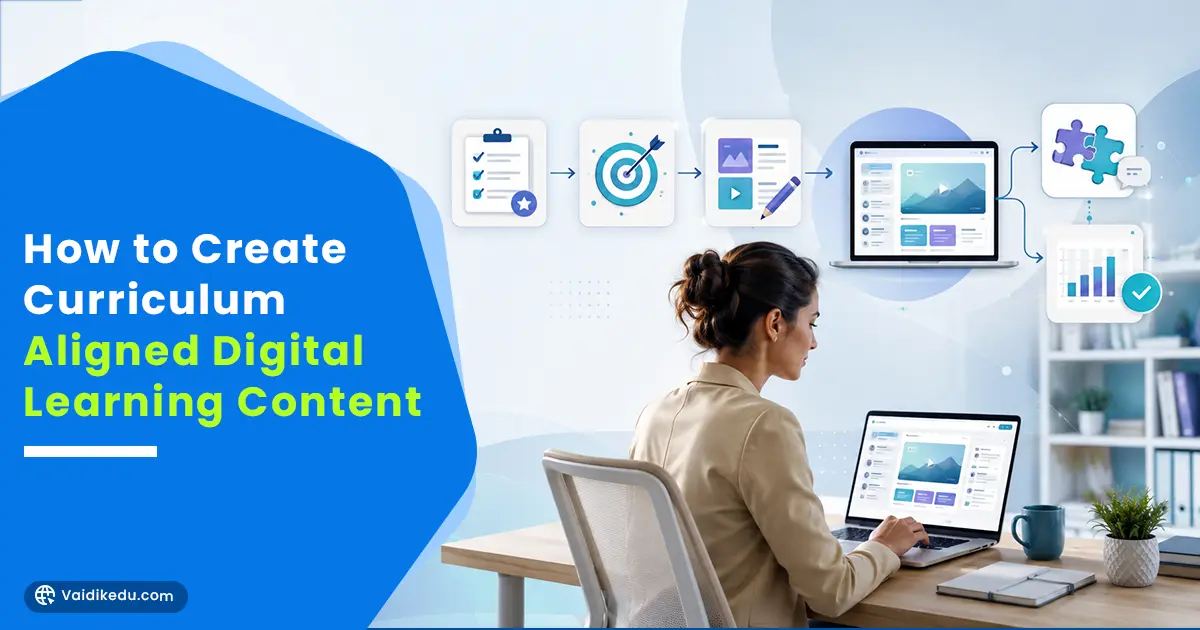

Digital learning has become an essential part of modern education. Schools, school districts, publishers, universities, and EdTech companies across the United States are increasingly using eLearning modules, interactive lessons, digital textbooks, educational videos, online assessments, and learning management systems (LMS) to support students.
However, simply converting traditional lessons into digital formats does not guarantee effective learning.
The content must be connected to curriculum standards, learning objectives, grade-level expectations, assessments, and student needs. This process is known as curriculum alignment.
Creating curriculum-aligned digital learning content ensures that every lesson, activity, assessment, and interactive element supports what students are expected to learn.
For organizations developing educational resources for the U.S. market, a structured approach to curriculum-aligned content development can improve instructional quality, learner engagement, assessment readiness, and consistency across digital learning programs.
In this guide, we explain how to create curriculum-aligned digital learning content step by step, including standards mapping, learning objectives, instructional design, content development, assessment alignment, accessibility, quality assurance, and continuous improvement.
What Is Curriculum-Aligned Digital Learning Content?
Curriculum-aligned digital learning content is educational material designed to directly support specific curriculum standards, learning objectives, skills, and expected student outcomes.
Unlike generic eLearning content, curriculum-aligned resources are developed around a defined academic framework.
Digital learning content may include:
- Interactive eLearning modules
- Digital textbooks
- Online lessons
- Educational videos
- Animated learning resources
- Interactive simulations
- Lesson plans
- Worksheets
- Digital activities
- Online quizzes
- Question banks
- Practice tests
- Formative assessments
- Summative assessments
- Teacher guides
- Learning management system content
- Microlearning resources
For U.S. schools and EdTech companies, alignment may involve frameworks such as Common Core State Standards (CCSS), Next Generation Science Standards (NGSS), state-specific academic standards, College and Career Readiness standards, and other subject-specific frameworks.
The objective is not simply to mention a standard within a lesson. The standard should influence the learning objective, instructional content, learning activity, and assessment.
Why Is Curriculum Alignment Important for Digital Learning?
Curriculum alignment helps ensure that digital learning experiences are academically relevant and connected to measurable learning outcomes.
1. Ensures Standards Coverage
A curriculum-aligned digital course can be mapped to specific standards and competencies.
This allows schools, publishers, and EdTech companies to determine whether their content adequately covers the required curriculum.
2. Creates Clear Learning Outcomes
Students learn more effectively when they understand what they are expected to accomplish.
Learning objectives provide a clear connection between curriculum standards and instructional activities.
3. Improves Assessment Alignment
Assessments should measure the knowledge and skills taught within the course.
When digital content and assessments are developed together, organizations can reduce gaps between instruction and evaluation.
4. Supports Consistent Instruction
Curriculum alignment creates a consistent instructional framework across lessons, teachers, classrooms, and digital platforms.
This is particularly valuable for school districts and organizations delivering content across multiple schools or states.
5. Improves Digital Learning Quality
Curriculum-aligned content combines academic accuracy with effective instructional design.
This can make digital learning experiences more meaningful, engaging, and measurable.
6. Supports Scalability
Once standards and learning objectives have been mapped, organizations can create reusable content frameworks for additional grades, subjects, or courses.
How to Create Curriculum-Aligned Digital Learning Content
Creating high-quality curriculum-aligned digital content requires more than writing lessons and adding multimedia.
A successful process typically includes curriculum research, standards mapping, instructional design, content development, assessment development, accessibility, quality assurance, and continuous improvement.
Step 1: Identify the Target Curriculum and Standards
The first step is identifying exactly which curriculum framework the digital content needs to support.
For U.S. educational content, this could include:
- Common Core State Standards
- Next Generation Science Standards
- State-specific standards
- College and Career Readiness standards
- Subject-specific standards
- District curriculum frameworks
- School-level learning objectives
The curriculum should be reviewed before content development begins.
For example, a Grade 6 mathematics digital learning program should identify the applicable standards, domains, concepts, skills, and grade-level expectations before individual lessons are created.
This creates the foundation for the entire content development process.
For organizations that need professional support, curriculum development services can help create structured learning frameworks based on academic requirements and learner outcomes.
Step 2: Conduct a Curriculum and Content Gap Analysis
Before creating new digital content, determine what already exists.
A content gap analysis can identify:
- Missing standards
- Underdeveloped topics
- Duplicate lessons
- Missing assessments
- Skill gaps
- Grade-level inconsistencies
- Outdated information
- Weak learning objectives
- Content that does not match assessment requirements
A curriculum gap analysis is particularly important when converting an existing textbook or traditional course into digital learning.
For example, a publisher may discover that its existing Grade 5 science textbook covers a particular standard but does not provide sufficient digital activities or formative assessments for that standard.
The gap analysis provides a roadmap for development.
Step 3: Build a Curriculum Mapping Framework
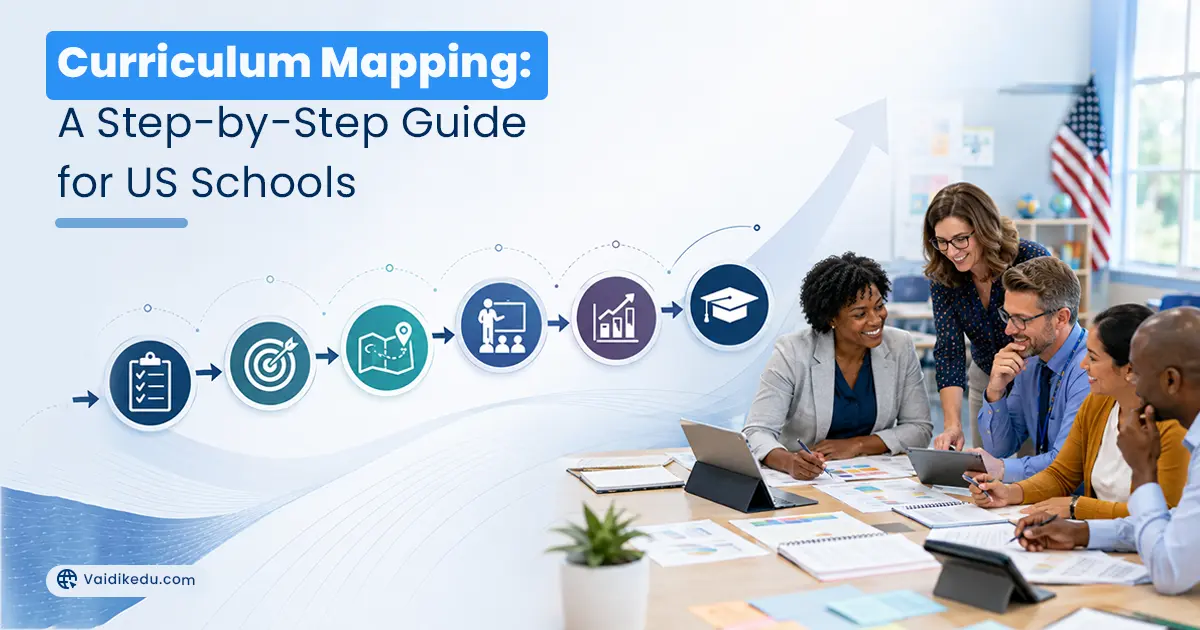
Curriculum mapping connects standards to instructional content.
A typical curriculum mapping structure can include:
Curriculum Standard | Learning Objective | Topic | Digital Activity | Assessment | Content Status |
Standard Code | Student outcome | Lesson topic | Interactive activity | Quiz/Test | Complete |
Standard Code | Student outcome | Lesson topic | Video/Simulation | Assignment | In Progress |
This mapping process makes it easier to identify whether every required standard is adequately addressed.
A strong curriculum map should answer:
- What should students learn?
- Which standard does it address?
- Which lesson teaches the concept?
- Which activity reinforces it?
- Which assessment measures it?
- What evidence demonstrates mastery?
Organizations can also use curriculum alignment services when they need detailed standards mapping, gap analysis, and alignment reviews for digital learning materials.
Step 4: Define Measurable Learning Objectives
Every digital learning module should have clear learning objectives.
Instead of writing a broad objective such as:
Students will understand fractions.
Use a measurable objective such as:
Students will compare and order fractions with different denominators using visual models and mathematical reasoning.
Measurable objectives make it easier to design activities and assessments.
Use Bloom’s Taxonomy
Bloom’s Taxonomy can help instructional designers create objectives that move beyond simple memorization.
Learning objectives can focus on:
- Remembering
- Understanding
- Applying
- Analyzing
- Evaluating
- Creating
For example:
Remember: Identify the parts of a cell.
Understand: Explain the function of major cell structures.
Apply: Use a diagram to identify cell structures.
Analyze: Compare plant and animal cells.
Evaluate: Explain how specific structures contribute to cell function.
Create: Develop a labeled model of a cell.
This progression helps digital learning content support higher-order thinking skills.
Step 5: Develop a Detailed Content Outline
Once learning objectives are defined, create a detailed content outline.
The outline should establish:
- Units
- Chapters
- Lessons
- Topics
- Subtopics
- Learning objectives
- Activities
- Assessments
- Multimedia requirements
- Teacher resources
- Student resources
For example:
Unit: Ecosystems
Lesson 1: Introduction to Ecosystems
Lesson 2: Food Chains and Food Webs
Lesson 3: Energy Flow
Lesson 4: Population Relationships
Lesson 5: Human Impact on Ecosystems
Each lesson should be connected to specific standards and learning outcomes.
A structured outline prevents content creators from producing disconnected lessons.
Step 6: Choose the Right Digital Learning Format
Different learning objectives require different content formats.
Digital learning content can include:
Interactive Lessons
Interactive lessons can combine text, images, questions, animations, and activities.
Educational Videos
Videos can demonstrate concepts that are difficult to explain through text alone.
Simulations
Simulations allow students to experiment with concepts in a controlled digital environment.
Interactive Exercises
Drag-and-drop activities, matching exercises, sorting activities, and scenario-based tasks can encourage active participation.
Digital Textbooks
Digital textbooks can combine traditional explanations with multimedia, hyperlinks, interactive questions, and embedded activities.
Microlearning
Short learning units can help students review specific concepts or skills.
Digital Assessments
Quizzes, tests, practice questions, and performance tasks can measure student progress.
The format should be selected based on the learning objective rather than simply adding technology for its own sake.
Step 7: Apply Instructional Design Principles
Curriculum alignment alone does not guarantee effective digital learning.
The content also needs strong instructional design.
Instructional designers can use established models such as:
- ADDIE
- SAM
- Backward Design
- Bloom’s Taxonomy
- Universal Design for Learning (UDL)
- Mastery learning
- Scenario-based learning
The instructional design process should determine how information is introduced, practiced, reinforced, and assessed.
For organizations developing complex digital learning programs, instructional design services can help transform curriculum requirements into structured and engaging learning experiences.
Step 8: Develop Engaging and Age-Appropriate Content
Digital content should be appropriate for the learner’s age, grade level, reading ability, and academic expectations.
For K–12 learners, consider:
- Reading level
- Vocabulary
- Cognitive development
- Visual design
- Interaction complexity
- Attention span
- Prior knowledge
- Cultural relevance
- Accessibility
Content should avoid unnecessary complexity.
For example, a Grade 3 lesson should not use university-level explanations simply because the subject matter is complex.
The goal is to simplify the explanation without oversimplifying the academic concept.
Step 9: Integrate Multimedia Strategically
Multimedia can make digital learning more engaging, but every element should have an instructional purpose.
Useful multimedia elements include:
- Illustrations
- Diagrams
- Infographics
- Animations
- Educational videos
- Audio narration
- Interactive simulations
- Virtual experiments
- Scenario-based activities
However, adding multimedia simply to make a lesson look attractive can increase cognitive load.
A better approach is to ask:
Does this visual, animation, video, or interaction help students understand the learning objective?
If the answer is yes, include it.
If not, remove it.
Step 10: Align Activities With Learning Objectives
Learning activities should give students opportunities to practice the skills identified in the objectives.
For example, if the objective requires students to analyze data, the activity should require students to analyze data rather than simply recall definitions.
A useful alignment chain is:
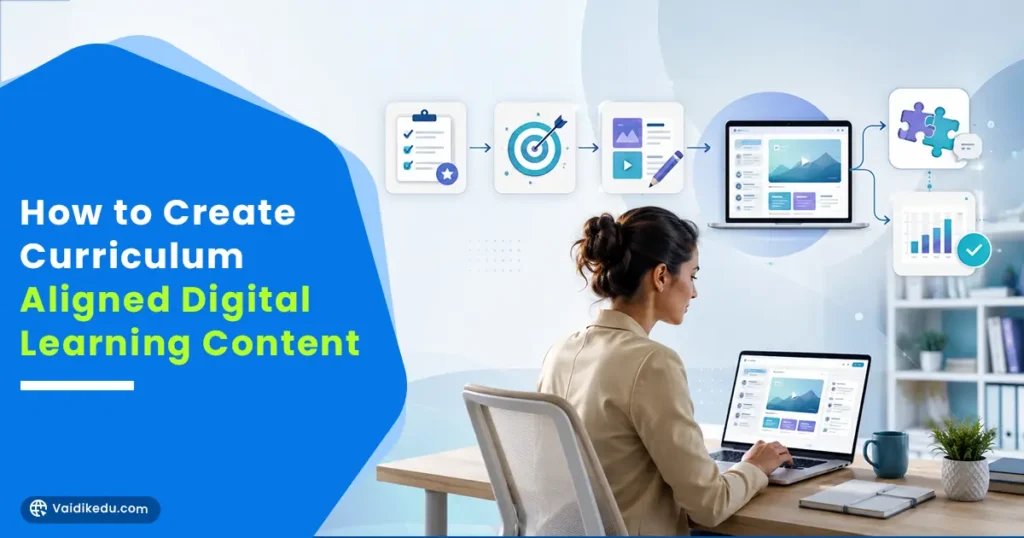
Standard → Learning Objective → Instruction → Activity → Assessment
This creates instructional consistency.
If one part of this chain does not match the others, students may receive instruction that does not adequately prepare them for the assessment.
Step 11: Develop Curriculum-Aligned Assessments
Assessment development is a critical component of curriculum-aligned digital learning.
Digital assessments can include:
- Multiple-choice questions
- Multiple-response questions
- Matching questions
- Drag-and-drop questions
- Short-answer questions
- Extended-response questions
- Scenario-based questions
- Performance tasks
- Practice tests
- Formative assessments
- Summative assessments
Assessments should measure the same knowledge and skills identified in the learning objectives.
Formative Assessment
Formative assessments help identify student understanding during learning.
Examples include:
- Knowledge checks
- Exit questions
- Interactive quizzes
- Practice activities
- Short assignments
Summative Assessment
Summative assessments evaluate learning after instruction.
Examples include:
- Unit tests
- Final exams
- Projects
- Performance assessments
When developing assessment items, organizations should also consider cognitive difficulty and alignment with the appropriate standard.
Step 12: Map Every Assessment Item to a Standard
For large digital learning programs, assessment alignment should be documented.
A question bank may include:
Question | Standard | Learning Objective | Bloom’s Level | Difficulty |
Question 1 | Standard A | Objective 1 | Understand | Easy |
Question 2 | Standard A | Objective 2 | Apply | Medium |
Question 3 | Standard B | Objective 3 | Analyze | Hard |
This approach makes it easier to measure curriculum coverage.
It also helps organizations identify standards that have too few assessment items.
Step 13: Make Digital Learning Content Accessible
Accessibility should be considered from the beginning of content development.
Accessible digital learning may include:
- Captions for videos
- Transcripts for audio
- Alternative text for meaningful images
- Keyboard navigation
- Readable typography
- Sufficient color contrast
- Accessible interactive elements
- Clear navigation
- Screen-reader compatibility
Accessibility is especially important for schools and organizations serving diverse learners.
Digital learning content should be designed so that students with different learning needs can access and interact with the material effectively.
Step 14: Ensure Content Is Mobile and LMS Ready
Modern learners may access digital content through:
- Laptops
- Tablets
- Chromebooks
- Smartphones
- Learning management systems
- School portals
- Web-based learning platforms
Content should therefore be responsive and compatible with the intended delivery environment.
For eLearning programs, technical considerations may include:
- SCORM
- xAPI
- LMS compatibility
- Responsive design
- Browser compatibility
- Interactive functionality
- Tracking and reporting
Technical compatibility should be tested before large-scale deployment.
Step 15: Conduct Curriculum Alignment Quality Assurance
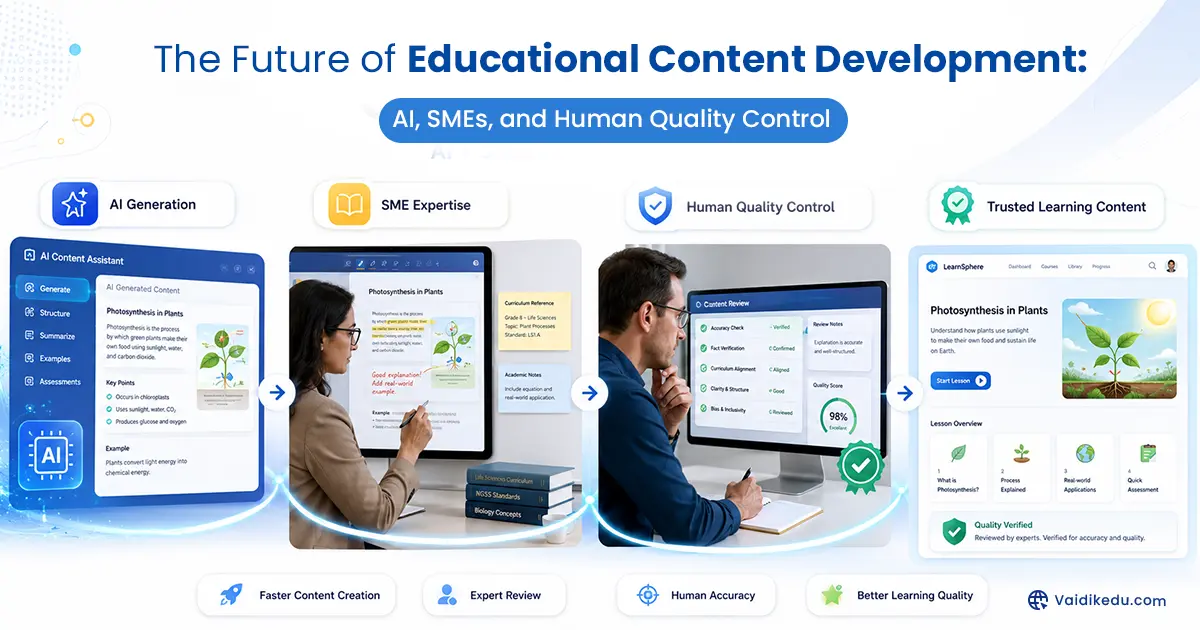
Before publishing digital learning content, conduct multiple quality assurance reviews.
A comprehensive review can include:
Academic Review
Subject matter experts verify:
- Factual accuracy
- Concept accuracy
- Curriculum relevance
- Grade-level appropriateness
Curriculum Alignment Review
Curriculum specialists verify:
- Standards coverage
- Learning objective alignment
- Topic sequencing
- Assessment alignment
Instructional Design Review
Instructional designers evaluate:
- Learning flow
- Engagement
- Cognitive load
- Instructional strategies
- Activity effectiveness
Editorial Review
Editors check:
- Grammar
- Spelling
- Clarity
- Consistency
- Style
Technical Review
Technical reviewers verify:
- LMS compatibility
- Navigation
- Links
- Multimedia
- Responsive behavior
- Interactive functionality
Multiple QA stages reduce the risk of publishing inaccurate or poorly aligned digital learning materials.
Step 16: Pilot the Digital Learning Content
Before releasing content to thousands of students, consider running a pilot.
A pilot can involve:
- Teachers
- Students
- Curriculum specialists
- Instructional designers
- School administrators
Collect feedback about:
- Content difficulty
- Navigation
- Engagement
- Technical issues
- Learning activities
- Assessment difficulty
- Standards coverage
Pilot testing can reveal issues that are difficult to identify during internal review.
Step 17: Measure Learning Outcomes and Improve the Content
Curriculum-aligned digital learning should not be treated as a one-time project.
After deployment, organizations should analyze:
- Student performance
- Assessment results
- Completion rates
- Engagement
- Time spent on lessons
- Question-level performance
- Drop-off points
- Teacher feedback
- Student feedback
This data can identify lessons that need improvement.
For example, if students consistently perform poorly on one assessment objective, the organization can review whether the instructional content provides enough explanation and practice for that skill.
Common Challenges in Creating Curriculum-Aligned Digital Learning Content
Despite the benefits, organizations can face several challenges.
1. Changing Curriculum Standards
Academic standards can change over time.
Digital learning content therefore needs a process for reviewing and updating standards alignment.
2. Maintaining Consistency Across Large Content Libraries
Large EdTech platforms may have thousands of lessons and assessment items.
Maintaining consistent terminology, instructional quality, and standards alignment requires structured workflows.
3. Balancing Engagement With Academic Rigor
Digital content should be engaging without sacrificing academic depth.
Gamification and multimedia should support learning objectives rather than distract from them.
4. Aligning Content and Assessments
A common problem is creating lessons and assessments separately.
This can result in assessments measuring skills that were not adequately taught.
5. Managing Multiple State Standards
U.S. education does not always operate under one single curriculum framework.
Different states, districts, and institutions may have additional standards and requirements.
Organizations serving multiple markets therefore need flexible curriculum mapping systems.
6. Keeping Content Updated
Scientific information, technology, regulations, standards, and educational practices can change.
A content maintenance strategy is necessary to keep digital learning resources accurate and relevant.
Best Practices for Curriculum-Aligned Digital Learning Content
To create effective digital learning resources, follow these best practices:
Start With Standards
Do not begin by writing lessons. Begin by identifying the curriculum standards and desired outcomes.
Use Backward Design
Start with the desired learning outcome and assessment, then determine the instruction and activities required to achieve it.
Maintain a Curriculum Map
Keep a central mapping document connecting standards, objectives, content, activities, and assessments.
Use Subject Matter Experts
SMEs can validate subject accuracy and academic relevance.
Use Instructional Designers
Instructional designers can convert academic requirements into effective digital learning experiences.
Build Accessibility Into the Design
Do not wait until the final QA stage to address accessibility.
Use Data to Improve Content
Review learner performance and feedback after deployment.
Establish a Content Governance Process
Define who is responsible for curriculum reviews, updates, approvals, version control, and standards maintenance.
Curriculum-Aligned Digital Learning Content for U.S. Schools
For U.S. schools and school districts, curriculum alignment can become particularly important when developing digital resources for different grade levels and subjects.
Organizations may need content aligned to:
- Common Core
- NGSS
- State standards
- Mathematics standards
- English Language Arts standards
- Science standards
- Social studies standards
- College and career readiness requirements
A well-designed digital curriculum can support classroom instruction, blended learning, remote learning, intervention programs, supplemental learning, and assessment preparation.
The key is to ensure that digital resources are connected to the curriculum rather than operating as independent educational materials.
Curriculum-Aligned Digital Content for EdTech Companies
EdTech companies often need to create large volumes of educational content while maintaining academic quality.
A scalable workflow can include:
Curriculum Research → Standards Mapping → Curriculum Architecture → Learning Objectives → Content Development → Multimedia → Assessment Development → QA → LMS Integration → Pilot → Optimization
This workflow enables EdTech companies to scale their content libraries while maintaining consistency.
For organizations that need end-to-end support, educational content development services can support the creation of curriculum-aligned lessons, assessments, eLearning modules, digital resources, and other educational materials.
How Vaidik Eduservices Supports Curriculum-Aligned Digital Learning
Creating curriculum-aligned digital learning content requires expertise across curriculum development, instructional design, educational content creation, assessment development, and quality assurance.
Vaidik Eduservices works with educational organizations, EdTech companies, publishers, schools, universities, and other learning organizations to develop structured educational solutions.
Our approach can include:
- Curriculum research
- Curriculum mapping
- Standards alignment
- Learning objective development
- Instructional design
- Educational content development
- Lesson plan development
- Digital learning content
- eLearning module development
- Assessment development
- Question bank development
- Multimedia learning content
- Quality assurance
- LMS-ready content
Our EdTech content development services are designed to help learning platforms and educational organizations develop scalable content across different subjects, grade levels, and curriculum frameworks.
Conclusion
Creating curriculum-aligned digital learning content requires much more than transforming textbooks or classroom materials into online formats.
The most effective approach begins with curriculum standards and learning outcomes and then connects those requirements to instructional design, digital content, activities, assessments, accessibility, and quality assurance.
A strong process looks like:
Standards → Curriculum Mapping → Learning Objectives → Instructional Design → Digital Content → Activities → Assessments → QA → Pilot → Continuous Improvement
For U.S. schools, publishers, EdTech companies, and other educational organizations, this approach can create digital learning experiences that are academically relevant, measurable, scalable, accessible, and aligned with learner needs.
When curriculum expertise and instructional design are combined with high-quality educational content development, organizations can build digital learning programs that support both educational outcomes and long-term scalability.
Frequently Asked Questions
Curriculum-aligned digital learning content is educational material that is directly connected to defined curriculum standards, learning objectives, skills, and student outcomes. It can include eLearning modules, digital textbooks, videos, interactive activities, assessments, and online lessons.
Curriculum alignment ensures that digital lessons, activities, and assessments support the skills and knowledge students are expected to learn. It also helps schools and EdTech companies measure curriculum coverage and maintain instructional consistency.
Curriculum mapping creates a clear connection between standards, learning objectives, lessons, activities, and assessments. It also helps identify missing standards, content gaps, duplication, and assessment coverage issues.
Curriculum development focuses on what learners should learn and how the overall learning program is structured. Instructional design focuses on how that learning is transformed into effective instructional experiences, activities, assessments, and digital learning materials.